MOE Laboratory of Biosystems Homeostasis & Protection and Zhejiang Provincial Key Laboratory for Cancer Molecular Cell Biology, Life Sciences Institute, Zhejiang University, Hangzhou 310058, China.
Department of Neuroscience and Developmental Biology, University of Vienna, Vienna 1090, Austria.
Genome Res. 2021 Mar;31(3):497-511. doi: 10.1101/gr.271569.120. Epub 2021 Jan 6.
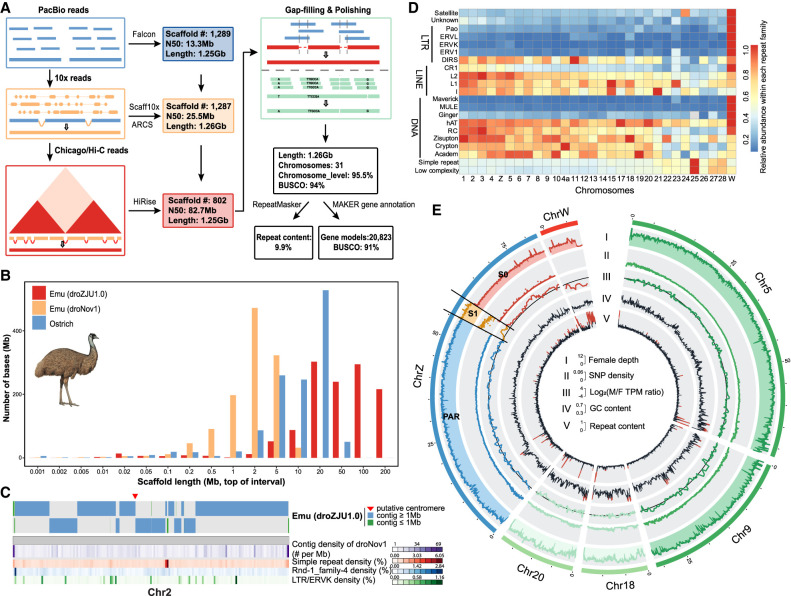
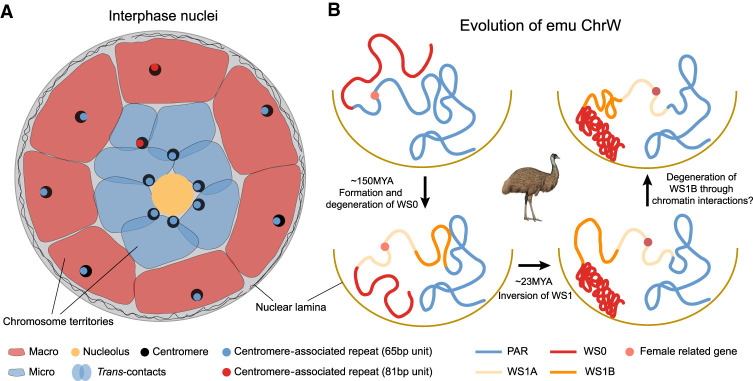
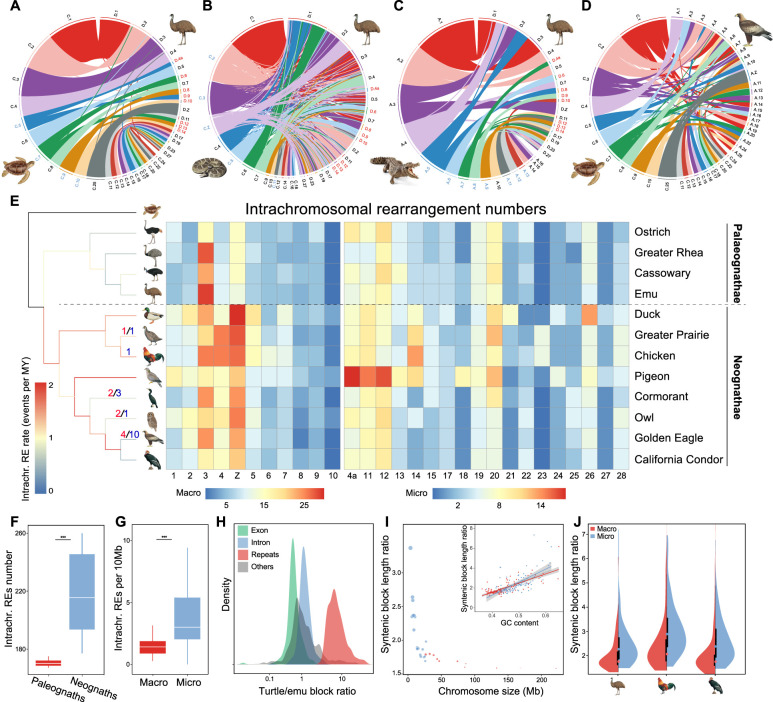
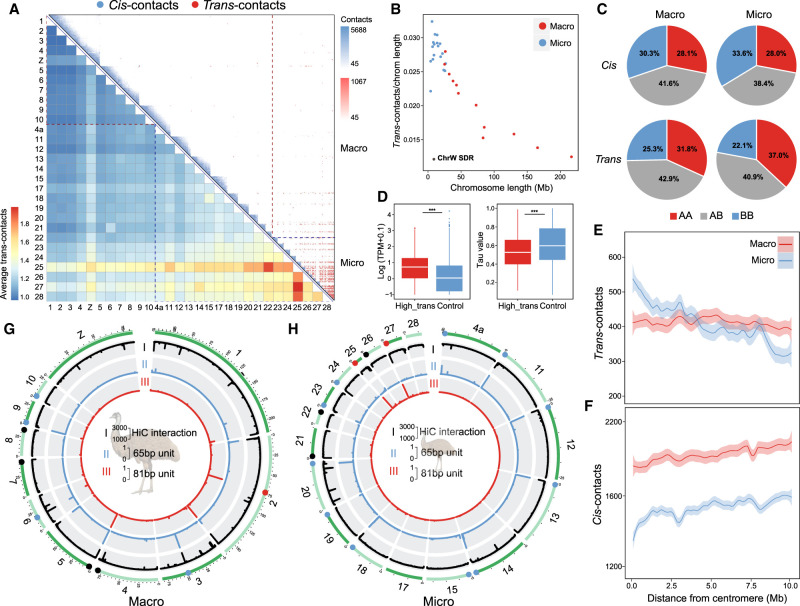
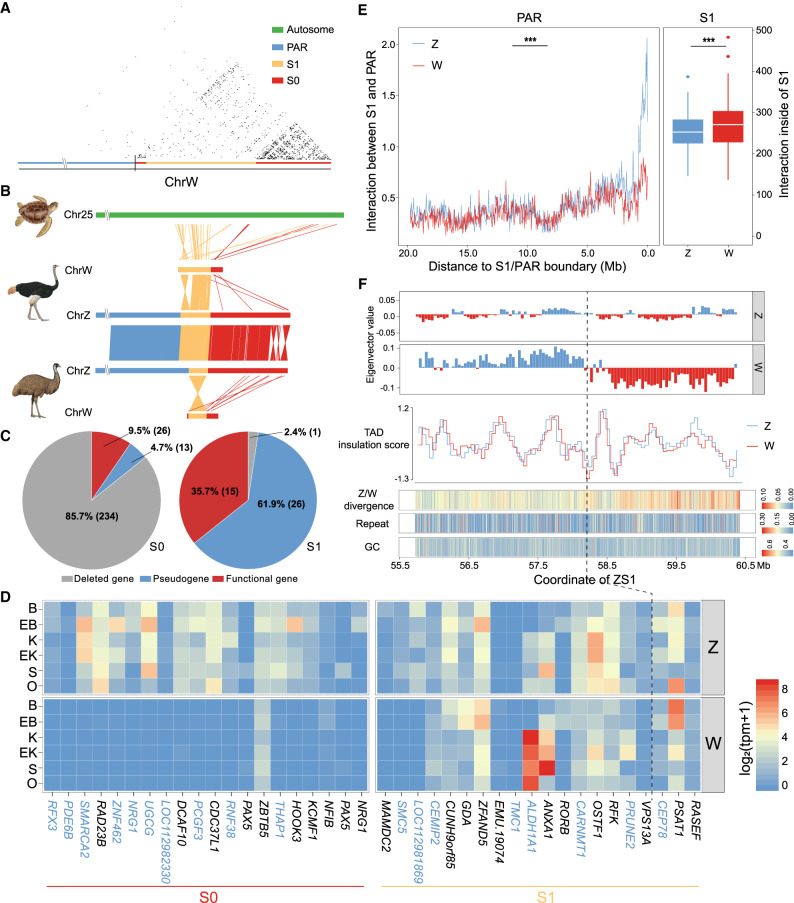
Emu and other ratites are more informative than any other birds in reconstructing the evolution of the ancestral avian or vertebrate karyotype because of their much slower rate of genome evolution. Here, we generated a new chromosome-level genome assembly of a female emu, and estimated the tempo of chromosome evolution across major avian phylogenetic branches, by comparing it to chromosome-level genome assemblies of 11 other bird and one turtle species. We found ratites exhibited the lowest numbers of intra- and inter-chromosomal changes among birds since their divergence with turtles. The small-sized and gene-rich emu microchromosomes have frequent inter-chromosomal contacts that are associated with housekeeping genes, which appears to be driven by clustering their centromeres in the nuclear interior, away from the macrochromosomes in the nuclear periphery. Unlike nonratite birds, only less than one-third of the emu W Chromosome regions have lost homologous recombination and diverged between the sexes. The emu W is demarcated into a highly heterochromatic region (WS0) and another recently evolved region (WS1) with only moderate sequence divergence with the Z Chromosome. WS1 has expanded its inactive chromatin compartment, increased chromatin contacts within the region, and decreased contacts with the nearby regions, possibly influenced by the spreading of heterochromatin from WS0. These patterns suggest that alteration of chromatin conformation comprises an important early step of sex chromosome evolution. Overall, our results provide novel insights into the evolution of avian genome structure and sex chromosomes in three-dimensional space.
鸸鹋和其他平胸鸟类在重建祖先鸟类或脊椎动物核型的进化方面比任何其他鸟类都更具信息量,因为它们的基因组进化速度要慢得多。在这里,我们生成了一只雌性鸸鹋的新染色体水平基因组组装,并通过将其与 11 种其他鸟类和一种海龟的染色体水平基因组组装进行比较,估计了主要鸟类系统发育分支的染色体进化速度。我们发现,自与海龟分化以来,平胸鸟类的染色体内部和染色体间变化数量在鸟类中是最低的。小型且富含基因的鸸鹋微染色体经常发生染色体间接触,这些接触与管家基因有关,这似乎是由它们的着丝粒在核内部聚集,远离核外周的大染色体驱动的。与非平胸鸟类不同,只有不到三分之一的鸸鹋 W 染色体区域在两性之间失去了同源重组和分化。鸸鹋 W 被划分为一个高度异染色质区域(WS0)和另一个最近进化的区域(WS1),与 Z 染色体的序列差异较小。WS1 扩大了其非活性染色质区室,增加了该区域内的染色质接触,减少了与附近区域的接触,这可能受到来自 WS0 的异染色质扩散的影响。这些模式表明,染色质构象的改变构成了性染色体进化的重要早期步骤。总的来说,我们的研究结果为三维空间中鸟类基因组结构和性染色体的进化提供了新的见解。