Jin Heejin, Lee Sanghun, Won Sungho
Department of Public Health Sciences, Seoul National University, Seoul, South Korea.
Department of Biostatistics, Medical Research Collaborating Center, Seoul National University Boramae Hospital, Seoul, South Korea.
Front Genet. 2020 Dec 21;11:597420. doi: 10.3389/fgene.2020.597420. eCollection 2020.
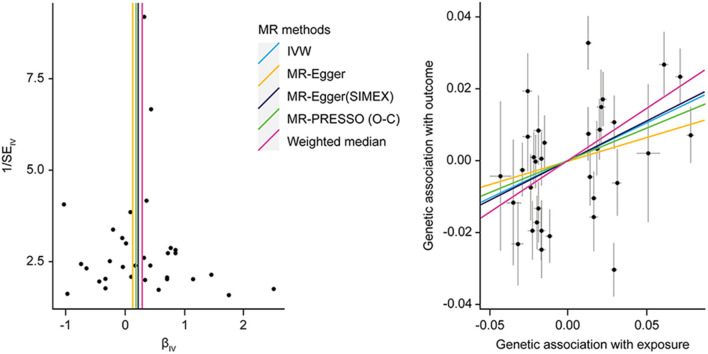
Multiple studies have demonstrated the effects of type 2 diabetes (T2D) on various human diseases; however, most of these were observational epidemiological studies that suffered from many potential biases including reported confounding and reverse causations. In this article, we investigated whether cancer and vascular disease can be affected by T2D-related traits, including fasting plasma glucose (FPG), 2-h postprandial glucose (2h-PG), and glycated hemoglobin A1c (HbA1c) levels, by using Mendelian randomization (MR). The summary statistics for FPG, 2h-PG, and HbA1c level were obtained through meta-analyses of large-scale genome-wide association studies that included data from 133,010 nondiabetic individuals from collaborating Meta-analysis of Glucose and Insulin Related Traits Consortium studies. Thereafter, based on the statistical assumptions for MR analyses, the most reliable approaches including inverse-variance-weighted (IVW), MR-Egger, MR-Egger with a simulation extrapolation (SIMEX), weighted median, and MR-pleiotropy residual sum and outlier (MR-PRESSO) methods were applied to identify traits affected by FPG, 2h-PG, and HbAlc. We found that coronary artery disease is affected by FPG, as per the IVW [log odds ratio (logOR): 0.21; = 0.012], MR-Egger (SIMEX) (logOR: 0.22; = 0.014), MR-PRESSO (logOR: 0.18; = 0.045), and weighted median (logOR: 0.29; < 0.001) methods but not as per the MR-Egger (logOR: 0.13; = 0.426) approach. Furthermore, low-density lipoprotein cholesterol levels are affected by HbA1c, as per the IVW [beta (B): 0.23; = 0.015), MR-Egger (B: 0.45; = 0.046), MR-Egger (SIMEX) (B: 0.27; = 0.007), MR-PRESSO (B; 0.14; = 0.010), and the weighted median (B: 0.15; = 0.012] methods. Further studies of the associated biological mechanisms are required to validate and understand the disease-specific differences identified in the TD2-related causal effects of each trait.
多项研究已证明2型糖尿病(T2D)对各种人类疾病的影响;然而,其中大多数是观察性流行病学研究,存在许多潜在偏倚,包括报告的混杂因素和反向因果关系。在本文中,我们使用孟德尔随机化(MR)研究癌症和血管疾病是否会受到T2D相关特征的影响,这些特征包括空腹血糖(FPG)、餐后2小时血糖(2h-PG)和糖化血红蛋白A1c(HbA1c)水平。FPG、2h-PG和HbA1c水平的汇总统计数据是通过对大规模全基因组关联研究的荟萃分析获得的,这些研究纳入了来自血糖和胰岛素相关特征联盟合作研究的133010名非糖尿病个体的数据。此后,基于MR分析的统计假设,应用了最可靠的方法,包括逆方差加权(IVW)、MR-Egger、带有模拟外推的MR-Egger(SIMEX)、加权中位数和MR多效性残差总和与异常值(MR-PRESSO)方法,以确定受FPG、2h-PG和HbAlc影响的特征。我们发现,根据IVW[对数优势比(logOR):0.21;P = 0.012]、MR-Egger(SIMEX)(logOR:0.22;P = 0.014)、MR-PRESSO(logOR:0.18;P = 0.045)和加权中位数(logOR:0.29;P < 0.001)方法,冠状动脉疾病受FPG影响,但根据MR-Egger(logOR:0.13;P = 0.426)方法则不受影响。此外,根据IVW[β(B):0.23;P = 0.015]、MR-Egger(B:0.45;P = 0.046)、MR-Egger(SIMEX)(B:0. – 此处原文有误,推测为0.27;P = 0.007)、MR-PRESSO(B;0.14;P = 0.010)和加权中位数(B:0.15;P = 0.012)方法,低密度脂蛋白胆固醇水平受HbA1c影响。需要对相关生物学机制进行进一步研究,以验证和理解在每个特征的TD2相关因果效应中确定的疾病特异性差异。