Oliver Kristin, Beskin Kera, Noonan Laura, Shah Amy, Perkins Rebecca, Humiston Sharon
Department of Environmental Medicine and Public Health, Icahn School of Medicine at Mount Sinai, New York, N.Y.
American Academy of Pediatrics, Itasca, Ill.
Pediatr Qual Saf. 2020 Dec 28;6(1):e377. doi: 10.1097/pq9.0000000000000377. eCollection 2021 Jan-Feb.
Many published accounts have shown that quality improvement (QI) initiatives within medical practice settings can increase vaccination rates. Project ECHO is a telementoring platform that uses video conferencing technology to educate and support healthcare professionals through case-based learning and brief lectures. This manuscript explores the results of a learning collaborative focused on combining QI and Project ECHO to increase human papillomavirus (HPV) vaccination rates within pediatric practices.
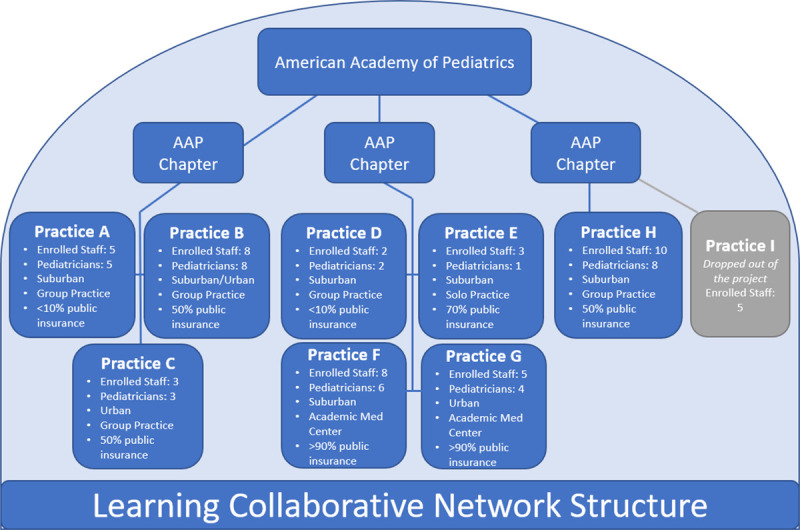
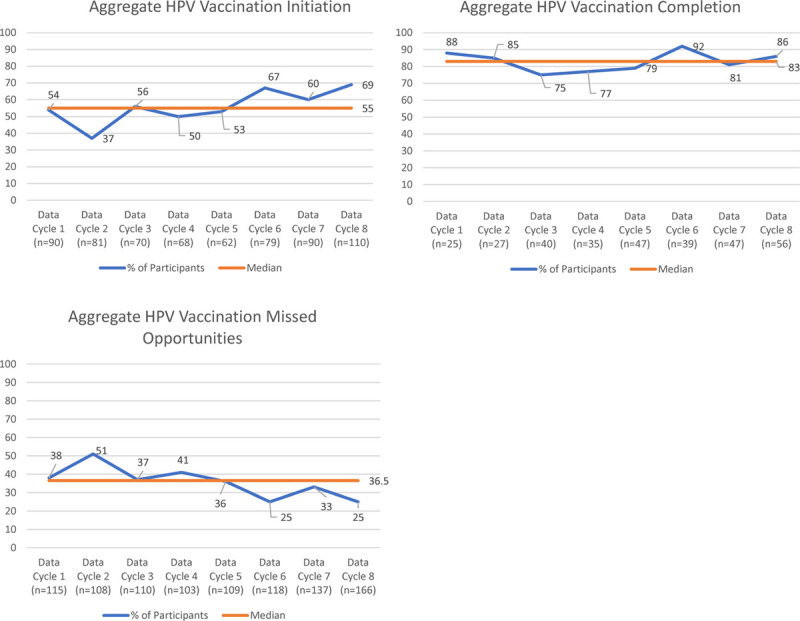
The American Academy of Pediatrics (AAP) recruited 3 AAP chapters that then recruited individual pediatricians and their practices for participation. Participants responded to surveys regarding chapter and pediatrician experience and satisfaction. Impact on HPV immunization rates (HPV initiation, series completion, and missed opportunities to vaccinate during visits) was measured using practice reports of chart reviews to AAP's data aggregator, which produced run charts.
Thirty-four pediatricians within 8 practices completed the project; 1 practice withdrew. Physicians self-reported increased confidence in communicating with vaccine-hesitant families and implementing QI activities. We analyzed practice run charts utilizing QI run chart rules and found nonrandom change towards improvement for aggregate missed opportunities to vaccinate but not for HPV vaccine initiation or series completion.
An HPV QI learning collaborative improved participant confidence in HPV vaccine communication and QI skills and decreased missed opportunities to vaccinate. Future projects should consider a more extended project period or more frequent data collection to reduce data variability to make it easier to spot nonrandom changes.
许多已发表的报道表明,医疗实践环境中的质量改进(QI)举措可以提高疫苗接种率。ECHO项目是一个远程指导平台,它利用视频会议技术,通过基于案例的学习和简短讲座来教育和支持医疗保健专业人员。本手稿探讨了一个学习协作项目的结果,该项目专注于将QI与ECHO项目相结合,以提高儿科诊所的人乳头瘤病毒(HPV)疫苗接种率。
美国儿科学会(AAP)招募了3个AAP分会,然后这些分会招募个体儿科医生及其诊所参与。参与者对有关分会和儿科医生经验及满意度的调查做出回应。使用向AAP数据汇总机构提交的图表审查实践报告来衡量对HPV免疫接种率(HPV起始接种、系列接种完成情况以及就诊期间错过的接种机会)的影响,这些报告生成了运行图。
8个诊所的34名儿科医生完成了该项目;1个诊所退出。医生自我报告称,在与对疫苗持犹豫态度的家庭沟通以及开展QI活动方面,信心有所增强。我们利用QI运行图规则分析了实践运行图,发现总体错过的接种机会有朝着改善方向的非随机变化,但HPV疫苗起始接种或系列接种完成情况没有。
一个HPV QI学习协作项目提高了参与者在HPV疫苗沟通方面的信心和QI技能,并减少了错过的接种机会。未来的项目应考虑延长项目周期或更频繁地收集数据,以减少数据变异性,使其更易于发现非随机变化。