Instituto de Biociências, Universidade de São Paulo (USP), Rua do Matão, trav. 14, A101, CEP., São Paulo, 05508-090, Brazil.
Max-Planck-Institut für Planzenzüchtungsforschung, Carl-von-Linné-Weg 10, 50829, Cologne, Germany.
J Mol Evol. 2021 Feb;89(1-2):12-18. doi: 10.1007/s00239-020-09979-5. Epub 2021 Jan 7.
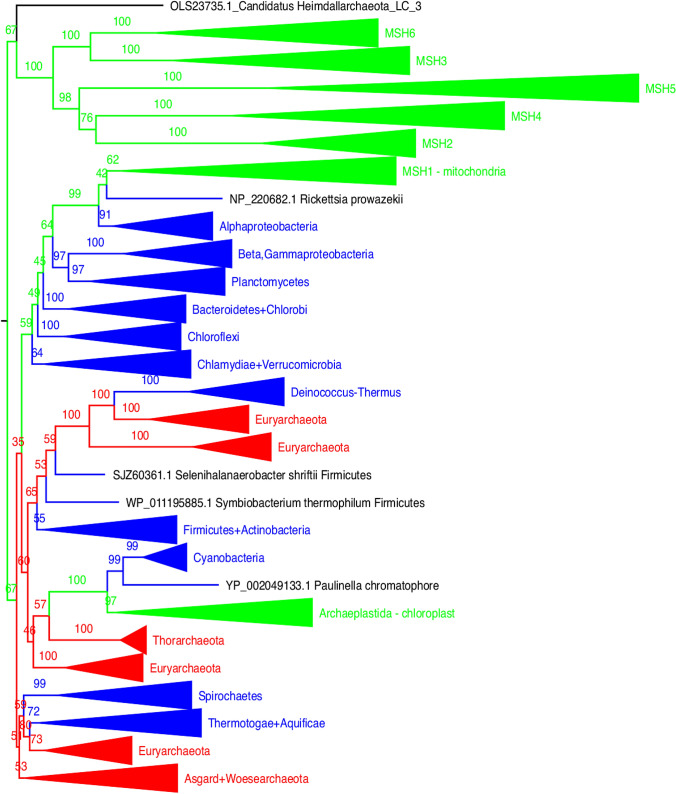
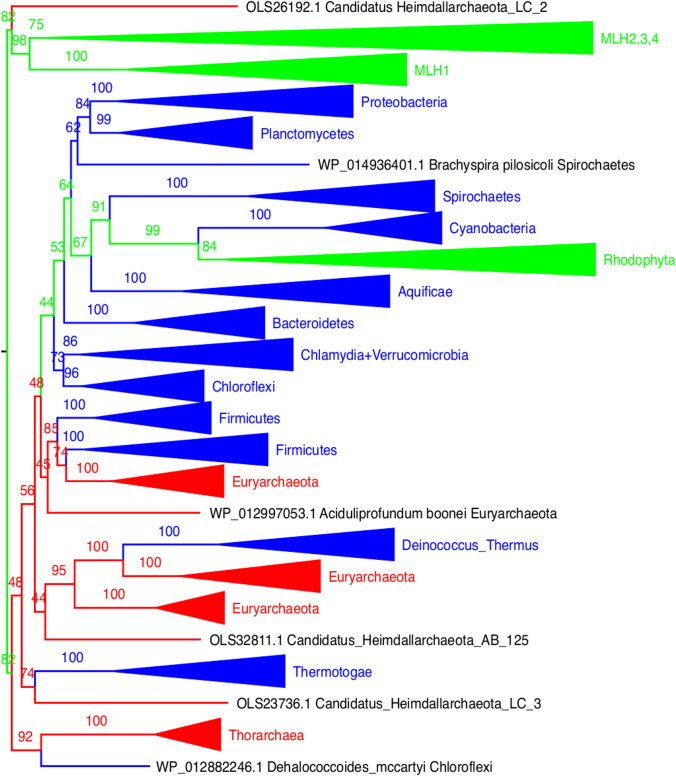
Repairing DNA damage is one of the most important functions of the 'housekeeping' proteins, as DNA molecules are constantly subject to different kinds of damage. An important mechanism of DNA repair is the mismatch repair system (MMR). In eukaryotes, it is more complex than it is in bacteria or Archaea due to an inflated number of paralogues produced as a result of an extensive process of gene duplication and further specialization upon the evolution of the first eukaryotes, including an important part of the meiotic machinery. Recently, the discovery and sequencing of Asgard Archaea allowed us to revisit the MMR system evolution with the addition of new data from a group that is closely related to the eukaryotic ancestor. This new analysis provided evidence for a complex evolutionary history of eukaryotic MMR: an archaeal origin for the nuclear MMR system in eukaryotes, with subsequent acquisitions of other MMR systems from organelles.
修复 DNA 损伤是“管家”蛋白最重要的功能之一,因为 DNA 分子经常受到各种损伤。DNA 修复的一个重要机制是错配修复系统 (MMR)。在真核生物中,由于在真核生物进化过程中发生了广泛的基因复制和进一步特化,导致产生了大量的同源基因,因此该系统比细菌或古菌中的更为复杂,其中包括减数分裂机制的重要部分。最近,Asgard 古菌的发现和测序使我们能够通过添加与真核生物祖先密切相关的一组新数据,重新审视 MMR 系统的进化。这项新分析为真核生物 MMR 的复杂进化历史提供了证据:真核生物核 MMR 系统的古菌起源,随后从细胞器中获得了其他 MMR 系统。