
两种半自动人工智能方法在PET肿瘤分割中的可重复性。
Repeatability of two semi-automatic artificial intelligence approaches for tumor segmentation in PET.
作者信息
Pfaehler Elisabeth, Mesotten Liesbet, Kramer Gem, Thomeer Michiel, Vanhove Karolien, de Jong Johan, Adriaensens Peter, Hoekstra Otto S, Boellaard Ronald
机构信息
Department of Nuclear Medicine and Molecular Imaging, Medical Imaging Center, University of Groningen, University Medical Center Groningen, Groningen, The Netherlands.
Faculty of Medicine and Life Sciences, Hasselt University, Agoralaan Building D, 3590, Diepenbeek, Belgium.
出版信息
EJNMMI Res. 2021 Jan 6;11(1):4. doi: 10.1186/s13550-020-00744-9.
BACKGROUND
Positron emission tomography (PET) is routinely used for cancer staging and treatment follow-up. Metabolic active tumor volume (MATV) as well as total MATV (TMATV-including primary tumor, lymph nodes and metastasis) and/or total lesion glycolysis derived from PET images have been identified as prognostic factor or for the evaluation of treatment efficacy in cancer patients. To this end, a segmentation approach with high precision and repeatability is important. However, the implementation of a repeatable and accurate segmentation algorithm remains an ongoing challenge.
METHODS
In this study, we compare two semi-automatic artificial intelligence (AI)-based segmentation methods with conventional semi-automatic segmentation approaches in terms of repeatability. One segmentation approach is based on a textural feature (TF) segmentation approach designed for accurate and repeatable segmentation of primary tumors and metastasis. Moreover, a convolutional neural network (CNN) is trained. The algorithms are trained, validated and tested using a lung cancer PET dataset. The segmentation accuracy of both segmentation approaches is compared using the Jaccard coefficient (JC). Additionally, the approaches are externally tested on a fully independent test-retest dataset. The repeatability of the methods is compared with those of two majority vote (MV2, MV3) approaches, 41%SUV, and a SUV > 4 segmentation (SUV4). Repeatability is assessed with test-retest coefficients (TRT%) and intraclass correlation coefficient (ICC). An ICC > 0.9 was regarded as representing excellent repeatability.
RESULTS
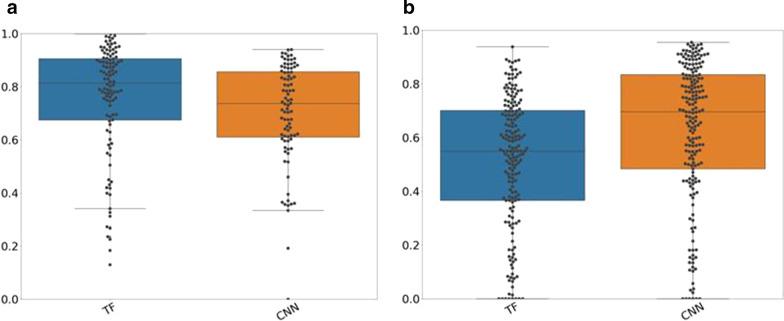
The accuracy of the segmentations with the reference segmentation was good (JC median TF: 0.7, CNN: 0.73). Both segmentation approaches outperformed most other conventional segmentation methods in terms of test-retest coefficient (TRT% mean: TF: 13.0%, CNN: 13.9%, MV2: 14.1%, MV3: 28.1%, 41%SUV: 28.1%, SUV4: 18.1%) and ICC (TF: 0.98, MV2: 0.97, CNN: 0.99, MV3: 0.73, SUV4: 0.81, and 41%SUV: 0.68).
CONCLUSION
The semi-automatic AI-based segmentation approaches used in this study provided better repeatability than conventional segmentation approaches. Moreover, both algorithms lead to accurate segmentations for both primary tumors as well as metastasis and are therefore good candidates for PET tumor segmentation.
背景
正电子发射断层扫描(PET)常用于癌症分期及治疗随访。代谢活性肿瘤体积(MATV)以及总MATV(TMATV,包括原发性肿瘤、淋巴结和转移灶)和/或源自PET图像的总病变糖酵解已被确定为癌症患者的预后因素或用于评估治疗效果。为此,一种具有高精度和可重复性的分割方法很重要。然而,实现一种可重复且准确的分割算法仍然是一个持续存在的挑战。
方法
在本研究中,我们在可重复性方面将两种基于人工智能(AI)的半自动分割方法与传统的半自动分割方法进行比较。一种分割方法基于为原发性肿瘤和转移灶的准确且可重复分割而设计的纹理特征(TF)分割方法。此外,还训练了一个卷积神经网络(CNN)。使用肺癌PET数据集对算法进行训练、验证和测试。使用杰卡德系数(JC)比较两种分割方法的分割准确性。此外,在一个完全独立的重测数据集上对这些方法进行外部测试。将这些方法的可重复性与两种多数投票(MV2、MV3)方法、41%SUV以及SUV>4分割(SUV4)的可重复性进行比较。用重测系数(TRT%)和组内相关系数(ICC)评估可重复性。ICC>0.9被视为代表具有出色的可重复性。
结果
与参考分割相比,分割的准确性良好(JC中位数TF:0.7,CNN:0.73)。在重测系数(TRT%均值:TF:13.0%,CNN:13.9%,MV2:14.1%,MV3:28.1%,41%SUV:28.1%,SUV4:18.1%)和ICC(TF:0.98,MV2:0.97,CNN:0.99,MV3:0.73,SUV4:0.81,41%SUV:0.68)方面,两种分割方法均优于大多数其他传统分割方法。
结论
本研究中使用的基于AI的半自动分割方法比传统分割方法具有更好的可重复性。此外,两种算法对原发性肿瘤和转移灶都能进行准确分割,因此是PET肿瘤分割的良好选择。


 Zotero 插件