Department of Nuclear Medicine, Henri Mondor University Hospital, Créteil, France.
Department of Nuclear Medicine and Molecular Imaging, Lausanne University Hospital, Lausanne, Switzerland.
PLoS One. 2018 Apr 13;13(4):e0195798. doi: 10.1371/journal.pone.0195798. eCollection 2018.
Amino-acids positron emission tomography (PET) is increasingly used in the diagnostic workup of patients with gliomas, including differential diagnosis, evaluation of tumor extension, treatment planning and follow-up. Recently, progresses of computer vision and machine learning have been translated for medical imaging. Aim was to demonstrate the feasibility of an automated 18F-fluoro-ethyl-tyrosine (18F-FET) PET lesion detection and segmentation relying on a full 3D U-Net Convolutional Neural Network (CNN).
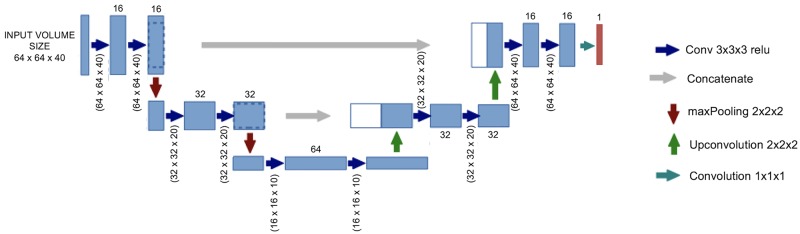
All dynamic 18F-FET PET brain image volumes were temporally realigned to the first dynamic acquisition, coregistered and spatially normalized onto the Montreal Neurological Institute template. Ground truth segmentations were obtained using manual delineation and thresholding (1.3 x background). The volumetric CNN was implemented based on a modified Keras implementation of a U-Net library with 3 layers for the encoding and decoding paths. Dice similarity coefficient (DSC) was used as an accuracy measure of segmentation.
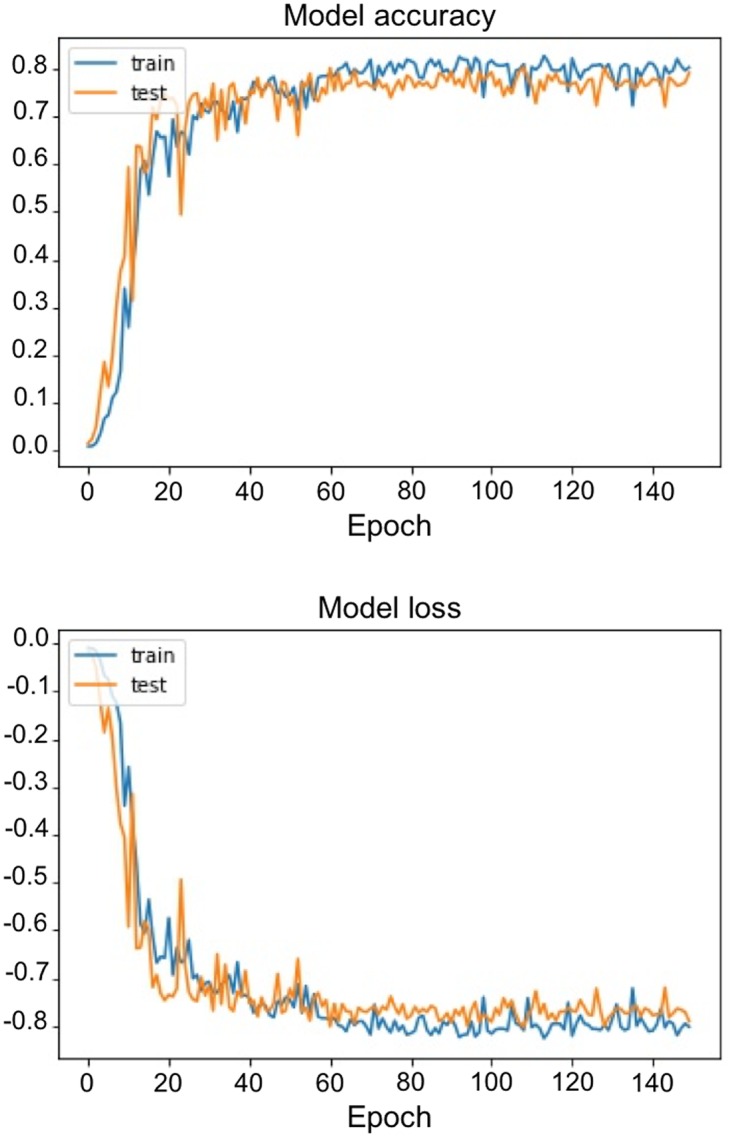
Thirty-seven patients were included (26 [70%] in the training set and 11 [30%] in the validation set). All 11 lesions were accurately detected with no false positive, resulting in a sensitivity and a specificity for the detection at the tumor level of 100%. After 150 epochs, DSC reached 0.7924 in the training set and 0.7911 in the validation set. After morphological dilatation and fixed thresholding of the predicted U-Net mask a substantial improvement of the DSC to 0.8231 (+ 4.1%) was noted. At the voxel level, this segmentation led to a 0.88 sensitivity [95% CI, 87.1 to, 88.2%] a 0.99 specificity [99.9 to 99.9%], a 0.78 positive predictive value: [76.9 to 78.3%], and a 0.99 negative predictive value [99.9 to 99.9%].
With relatively high performance, it was proposed the first full 3D automated procedure for segmentation of 18F-FET PET brain images of patients with different gliomas using a U-Net CNN architecture.
氨基酸正电子发射断层扫描(PET)越来越多地用于胶质瘤患者的诊断,包括鉴别诊断、肿瘤扩展评估、治疗计划和随访。最近,计算机视觉和机器学习的进展已经应用于医学成像。目的是证明基于全 3D U-Net 卷积神经网络(CNN)的自动 18F-氟乙基酪氨酸(18F-FET)PET 病变检测和分割的可行性。
所有动态 18F-FET PET 脑图像体积均进行时间校正,以获得第一个动态采集的图像,与蒙特利尔神经学研究所模板进行配准,并进行空间标准化。使用手动勾画和阈值(1.3x 背景)获得地面真实分割。体积 CNN 是基于带有 3 个编码和解码路径层的 U-Net 库的修改后的 Keras 实现来实现的。Dice 相似系数(DSC)用作分割准确性的度量。
共纳入 37 例患者(训练集 26 例[70%],验证集 11 例[30%])。所有 11 个病变均准确检测到,无假阳性,肿瘤水平的灵敏度和特异性均为 100%。在 150 个时期后,训练集的 DSC 达到 0.7924,验证集的 DSC 达到 0.7911。在预测 U-Net 掩模的形态扩张和固定阈值之后,DSC 显著提高到 0.8231(+4.1%)。在体素水平上,该分割方法的灵敏度为 0.88[95%CI,87.1%至 88.2%],特异性为 0.99[99.9%至 99.9%],阳性预测值为 0.78[76.9%至 78.3%],阴性预测值为 0.99[99.9%至 99.9%]。
使用 U-Net CNN 架构,提出了首个用于不同脑胶质瘤患者 18F-FET PET 脑图像分割的全自动全 3D 处理程序,具有较高的性能。