Hu Zongfu, Ma Deying, Niu Huaxin, Chang Jie, Yu Jianhua, Tong Qing, Li Shuguo
College of Animal Science and Technology, Northeast Agricultural University, Harbin, People's Republic of China.
College of Animal Science and Technology, Inner Mongolia University for Nationalities, Tongliao, People's Republic of China.
AMB Express. 2021 Jan 6;11(1):5. doi: 10.1186/s13568-020-01158-5.
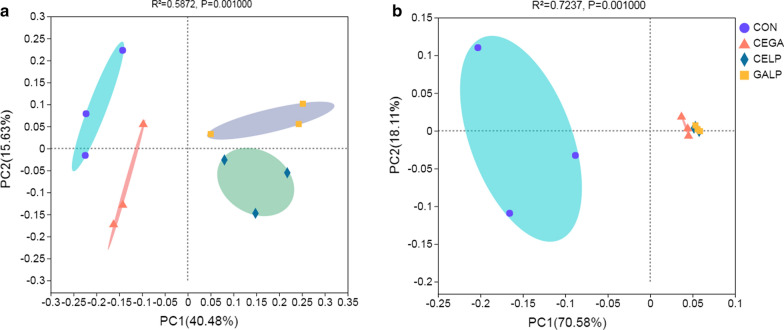
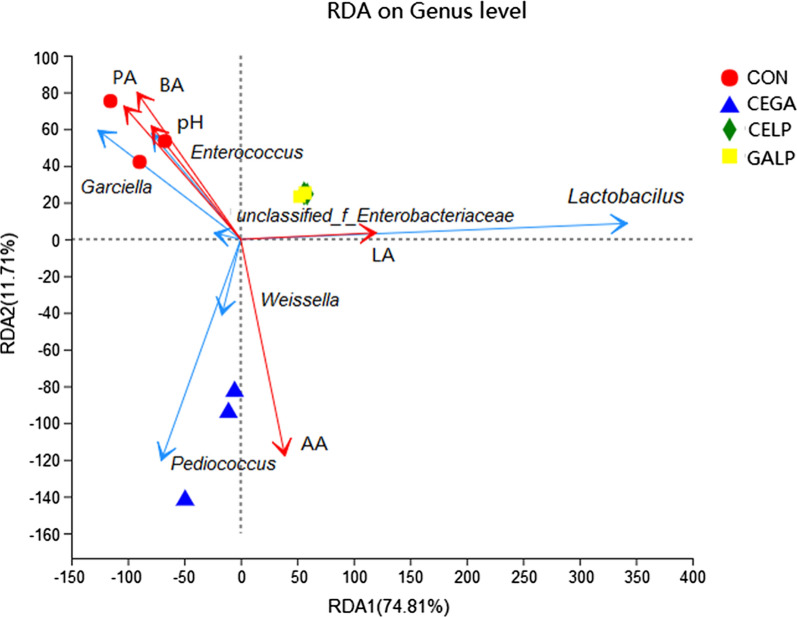
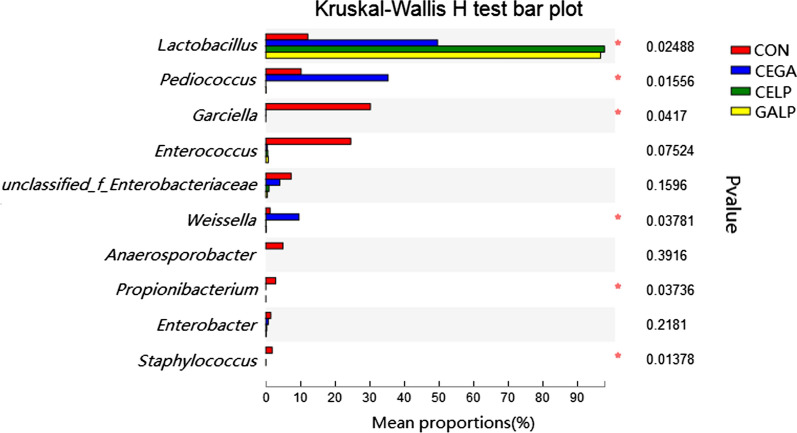
The goal of the present study was to evaluate the effects of enzymes (cellulase combined with galactosidase) and their combination with Lactobacillus plantarum (LP) on bacterial diversity in alfalfa silages using high-throughput sequencing. Alfalfa forages were treated with or without cellulase + ɑ-galactosidase (CEGA), cellulase + LP (CELP), or ɑ-galactosidase + LP (GALP). After 56 days of ensiling, all treated silages exhibited improved fermentation quality, as reflected by decreased pH, ammonium-N and increased lactic acid levels compared to the control silage (P < 0.05). Enzymatic treatment improved nutrient value by increasing crude protein levels and decreasing neutral detergent fibre (NDF) levels (P < 0.05). Silage treatment significantly altered the bacterial community, as determined by PCoA (P < 0.05). Lactic acid bacteria (LAB) dominated the bacterial community of the treated silage after ensiling. The dominant bacteria changed from Garciella, Enterococcus, Lactobacillus and Pediococcus in the control silage to Lactobacillus and Pediococcus in the CEGA silage and Lactobacillus in the CELP and GALP silages. Collectively, these results suggest that treatment with both enzymes alone and in combination with inoculants greatly increased the abundance of LAB, with Enterococcus, Lactobacillus and Pediococcus observed in the silage treated with enzymes alone (CEGA) and Lactobacillus observed in the silage treated with a combination of enzymes and inoculants (CELP and GALP).
本研究的目的是利用高通量测序技术评估酶(纤维素酶与半乳糖苷酶组合)及其与植物乳杆菌(LP)的组合对苜蓿青贮饲料中细菌多样性的影响。苜蓿草料分别用或不用纤维素酶+α-半乳糖苷酶(CEGA)、纤维素酶+LP(CELP)或α-半乳糖苷酶+LP(GALP)处理。青贮56天后,与对照青贮饲料相比,所有处理的青贮饲料发酵品质均有所改善,表现为pH值、铵态氮降低,乳酸水平升高(P<0.05)。酶处理通过提高粗蛋白水平和降低中性洗涤纤维(NDF)水平提高了营养价值(P<0.05)。通过主坐标分析(PCoA)确定,青贮处理显著改变了细菌群落(P<0.05)。青贮后,乳酸菌(LAB)在处理过的青贮饲料细菌群落中占主导地位。优势细菌从对照青贮饲料中的加氏菌属、肠球菌属、乳杆菌属和片球菌属变为CEGA青贮饲料中的乳杆菌属和片球菌属,以及CELP和GALP青贮饲料中的乳杆菌属。总体而言,这些结果表明,单独使用酶以及酶与接种剂组合处理均大大增加了LAB的丰度,单独使用酶处理的青贮饲料(CEGA)中观察到肠球菌属、乳杆菌属和片球菌属,酶与接种剂组合处理的青贮饲料(CELP和GALP)中观察到乳杆菌属。