Division of Cardiology Cardiocentro Ticino Lugano Switzerland.
Center for Computational Medicine in Cardiology Università della Svizzera Italiana Lugano Switzerland.
J Am Heart Assoc. 2021 Jan 19;10(2):e018572. doi: 10.1161/JAHA.120.018572. Epub 2021 Jan 7.
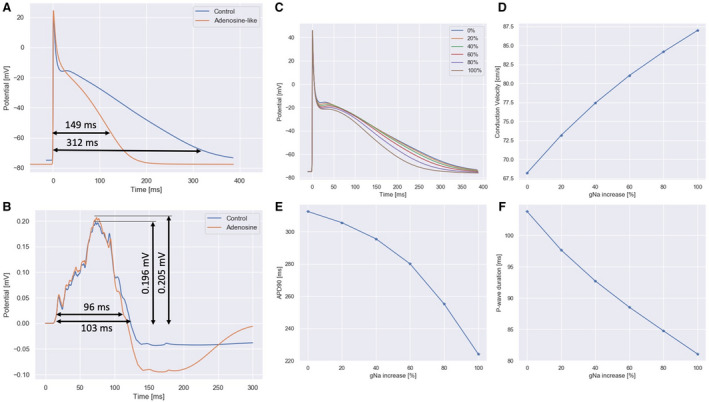
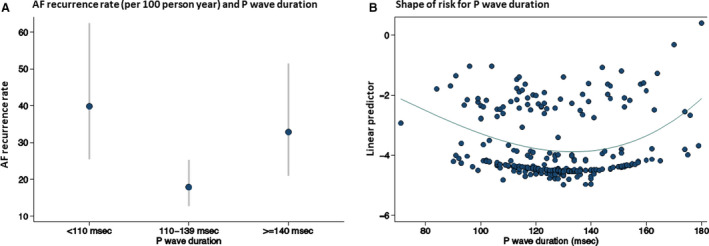
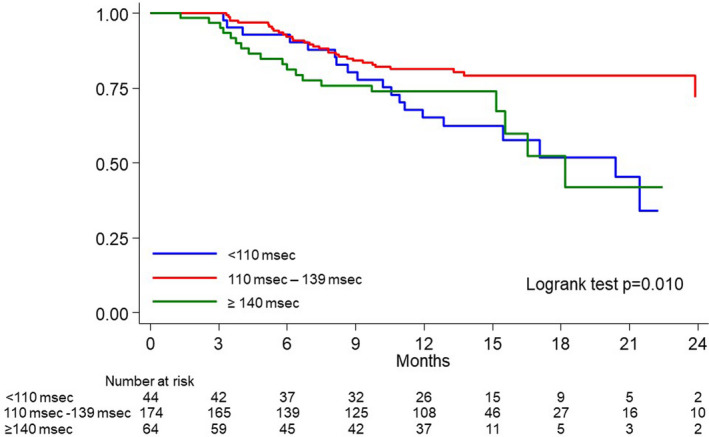
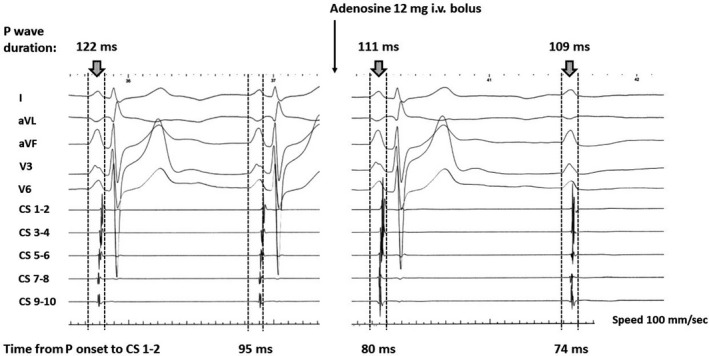
Background Short ECG P-wave duration has recently been demonstrated to be associated with higher risk of atrial fibrillation (AF). The aim of this study was to assess the rate of AF recurrence after pulmonary vein isolation in patients with a short P wave, and to mechanistically elucidate the observation by computer modeling. Methods and Results A total of 282 consecutive patients undergoing a first single-pulmonary vein isolation procedure for paroxysmal or persistent AF were included. Computational models studied the effect of adenosine and sodium conductance on action potential duration and P-wave duration (PWD). About 16% of the patients had a PWD of 110 ms or shorter (median PWD 126 ms, interquartile range, 115 ms-138 ms; range, 71 ms-180 ms). At Cox regression, PWD was significantly associated with AF recurrence (=0.012). Patients with a PWD <110 ms (hazard ratio [HR], 2.20; 95% CI, 1.24-3.88; =0.007) and patients with a PWD ≥140 (HR, 1.87, 95% CI, 1.06-3.30; =0.031) had a nearly 2-fold increase in risk with respect to the other group. In the computational model, adenosine yielded a significant reduction of action potential duration 90 (52%) and PWD (7%). An increased sodium conductance (up to 200%) was robustly accompanied by an increase in conduction velocity (26%), a reduction in action potential duration 90 (28%), and PWD (22%). Conclusions One out of 5 patients referred for pulmonary vein isolation has a short PWD which was associated with a higher rate of AF after the index procedure. Computer simulations suggest that shortening of atrial action potential duration leading to a faster atrial conduction may be the cause of this clinical observation.
背景 短的心电图 P 波持续时间最近被证明与心房颤动(AF)的风险增加有关。本研究的目的是评估在接受单次肺静脉隔离治疗阵发性或持续性 AF 的患者中,短 P 波后 AF 复发的发生率,并通过计算机建模从机制上阐明这一观察结果。方法 共纳入 282 例接受首次单肺静脉隔离治疗阵发性或持续性 AF 的连续患者。计算模型研究了腺苷和钠电导对动作电位持续时间和 P 波持续时间(PWD)的影响。约 16%的患者 PWD 为 110 ms 或更短(中位数 PWD 为 126 ms,四分位距为 115 ms-138 ms;范围为 71 ms-180 ms)。在 Cox 回归中,PWD 与 AF 复发显著相关(=0.012)。PWD<110 ms 的患者(危险比[HR],2.20;95%置信区间,1.24-3.88;=0.007)和 PWD≥140 的患者(HR,1.87,95%置信区间,1.06-3.30;=0.031)的风险增加近 2 倍。在计算模型中,腺苷使动作电位持续时间 90(52%)和 PWD(7%)显著缩短。钠电导增加(高达 200%)与传导速度增加(26%)、动作电位持续时间 90 缩短(28%)和 PWD 缩短(22%)强烈相关。结论 接受肺静脉隔离治疗的患者中,有 1/5 的患者 PWD 较短,该患者在索引手术后 AF 复发率较高。计算机模拟表明,心房动作电位持续时间缩短导致心房传导加快可能是这一临床观察的原因。