Department of General & Experimental Pathology with Centre for Preclinical Research and Technology (CEPT), Medical University of Warsaw, Pawinskiego 3C, 02-106, Warsaw, Poland.
Departamento de Bioquímica y Biología Molecular III e Inmunología, Facultad de Medicina, Universidad de Granada, Avenida de la Investigación, 11, 18016, Granada, Spain.
Stem Cell Rev Rep. 2021 Aug;17(4):1174-1193. doi: 10.1007/s12015-020-10115-5. Epub 2021 Jan 7.
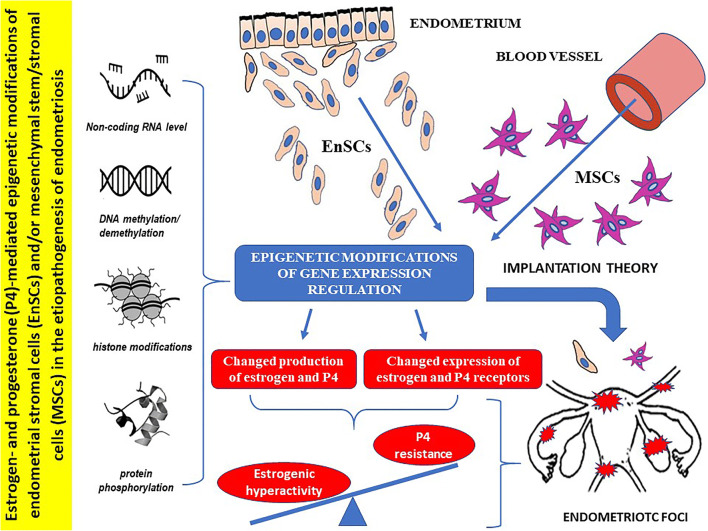
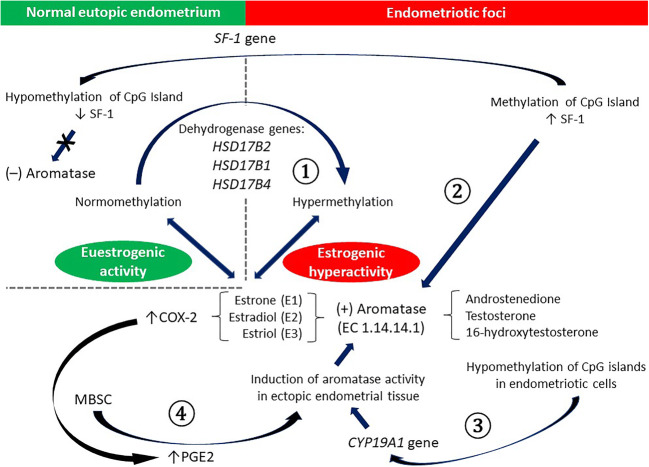
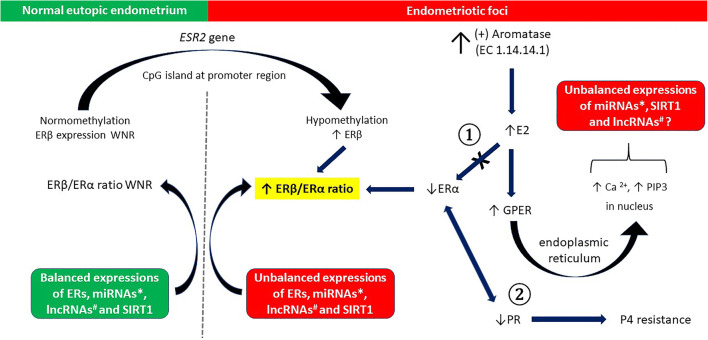
Endometriosis is a common chronic inflammatory condition in which endometrial tissue appears outside the uterine cavity. Because ectopic endometriosis cells express both estrogen and progesterone (P4) receptors, they grow and undergo cyclic proliferation and breakdown similar to the endometrium. This debilitating gynecological disease affects up to 15% of reproductive aged women. Despite many years of research, the etiopathogenesis of endometrial lesions remains unclear. Retrograde transport of the viable menstrual endometrial cells with retained ability for attachment within the pelvic cavity, proliferation, differentiation and subsequent invasion into the surrounding tissue constitutes the rationale for widely accepted implantation theory. Accordingly, the most abundant cells in the endometrium are endometrial stromal cells (EnSCs). These cells constitute a particular population with clonogenic activity that resembles properties of mesenchymal stem/stromal cells (MSCs). Thus, a significant role of stem cell-based dysfunction in formation of the initial endometrial lesions is suspected. There is increasing evidence that the role of epigenetic mechanisms and processes in endometriosis have been underestimated. The importance of excess estrogen exposure and P4 resistance in epigenetic homeostasis failure in the endometrial/endometriotic tissue are crucial. Epigenetic alterations regarding transcription factors of estrogen and P4 signaling pathways in MSCs are robust in endometriotic tissue. Thus, perspectives for the future may include MSCs and EnSCs as the targets of epigenetic therapies in the prevention and treatment of endometriosis. Here, we reviewed the current known changes in the epigenetic background of EnSCs and MSCs due to estrogen/P4 imbalances in the context of etiopathogenesis of endometriosis. Graphical Abstract.
子宫内膜异位症是一种常见的慢性炎症性疾病,其中子宫内膜组织出现在子宫腔外。由于异位子宫内膜细胞表达雌激素和孕激素 (P4) 受体,它们的生长和周期性增殖和分解与子宫内膜相似。这种使人衰弱的妇科疾病影响了多达 15%的育龄妇女。尽管经过多年的研究,子宫内膜病变的病因仍然不清楚。有活力的月经子宫内膜细胞的逆行运输,保留在盆腔内附着、增殖、分化和随后侵袭周围组织的能力,构成了广泛接受的植入理论的基础。因此,子宫内膜中最丰富的细胞是子宫内膜基质细胞 (EnSCs)。这些细胞构成了一个具有克隆形成活性的特定群体,类似于间充质干细胞/基质细胞 (MSCs) 的特性。因此,怀疑干细胞功能障碍在初始子宫内膜病变的形成中起重要作用。越来越多的证据表明,表观遗传机制和过程在子宫内膜异位症中的作用被低估了。雌激素暴露过多和 P4 抵抗在子宫内膜/异位内膜组织中表观遗传平衡失败中的重要性。MSCs 中雌激素和 P4 信号通路转录因子的表观遗传改变在子宫内膜异位组织中是明显的。因此,未来的研究方向可能包括 MSCs 和 EnSCs 作为表观遗传治疗子宫内膜异位症预防和治疗的靶点。在这里,我们综述了由于雌激素/P4 失衡在子宫内膜异位症发病机制中,EnSCs 和 MSCs 表观遗传背景的已知变化。图表摘要。