Department, of Epidemiology, School of Medicine, Fukushima Medical University, 1 Hikarigaoka, Fukushima-city, Fukushima, 960-1295, Japan.
Radiation Medical Science Center for the Fukushima Health Management Survey, Fukushima Medical University, 1 Hikarigaoka, Fukushima-city, Fukushima, 960-1295, Japan.
BMC Geriatr. 2021 Jan 7;21(1):18. doi: 10.1186/s12877-020-01934-9.
It has been reported that psychological stress affects bone metabolism and increases the risk of fracture. However, the relationship between bone fractures and post-traumatic stress disorder (PTSD) is unclear. This study aimed to evaluate the effects of disaster-induced PTSD symptoms on fracture risk in older adults.
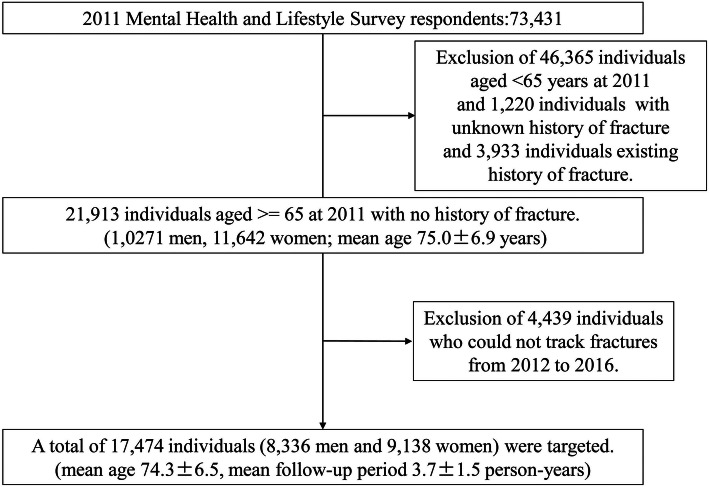
This study evaluated responses from 17,474 individuals aged ≥ 65 years without a history of fractures during the Great East Japan Earthquake who answered the Mental Health and Lifestyle Survey component of the Fukushima Health Management Survey conducted in 2011. The obtained data could determine the presence or absence of fractures until 2016. Age, sex, physical factors, social factors, psychological factors, and lifestyle factors were subsequently analyzed. Survival analysis was then performed to determine the relationship between the fractures and each factor. Thereafter, univariate and multivariate Cox proportional hazard models were constructed to identify fracture risk factors.
In total, 2,097 (12.0%) fractures were observed throughout the follow-up period. Accordingly, univariate and multivariate Cox proportional hazard models showed that PTSD symptoms (total PTSD checklists scoring ≥ 44) [hazard ratio (HR): 1.26; 95% confidence interval (CI): 1.10-1.44; P = 0.001], history of cancer (HR: 1.49; 95% CI: 1.24-1.79; P < 0.001), history of stroke (HR: 1.25; 95% CI: 1.03-1.52; P = 0.023), history of heart disease (HR: 1.30; 95% CI: 1.13-1.50; P < 0.001), history of diabetes (HR: 1.23; 95% CI: 1.09-1.39; P < 0.001), current smoking (HR: 1.29; 95% CI: 1.02-1.63; P = 0.036), and high dissatisfaction with sleep or no sleep at all (HR: 1.33; 95% CI: 1.02-1.74; P = 0.035) promoted a significant increase in fracture risk independent of age and sex.
The present study indicates that disaster-induced PTSD symptoms and insomnia contribute to increased fracture risk among older adults residing in evacuation areas within the Fukushima Prefecture.
有报道称,心理压力会影响骨骼代谢并增加骨折风险。然而,骨折与创伤后应激障碍(PTSD)之间的关系尚不清楚。本研究旨在评估灾害引起的 PTSD 症状对老年人骨折风险的影响。
本研究评估了 2011 年进行的福岛健康管理调查中,没有在东日本大地震期间发生骨折史的 17474 名年龄≥65 岁的个体对心理健康和生活方式调查部分的回答。获得的数据可以确定 2016 年之前是否发生骨折。随后分析年龄、性别、身体因素、社会因素、心理因素和生活方式因素。然后进行生存分析以确定骨折与每个因素之间的关系。此后,构建单变量和多变量 Cox 比例风险模型以确定骨折的危险因素。
在整个随访期间,共观察到 2097 例(12.0%)骨折。因此,单变量和多变量 Cox 比例风险模型显示 PTSD 症状(总 PTSD 检查表评分≥44)[风险比(HR):1.26;95%置信区间(CI):1.10-1.44;P=0.001]、癌症史(HR:1.49;95%CI:1.24-1.79;P<0.001)、中风史(HR:1.25;95%CI:1.03-1.52;P=0.023)、心脏病史(HR:1.30;95%CI:1.13-1.50;P<0.001)、糖尿病史(HR:1.23;95%CI:1.09-1.39;P<0.001)、当前吸烟(HR:1.29;95%CI:1.02-1.63;P=0.036)和对睡眠高度不满或根本无法入睡(HR:1.33;95%CI:1.02-1.74;P=0.035)独立于年龄和性别因素显著增加了骨折风险。
本研究表明,灾害引起的 PTSD 症状和失眠会导致福岛县撤离区老年人骨折风险增加。