Department of Pharmaceutical Sciences, College of Pharmacy, University of New Mexico, Albuquerque, New Mexico, USA.
Division of Molecular Medicine, School of Medicine, University of New Mexico, Albuquerque, New Mexico, USA.
BMC Cancer. 2021 Jan 7;21(1):40. doi: 10.1186/s12885-020-07716-1.
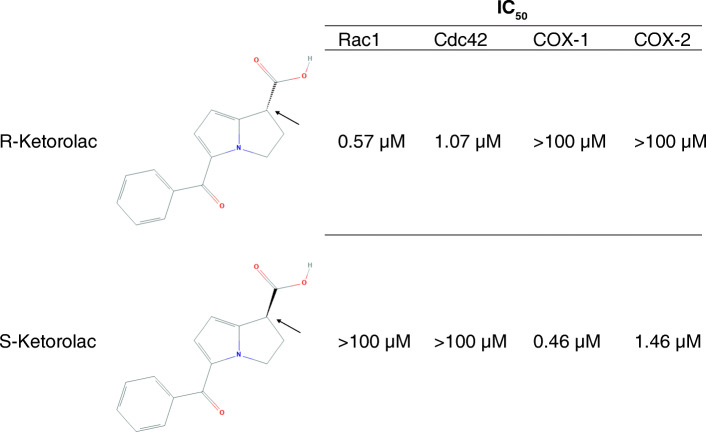
Rho-family GTPases, including Ras-related C3 botulinum toxin substrate 1 (Rac1) and cell division control protein 42 (Cdc42), are important modulators of cancer-relevant cell functions and are viewed as promising therapeutic targets. Based on high-throughput screening and cheminformatics we identified the R-enantiomer of an FDA-approved drug (ketorolac) as an inhibitor of Rac1 and Cdc42. The corresponding S-enantiomer is a non-steroidal anti-inflammatory drug (NSAID) with selective activity against cyclooxygenases. We reported previously that R-ketorolac, but not the S-enantiomer, inhibited Rac1 and Cdc42-dependent downstream signaling, growth factor stimulated actin cytoskeleton rearrangements, cell adhesion, migration and invasion in ovarian cancer cell lines and patient-derived tumor cells.
In this study we treated mice with R-ketorolac and measured engraftment of tumor cells to the omentum, tumor burden, and target GTPase activity. In order to gain insights into the actions of R-ketorolac, we also performed global RNA-sequencing (RNA-seq) analysis on tumor samples.
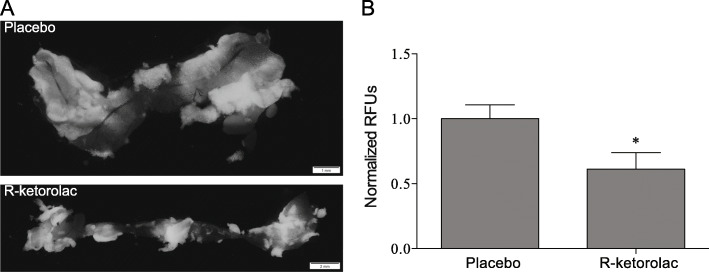
Treatment of mice with R-ketorolac decreased omental engraftment of ovarian tumor cells at 18 h post tumor cell injection and tumor burden after 2 weeks of tumor growth. R-ketorolac treatment inhibited tumor Rac1 and Cdc42 activity with little impact on mRNA or protein expression of these GTPase targets. RNA-seq analysis revealed that R-ketorolac decreased expression of genes in the HIF-1 signaling pathway. R-ketorolac treatment also reduced expression of additional genes associated with poor prognosis in ovarian cancer.
These findings suggest that R-ketorolac may represent a novel therapeutic approach for ovarian cancer based on its pharmacologic activity as a Rac1 and Cdc42 inhibitor. R-ketorolac modulates relevant pathways and genes associated with disease progression and worse outcome.
Rho 家族 GTPases,包括 Ras 相关 C3 肉毒梭菌毒素底物 1(Rac1)和细胞分裂控制蛋白 42(Cdc42),是调节与癌症相关的细胞功能的重要调节剂,被视为有前途的治疗靶点。基于高通量筛选和化学信息学,我们鉴定出一种已获美国食品和药物管理局批准的药物(酮咯酸)的 R-对映异构体是 Rac1 和 Cdc42 的抑制剂。相应的 S-对映异构体是非甾体抗炎药(NSAID),对环氧化酶具有选择性活性。我们之前报道过,R-酮咯酸而非 S-对映异构体抑制 Rac1 和 Cdc42 依赖性下游信号转导、生长因子刺激的肌动蛋白细胞骨架重排、细胞黏附、迁移和侵袭在卵巢癌细胞系和患者来源的肿瘤细胞中。
在这项研究中,我们用 R-酮咯酸治疗小鼠,并测量肿瘤细胞向大网膜的植入、肿瘤负担和靶 GTPase 活性。为了深入了解 R-酮咯酸的作用,我们还对肿瘤样本进行了全基因组 RNA 测序(RNA-seq)分析。
用 R-酮咯酸治疗小鼠可降低卵巢肿瘤细胞在肿瘤细胞注射后 18 小时大网膜的植入和 2 周肿瘤生长后的肿瘤负担。R-酮咯酸治疗抑制肿瘤 Rac1 和 Cdc42 活性,对这些 GTPase 靶标mRNA 或蛋白表达影响不大。RNA-seq 分析显示,R-酮咯酸降低了 HIF-1 信号通路中基因的表达。R-酮咯酸治疗还降低了卵巢癌中与预后不良相关的其他基因的表达。
这些发现表明,R-酮咯酸可能代表一种新的治疗卵巢癌的方法,其药理活性作为 Rac1 和 Cdc42 抑制剂。R-酮咯酸调节与疾病进展和预后不良相关的相关途径和基因。