Buljan Ivan, Marušić Matko, Tokalić Ružica, Viđak Marin, Peričić Tina Poklepović, Hren Darko, Marušić Ana
Department of Research in Biomedicine and Health, University of Split School of Medicine, Šoltanska 2, 21000, Split, Croatia.
Department of Psychology, Faculty of Humanities and Social Sciences, University of Split, Split, Croatia.
BMC Med Educ. 2021 Jan 7;21(1):25. doi: 10.1186/s12909-020-02449-y.
Knowledge assessment in evidence-based medicine (EBM) is usually performed by the measurement of memorised facts, understanding of EBM concepts and application of learned knowledge in familiar situations, all of which are considered lower-level educational objectives. The aim of this study was to assess EBM knowledge both on higher and lower cognitive levels across EBM topics.
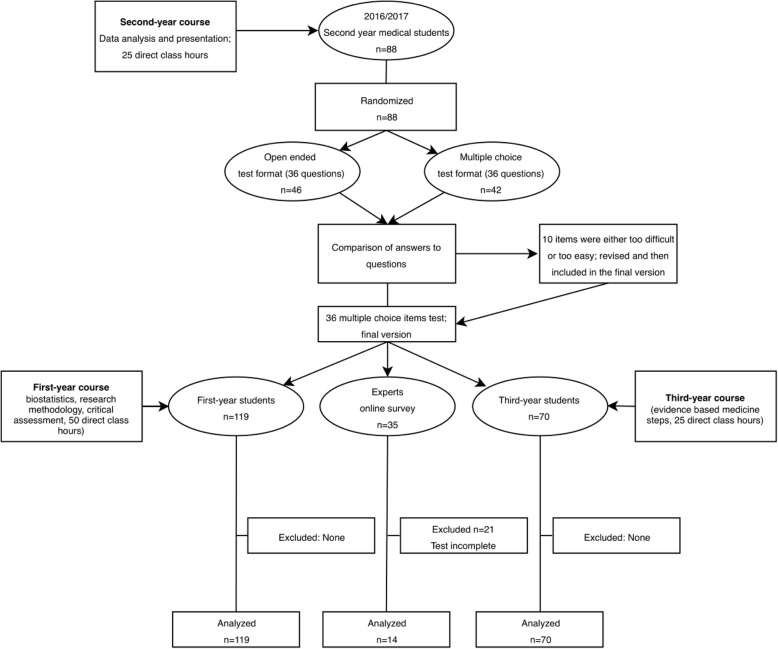
In order to assess knowledge on different EBM topics across learning levels, we created a knowledge test (Six Progressive Levels in Testing - SPLIT instrument), which consists of 36 multiple choice items and measures knowledge in EBM at six cognitive levels (Remembering, Understanding, Applying, Analysing, Evaluating and Creating) and addresses six EBM topics (Evidence-based practice, Internal validity, Clinical importance, Study design, Sources of evidence, Diagnostic studies). Three independent assessors defined the minimum passing score (MPS) for the overall test, based on the first-year course content and educational objectives. The instrument was assessed in a sample of first- (n = 119) and third-year medical students (n = 70) and EBM experts (n = 14).
The MPS was 16 correct answers out of total 36 questions, and was achieved by 21 out of 119 first-year students, 14 out of 70 third-year students and 9 out of 14 EBM experts (χ = 13.3; P < 0.001, with significantly higher proportion of experts passing compared to students). Although experts had the highest scores overall, none of the groups outperformed others on individual cognitive levels, but the experts outperformed students in EBM topics of Study design and Sources of evidence (P = 0.002 and 0.004, respectively, Kruskal-Wallis test). First- and third-year students performed better on specific course topics taught in that study year (Diagnostic studies and Clinical relevance, respectively).
EBM knowledge of students and experts differ according to the specificities of their education/expertise, but neither group had excellent knowledge in all areas. It may be difficult to develop a knowledge test that includes different EBM topics at different cognitive levels to follow the development of specific and general aspects of EBM knowledge.
循证医学(EBM)中的知识评估通常通过对记忆事实的测量、对EBM概念的理解以及在熟悉情境中应用所学知识来进行,所有这些都被视为较低层次的教育目标。本研究的目的是在EBM各个主题的较高和较低认知水平上评估EBM知识。
为了评估不同学习水平上关于不同EBM主题的知识,我们创建了一个知识测试(测试中的六个进阶水平 - SPLIT工具),它由36个多项选择题组成,可在六个认知水平(记忆、理解、应用、分析、评估和创造)上测量EBM知识,并涉及六个EBM主题(循证实践、内部效度、临床重要性、研究设计、证据来源、诊断研究)。三名独立评估者根据一年级课程内容和教育目标确定了整个测试的最低及格分数(MPS)。该工具在一年级(n = 119)和三年级医学生(n = 70)以及EBM专家(n = 14)的样本中进行了评估。
MPS是在总共36个问题中答对16道题,119名一年级学生中有21人达到该分数,70名三年级学生中有14人达到,14名EBM专家中有9人达到(χ = 13.3;P < 0.001,与学生相比,专家通过的比例显著更高)。尽管专家总体得分最高,但在各个认知水平上没有一个组的表现优于其他组,但专家在研究设计和证据来源的EBM主题上表现优于学生(分别为P = 0.002和0.004,Kruskal-Wallis检验)。一年级和三年级学生在该学年所教授的特定课程主题上表现更好(分别为诊断研究和临床相关性)。
学生和专家的EBM知识因其教育/专业知识的特殊性而有所不同,但两组在所有领域都没有卓越的知识。可能难以开发一个在不同认知水平上涵盖不同EBM主题的知识测试,以跟踪EBM知识的特定和一般方面的发展。