Chen Peilin, Chen Ziming, Mitchell Christopher, Gao Junjie, Chen Lianzhi, Wang Allan, Leys Toby, Landao-Bassonga Euphemie, Zheng Qiujian, Wang Tao, Zheng Minghao
Center for Orthopaedic Translational Research, Medical School, University of Western Australia, Nedlands, Australia.
Perron Institute for Neurological and Translational Science, Perth, Western Australia, Australia.
Stem Cell Res Ther. 2021 Jan 7;12(1):38. doi: 10.1186/s13287-020-02084-w.
Botulinum toxin (Botox) injection is in widespread clinical use for the treatment of muscle spasms and tendinopathy but the mechanism of action is poorly understood.
We hypothesised that the reduction of patellar-tendon mechanical-loading following intra-muscular injection of Botox results in tendon atrophy that is at least in part mediated by the induction of senescence of tendon-derived stem cells (TDSCs).
Controlled laboratory study METHODS: A total of 36 mice were randomly divided into 2 groups (18 Botox-injected and 18 vehicle-only control). Mice were injected into the right vastus lateralis of quadriceps muscles either with Botox (to induce mechanical stress deprivation of the patellar tendon) or with normal saline as a control. At 2 weeks post-injection, animals were euthanized prior to tissues being harvested for either evaluation of tendon morphology or in vitro studies. TDSCs were isolated by cell-sorting prior to determination of viability, differentiation capacity or the presence of senescence markers, as well as assessing their response to mechanical loading in a bioreactor. Finally, to examine the mechanism of tendon atrophy in vitro, the PTEN/AKT-mediated cell senescence pathway was evaluated in TDSCs from both groups.
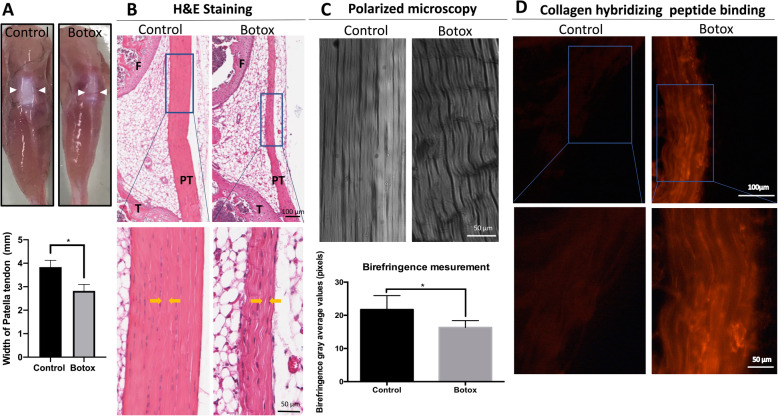
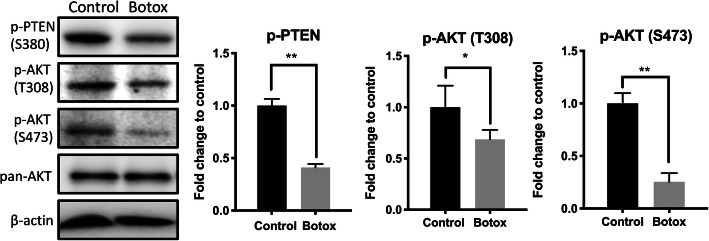
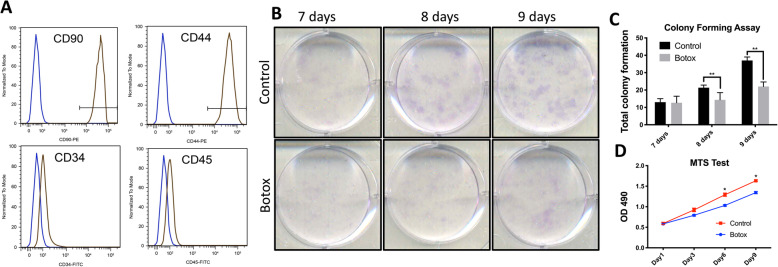
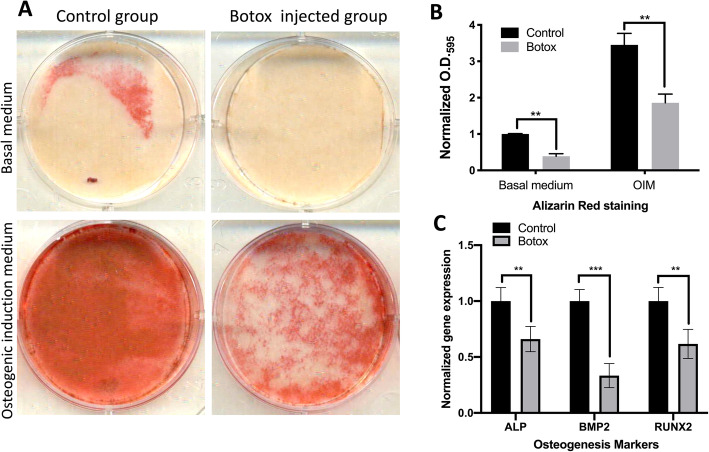
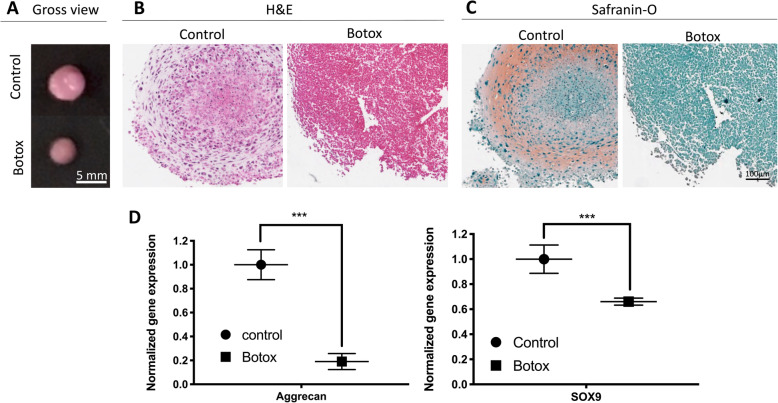
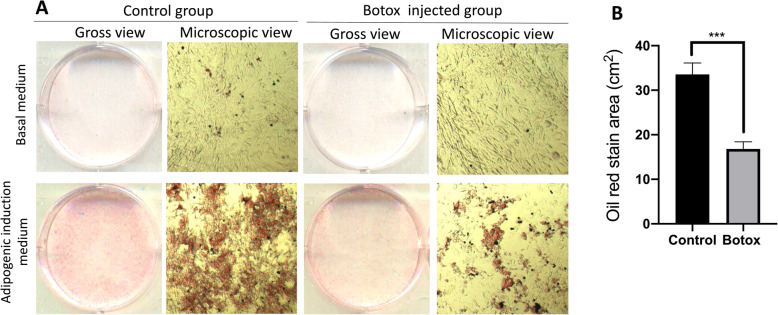
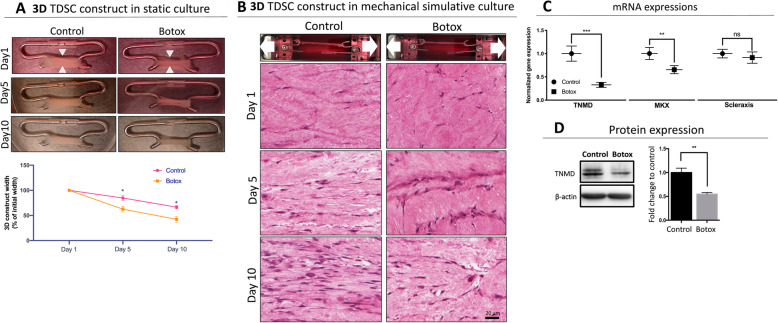
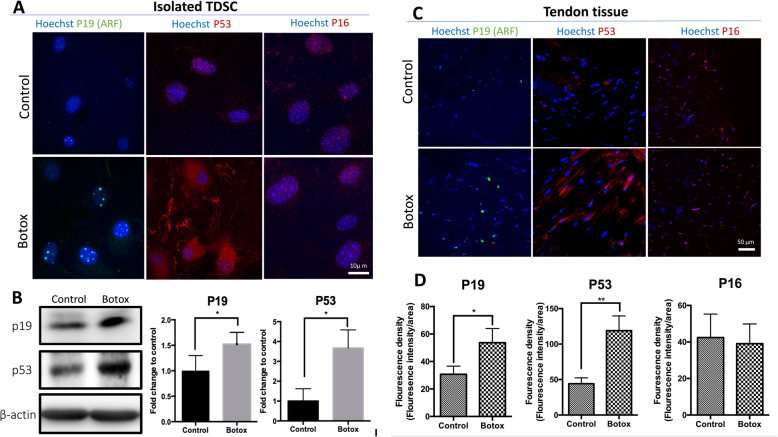
Two weeks after Botox injection, patellar tendons displayed several atrophic features including tissue volume reduction, collagen fibre misalignment and increased degradation. A colony formation assay revealed a significantly reduced number of colony forming units of TDSCs in the Botox-injected group compared to controls. Multipotent differentiation capacities of TDSCs were also diminished after Botox injection. To examine if mechanically deprived TDSC are capable of forming tendon tissue, we used an isolated bioreactor system to culture tendon constructs using TDSC. These results showed that TDSCs from the Botox-treated group failed to restore tenogenic differentiation after appropriate mechanical loading. Examination of the signalling pathway revealed that injection of Botox into quadriceps muscles causes PTEN/AKT-mediated cell senescence of TDSCs.
Intramuscular injection of Botox interferes with tendon homeostasis by inducing tendon atrophy and senescence of TDSCs. Botox injection may have long-term adverse consequences for the treatment of tendinopathy.
Intramuscular Botox injection for tendinopathy or tendon injury could result in adverse effects in human tendons and evaluation of its long-term efficacy is warranted.
肉毒杆菌毒素(保妥适)注射在临床上广泛用于治疗肌肉痉挛和肌腱病,但其作用机制尚不清楚。
我们假设肌肉注射保妥适后髌腱机械负荷的降低会导致肌腱萎缩,这至少部分是由肌腱衍生干细胞(TDSCs)衰老的诱导介导的。
对照实验室研究
总共36只小鼠被随机分为2组(18只注射保妥适组和18只仅注射赋形剂对照组)。小鼠的股四头肌外侧头右侧要么注射保妥适(以诱导髌腱的机械应力剥夺),要么注射生理盐水作为对照。注射后2周,在采集组织用于评估肌腱形态或体外研究之前对动物实施安乐死。在确定活力、分化能力或衰老标志物的存在之前,通过细胞分选分离TDSCs,并在生物反应器中评估它们对机械负荷的反应。最后,为了在体外研究肌腱萎缩的机制,评估了两组TDSCs中PTEN/AKT介导的细胞衰老途径。
保妥适注射2周后,髌腱呈现出几种萎缩特征,包括组织体积减小、胶原纤维排列紊乱和降解增加。集落形成试验显示,与对照组相比,注射保妥适组的TDSCs集落形成单位数量显著减少。保妥适注射后TDSCs的多能分化能力也减弱。为了研究机械剥夺的TDSCs是否能够形成肌腱组织,我们使用了一个分离的生物反应器系统,用TDSCs培养肌腱构建体。这些结果表明,保妥适治疗组的TDSCs在适当的机械负荷后未能恢复肌腱分化。对信号通路的检查显示,向股四头肌注射保妥适会导致TDSCs的PTEN/AKT介导的细胞衰老。
肌肉注射保妥适通过诱导肌腱萎缩和TDSCs衰老干扰肌腱内环境稳定。保妥适注射可能对肌腱病的治疗产生长期不良后果。
肌肉注射保妥适治疗肌腱病或肌腱损伤可能会对人体肌腱产生不良影响,因此有必要评估其长期疗效。