Chen Peilin, Wang Allan, Haynes William, Landao-Bassonga Euphemie, Lee Clair, Ruan Rui, Breidahl William, Shiroud Heidari Behzad, Mitchell Christopher A, Zheng Minghao
Centre for Orthopaedic Research, The UWA Medical School, The University of Western Australia, Crawley, WA, 6009, Australia.
Australian Research Council Centre for Personalised Therapeutics Technologies, Australia.
J Orthop Translat. 2021 Dec 11;31:91-101. doi: 10.1016/j.jot.2021.10.006. eCollection 2021 Nov.
Rotator Cuff (RC) tendon tearing is a common clinical problem and there is a high incidence of revision surgery due to re-tearing. In an effort to improve patient outcome and reduce surgical revision, scaffolds have been widely used for augmentation of RC repairs. However, little is known about how scaffolds support tendon stem cell growth or facilitate tendon regeneration. The purpose of this study is to evaluate the structural and biological properties of a bioactive collagen scaffold (BCS) with the potential to promote tendon repair. Additionally, we conducted a pilot clinical study to assess the safety and feasibility of using the BCS for repair of RC tears.
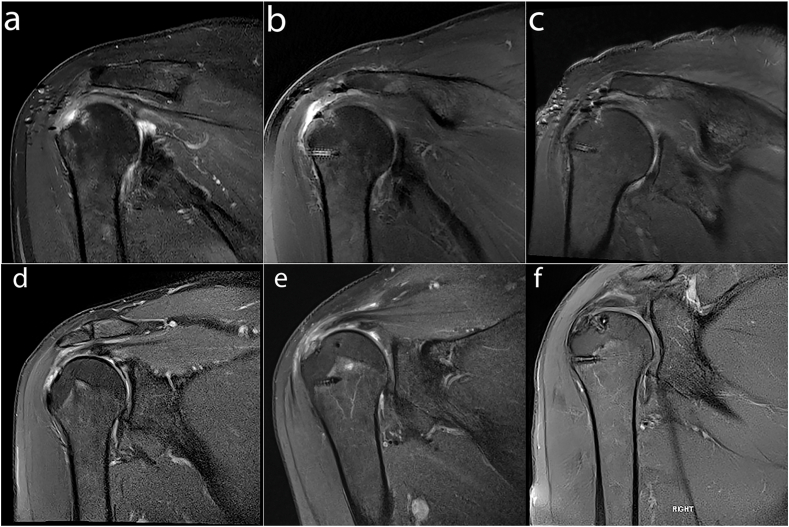
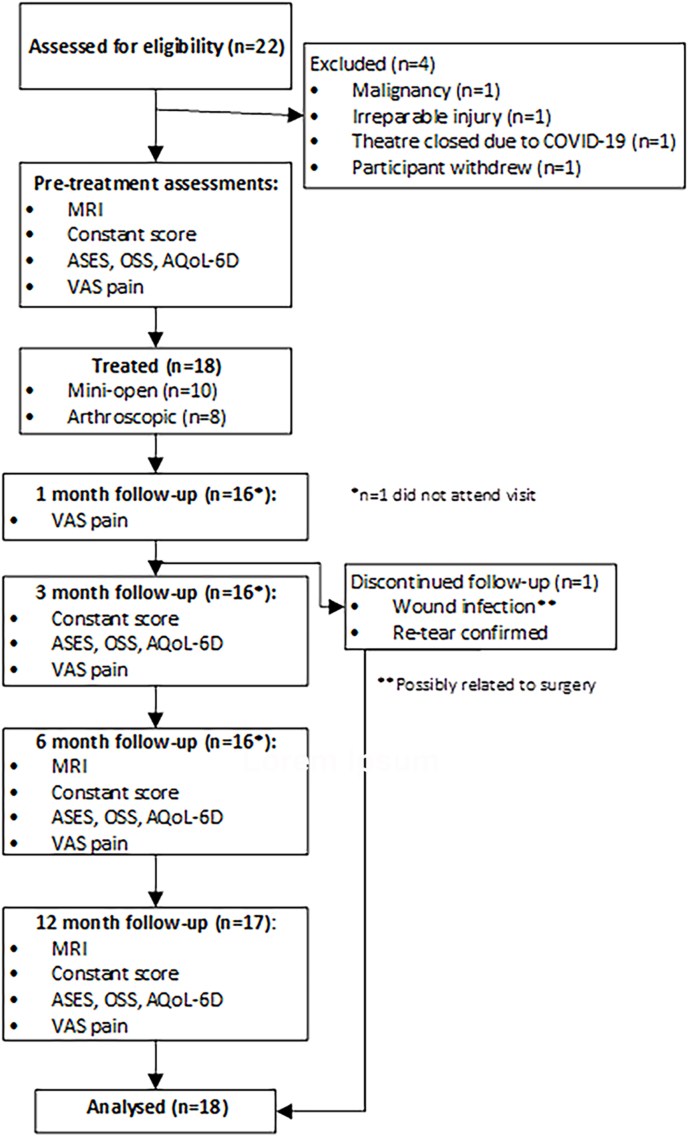
A series of physical, ultrastructural, molecular and tests determined the biocompatibility and teno-inductive properties of this BCS. In addition, a prospective case study of 18 patients with RC tendon tears (>20 mm in diameter) was performed in an open-label, single-arm study, involving either mini-open or arthroscopic surgical RC repair with the BCS. Clinical assessment of RC repair status was undertaken by MRI-imaging at baseline, 6 and 12 months and patient evaluated questionnaires were taken at baseline as well as 3, 6 & 12 months.
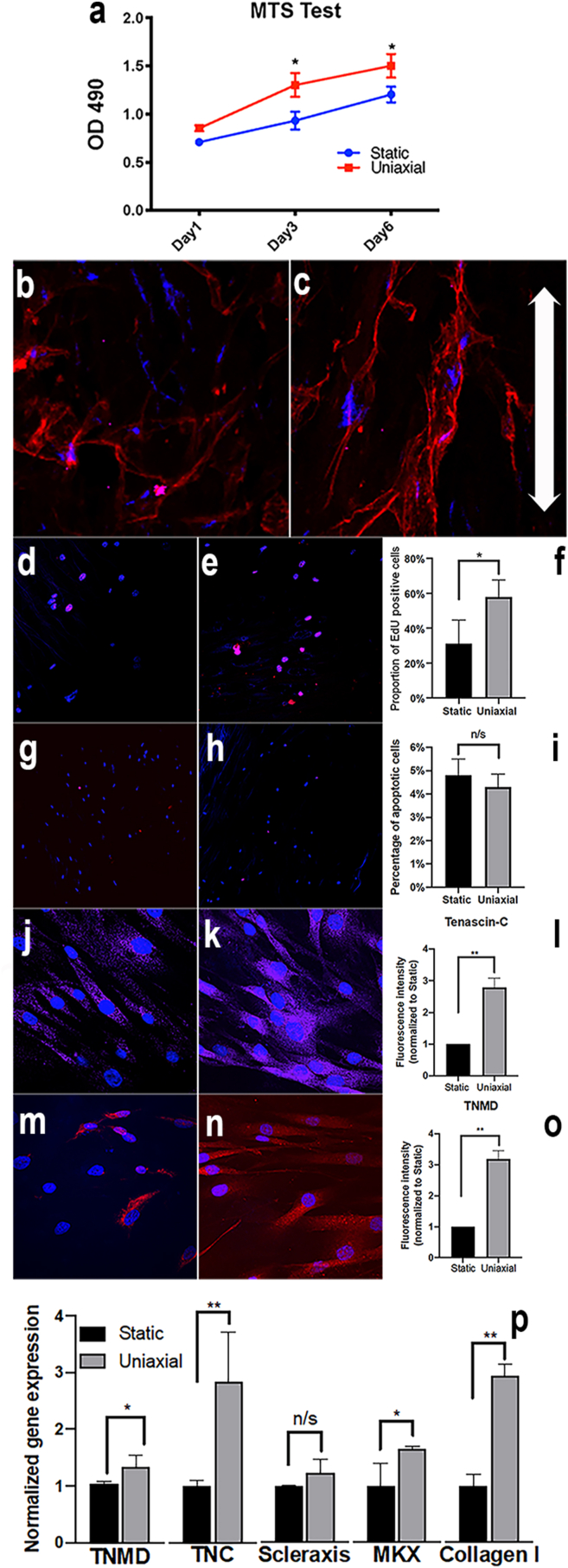
The BCS consists of highly purified type-I collagen, in bundles of varying diameter, arranged in a higher order tri-laminar structure. BCS have minimal immunogenicity, being cell and essentially DNA-free as well as uniformly negative for the porcine α-Gal protein. BCS seeded with human primary tendon-derived cells and exposed to 6% uniaxial loading conditions , supported increased levels of growth and proliferation as well as up-regulating expression of tenocyte differentiation marker genes including TNMD, Ten-C, Mohawk and Collagen-1α1. To test the safety and feasibility of using the BCS for augmentation of RC repairs, we followed the IDEAL framework and conducted a first, open-label single arm prospective case series study of 18 patients. One patient was withdrawn from the study at 3 months due to wound infection unrelated to the BCS. The remaining 17 cases showed that the BCS is safe to be implanted. The patients reported encouraging improvements in functional outcomes (ASES, OSS and Constant-Murley scores), as well as quality of life assessments (AQoL) and a reduction in VAS pain scores. MRI assessment at 12 months revealed complete healing in 64.8% patients (11/17), 3 partial thickness re-tears (17.6%) and 3 full thickness re-tears (17.6%).
The BCS is composed of type-I collagen that is free of immunogenic proteins and supports tendon-derived cell growth under mechanical loading . This pilot study shows that it is safe and feasible to use BCS for RC argumentation and further controlled prospective studies are required to demonstrate its efficacy.
The results of this study indicate that this bioactive collagen scaffold has unique properties for supporting tendon growth and that it is non-immunogenic. The clinical study further confirms that the scaffold is a promising biological device for augment of human rotator cuff repairs.
肩袖(RC)肌腱撕裂是常见的临床问题,因再次撕裂导致翻修手术的发生率很高。为了改善患者预后并减少手术翻修,支架已被广泛用于增强RC修复。然而,关于支架如何支持肌腱干细胞生长或促进肌腱再生知之甚少。本研究的目的是评估具有促进肌腱修复潜力的生物活性胶原支架(BCS)的结构和生物学特性。此外,我们进行了一项初步临床研究,以评估使用BCS修复RC撕裂的安全性和可行性。
通过一系列物理、超微结构、分子和测试确定了该BCS的生物相容性和腱诱导特性。此外,在一项开放标签、单臂研究中,对18例RC肌腱撕裂(直径>20毫米)患者进行了前瞻性病例研究,采用微型开放或关节镜手术用BCS进行RC修复。在基线、6个月和12个月时通过MRI成像对RC修复状态进行临床评估,并在基线以及3、6和12个月时采用患者评估问卷。
BCS由高度纯化的I型胶原组成,呈不同直径的束状排列,形成更高阶的三层结构。BCS具有最小的免疫原性,无细胞且基本无DNA,对猪α-Gal蛋白呈均匀阴性。接种人原代肌腱来源细胞并暴露于6%单轴加载条件下的BCS,支持生长和增殖水平增加,并上调肌腱细胞分化标记基因的表达,包括TNMD、Ten-C、Mohawk和Collagen-1α1。为了测试使用BCS增强RC修复的安全性和可行性,我们遵循IDEAL框架,对18例患者进行了首例开放标签单臂前瞻性病例系列研究。1例患者在3个月时因与BCS无关的伤口感染退出研究。其余17例病例表明植入BCS是安全的。患者报告功能结局(ASES、OSS和Constant-Murley评分)、生活质量评估(AQoL)有令人鼓舞的改善,VAS疼痛评分降低。12个月时的MRI评估显示64.8%的患者(11/17)完全愈合,3例部分厚度再次撕裂(17.6%)和3例全厚度再次撕裂(17.6%)。
BCS由不含免疫原性蛋白的I型胶原组成,并在机械加载下支持肌腱来源细胞生长。这项初步研究表明,使用BCS进行RC增强是安全可行的,需要进一步的对照前瞻性研究来证明其疗效。
本研究结果表明,这种生物活性胶原支架具有支持肌腱生长的独特特性,且无免疫原性。临床研究进一步证实,该支架是一种有前景的用于增强人类肩袖修复的生物装置。