Department of Emergency Medicine, Icahn School of Medicine At Mount Sinai, 1 Gustave L. Levy Place, New York, NY, 10029, USA.
Mount Sinai Beth Israel, First Avenue at 16th Street, Suite 2S34H, New York, NY, 1003, USA.
Addict Sci Clin Pract. 2021 Jan 7;16(1):4. doi: 10.1186/s13722-020-00210-w.
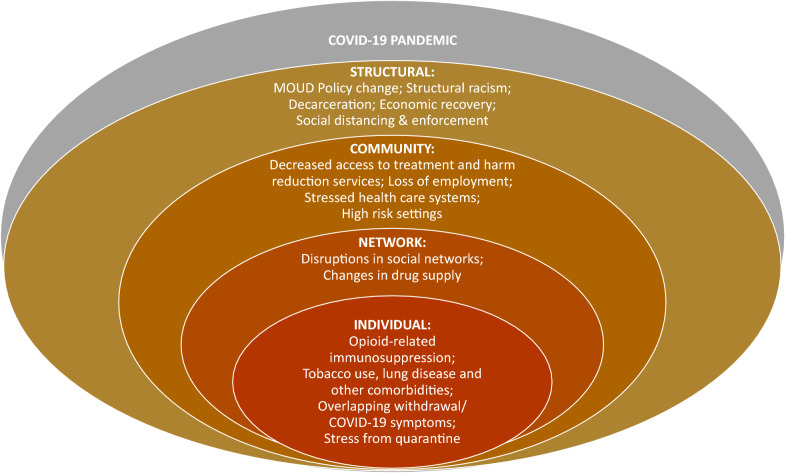
The COVID-19 pandemic has resulted in unparalleled societal disruption with wide ranging effects on individual liberties, the economy, and physical and mental health. While no social strata or population has been spared, the pandemic has posed unique and poorly characterized challenges for individuals with opioid use disorder (OUD). Given the pandemic's broad effects, it is helpful to organize the risks posed to specific populations using theoretical models. These models can guide scientific inquiry, interventions, and public policy. Models also provide a visual image of the interplay of individual-, network-, community-, structural-, and pandemic-level factors that can lead to increased risks of infection and associated morbidity and mortality for individuals and populations. Such models are not unidirectional, in that actions of individuals, networks, communities and structural changes can also affect overall disease incidence and prevalence. In this commentary, we describe how the social ecological model (SEM) may be applied to describe the theoretical effects of the COVID-19 pandemic on individuals with opioid use disorder (OUD). This model can provide a necessary framework to systematically guide time-sensitive research and implementation of individual-, community-, and policy-level interventions to mitigate the impact of the COVID-19 pandemic on individuals with OUD.
新冠疫情大流行造成了前所未有的社会混乱,对个人自由、经济以及身心健康都产生了广泛影响。虽然没有任何社会阶层或人群能够幸免,但这场大流行给患有阿片类药物使用障碍(OUD)的人带来了独特且特征描述不佳的挑战。鉴于大流行的广泛影响,使用理论模型来组织对特定人群构成的风险是有帮助的。这些模型可以指导科学研究、干预措施和公共政策。这些模型还提供了一个直观的图像,展示了个体、网络、社区、结构和大流行水平因素的相互作用,这些因素可能导致感染风险以及个人和人群相关发病率和死亡率增加。这些模型不是单向的,因为个体、网络、社区和结构变化的行为也会影响整体疾病的发病率和流行率。在这篇评论中,我们描述了社会生态学模型(SEM)如何应用于描述新冠疫情对患有阿片类药物使用障碍(OUD)的个体的理论影响。该模型可以为有针对性的研究和实施个体、社区和政策层面的干预措施提供必要的框架,以减轻新冠疫情对患有 OUD 的个体的影响。