Deaconu Ana, Mercille Geneviève, Batal Malek
Transnut WHO Collaborating Centre on Nutrition Changes and Development at Université de Montréal, Faculty of Medicine, Nutrition Department, 2900, boul. Édouard-Montpetit, Montréal, Québec, H3T 1J4, Canada.
Centre de Recherche en Santé Publique (CReSP), 7101, avenue du Parc, Montréal, Québec, H3N, 1X9, Canada.
BMC Nutr. 2021 Jan 7;7(1):1. doi: 10.1186/s40795-020-00395-y.
The displacement of traditional dietary practices is associated with negative nutritional consequences for rural Indigenous people, who already face the brunt of both nutritional inadequacies and excesses. Traditional food (TF) consumption and production practices can improve nutritional security by mitigating disruptive dietary transitions, providing nutrients and improving agricultural resilience. Meanwhile, traditional agricultural practices regenerate biodiversity to support healthy ecosystems. In Ecuador, Indigenous people have inserted TF agricultural and dietary practices as central elements of the country's agroecological farming movement. This study assesses factors that may promote TF practices in rural populations and explores the role of agroecology in strengthening such factors.
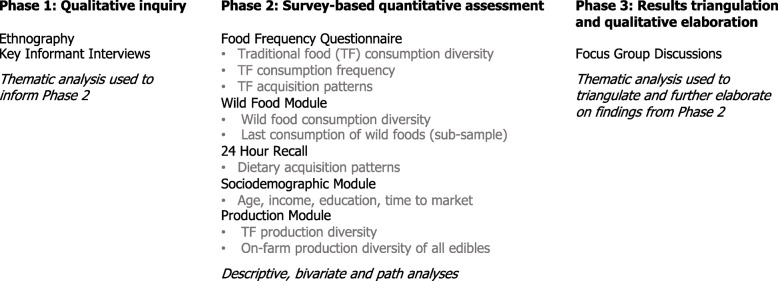
Mixed methods include a cross-sectional comparative survey of dietary, food acquisition, production and socioeconomic characteristics of agroecological farmers (n = 61) and neighboring reference farmers (n = 30) in Ecuador's Imbabura province. Instruments include 24-h dietary recall and a food frequency questionnaire of indicator traditional foods. We triangulate results using eight focus group discussions with farmers' associations.
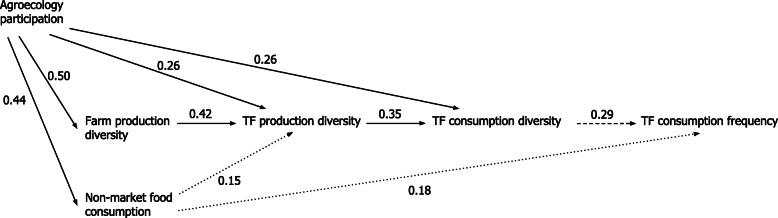
Compared to their neighbors, agroecological farmers produce and consume more TFs, and particularly underutilized TFs. Farm production diversity, reliance on non-market foods and agroecology participation act on a pathway in which TF production diversity predicts higher TF consumption diversity and ultimately TF consumption frequency. Age, income, market distance and education are not consistently associated with TF practices. Focus group discussions corroborate survey results and also identify affective (e.g. emotional) and commercial relationships in agroecological spaces as likely drivers of stronger TF practices.
Traditional food practices in the Ecuadorian highlands are not relics of old, poor and isolated populations but rather an established part of life for diverse rural people. However, many TFs are underutilized. Sustainable agriculture initiatives may improve TF practices by integrating TFs into production diversity increases and into consumption of own production. Agroecology may be particularly effective because it is a self-expanding global movement that not only promotes the agricultural practices that are associated with TF production, but also appears to intensify affective sentiments toward TFs and inserts TFs in commercial spaces. Understanding how to promote TFs is necessary in order to scale up their potential to strengthen nutritional health.
传统饮食习惯的改变对农村原住民产生了负面的营养影响,而他们本就首当其冲地面临着营养不足和营养过剩的问题。传统食物(TF)的消费和生产方式可以通过缓解饮食结构的破坏性转变、提供营养以及提高农业恢复力来改善营养安全。与此同时,传统农业生产方式能够恢复生物多样性,以支持健康的生态系统。在厄瓜多尔,原住民已将传统食物的农业和饮食方式作为该国生态农业运动的核心要素。本研究评估了可能促进农村人口采用传统食物方式的因素,并探讨了生态农业在强化这些因素方面的作用。
混合研究方法包括对厄瓜多尔因巴布拉省生态农业农民(n = 61)和邻近对照农民(n = 30)的饮食、食物获取、生产及社会经济特征进行横断面比较调查。调查工具包括24小时饮食回顾和一份关于传统标志性食物的食物频率问卷。我们通过与农民协会进行八次焦点小组讨论来验证研究结果。
与邻居相比,生态农业农民生产和消费的传统食物更多,尤其是未充分利用的传统食物。农场生产多样性、对非市场食物的依赖以及参与生态农业,在这样一条路径上发挥作用:传统食物生产多样性预示着更高的传统食物消费多样性,并最终决定传统食物的消费频率。年龄、收入、与市场的距离和教育程度与传统食物方式并无始终如一的关联。焦点小组讨论证实了调查结果,并且还确定了生态农业环境中的情感(如情绪方面的)和商业关系可能是强化传统食物方式的驱动因素。
厄瓜多尔高地的传统食物方式并非老旧、贫困和孤立人群的遗留,而是不同农村人口生活中既定的一部分。然而,许多传统食物未得到充分利用。可持续农业倡议可通过将传统食物纳入生产多样性增加以及自身生产的消费中,来改善传统食物方式。生态农业可能特别有效,因为它是一场自我扩展的全球运动,不仅促进与传统食物生产相关的农业实践,而且似乎还强化了对传统食物的情感倾向,并将传统食物引入商业领域。为了扩大传统食物增强营养健康的潜力,了解如何推广传统食物是很有必要的。