Liu Yaqiang, Zhu Chunhua, Guo Jiahui, Chen Yonghong, Meng Chaoyue
Department of Neurology, Second Hospital of Hebei Medical University, Shijiazhuang, China.
Front Aging Neurosci. 2020 Dec 22;12:588958. doi: 10.3389/fnagi.2020.588958. eCollection 2020.
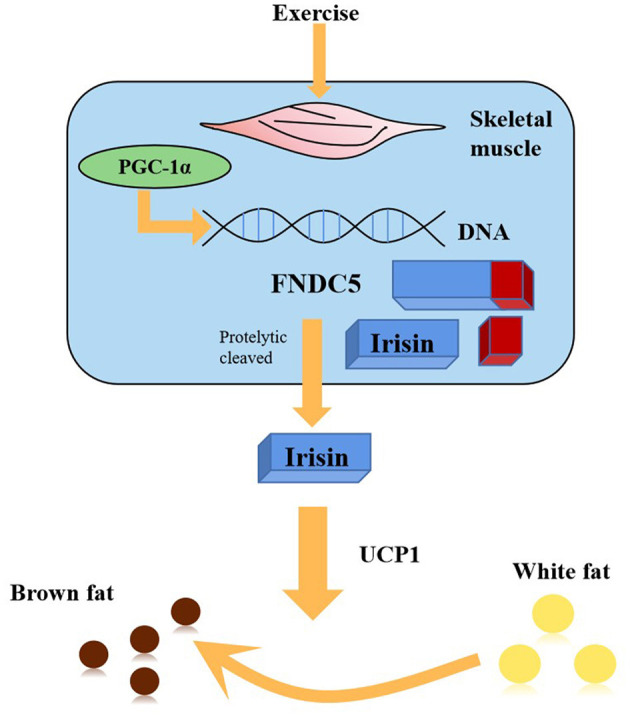
Irisin is a PGC-1α-dependent myokine that causes increased energy expenditure by driving the development of white adipose tissue into brown fat-like tissue. Exercise can improve irisin levels and lead to its release into the blood. In ischemic stroke, neurons are always sensitive to energy supply; after a series of pathophysiological processes, reactive oxygen species that are detrimental to cell survival via mitochondrial dysfunction are generated in large quantities. As a protein associated with exercise, irisin can alleviate brain injury in the pathogenesis of ischemic stroke. It is thought that irisin can upregulate the levels of brain-derived neurotrophic factor (BDNF), which protects nerve cells from injury during ischemic stroke. Furthermore, the release of irisin into the blood via exercise influences the mitochondrial dynamics crucial to maintaining the normal function of nerve cells. Consequently, we intended to summarize the known effects of irisin during ischemic stroke.
鸢尾素是一种依赖过氧化物酶体增殖物激活受体γ共激活因子1α(PGC-1α)的肌动蛋白,它通过促使白色脂肪组织发育为棕色脂肪样组织来增加能量消耗。运动可以提高鸢尾素水平并使其释放到血液中。在缺血性卒中中,神经元对能量供应一直很敏感;经过一系列病理生理过程后,会通过线粒体功能障碍产生大量对细胞存活有害的活性氧。作为一种与运动相关的蛋白质,鸢尾素可以在缺血性卒中的发病机制中减轻脑损伤。据认为,鸢尾素可以上调脑源性神经营养因子(BDNF)的水平,该因子在缺血性卒中期间保护神经细胞免受损伤。此外,通过运动使鸢尾素释放到血液中会影响对维持神经细胞正常功能至关重要的线粒体动力学。因此,我们打算总结鸢尾素在缺血性卒中期间的已知作用。