Rodriguez-Seijas Craig, Fields Eric C, Bottary Ryan, Kark Sarah M, Goldstein Michael R, Kensinger Elizabeth A, Payne Jessica D, Cunningham Tony J
Department of Psychology, University of Michigan, Ann Arbor, MI, United States.
Department of Psychology, Brandeis University, Waltham, MA, United States.
Front Psychiatry. 2020 Dec 22;11:590318. doi: 10.3389/fpsyt.2020.590318. eCollection 2020.
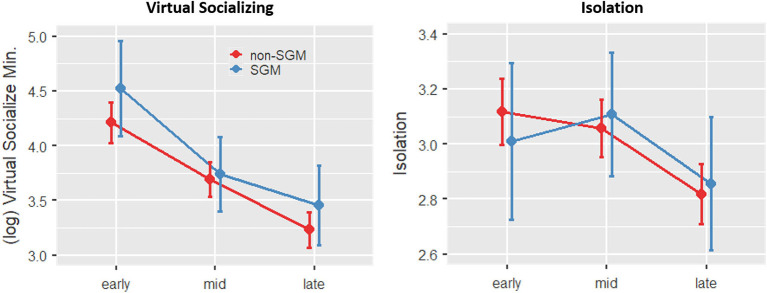
Empirical evidence demonstrates mental health disparities between sexual and gender minority individuals (SGM) compared with cisgender heterosexual individuals. SGM individuals report elevated rates of emotional distress, symptoms related to mood and anxiety disorders, self-harm, and suicidal ideation and behavior. Social support is inversely related to psychiatric symptoms, regardless of SGM status. The COVID-19 pandemic-with its associated limited social interactions-represents an unprecedented period of acute distress with potential reductions in accessibility of social support, which might be of particular concern for SGM individuals' mental well-being. In the present study, we explored the extent to which potential changes in mental health outcomes (depressive symptoms, worry, perceived stress, positive and negative affect) throughout the duration of the pandemic were related to differences in perceptions of social support and engagement in virtual social activity, as a function of SGM status. Utilizing a large sample of US adults ( = 1,014; 18% reported SGM status), we assessed psychiatric symptoms, perceptions of social isolation, and amount of time spent socializing virtually at 3 time windows during the pandemic (between March 21 and May 21). Although SGM individuals reported greater levels of depression compared with non-SGM individuals at all 3 time points, there was no interaction between time and SGM status. Across all participants, mental health outcomes improved across time. Perceived social isolation was associated with poorer mental health outcomes. Further, time spent engaging in virtual socialization was associated with reduced depression, but only for those in self-reported quarantine. We discuss these results in terms of the nature of our sample and its impact on the generalizability of these findings to other SGM samples as well as directions for future research aimed at understanding potential health disparities in the face of the COVID-19 pandemic.
实证证据表明,与顺性别异性恋者相比,性取向和性别少数群体(SGM)存在心理健康差异。SGM个体报告称,情绪困扰、与情绪和焦虑障碍相关的症状、自我伤害以及自杀意念和行为的发生率较高。无论SGM身份如何,社会支持与精神症状呈负相关。2019冠状病毒病疫情及其相关的有限社会互动,代表了一个前所未有的急性痛苦时期,社会支持的可及性可能会降低,这可能特别值得关注SGM个体的心理健康。在本研究中,我们探讨了在疫情期间心理健康结果(抑郁症状、担忧、感知压力、积极和消极情绪)的潜在变化在多大程度上与社会支持感知和虚拟社交活动参与度的差异相关,这是SGM身份的一个函数。我们利用一大样本美国成年人(n = 1014;18%报告为SGM身份),在疫情期间的3个时间窗口(3月21日至5月21日)评估了精神症状、社会隔离感知以及虚拟社交花费的时间量。尽管在所有3个时间点,SGM个体报告的抑郁水平均高于非SGM个体,但时间与SGM身份之间没有交互作用。在所有参与者中,心理健康结果随时间改善。感知到的社会隔离与较差的心理健康结果相关。此外,参与虚拟社交的时间与抑郁减轻相关,但仅适用于自我报告处于隔离状态的人。我们根据样本的性质及其对这些发现推广到其他SGM样本的影响来讨论这些结果,以及未来旨在理解面对2019冠状病毒病疫情时潜在健康差异的研究方向。