Umeå Plant Science Centre, Department of Plant Physiology, Umeå University, SE-901 87 Umeå, Sweden.
Umeå Plant Science Centre, Department of Forest Genetics and Plant Physiology, Swedish University of Agricultural Sciences (SLU), SE-901 83 Umeå, Sweden.
Tree Physiol. 2021 Jul 5;41(7):1230-1246. doi: 10.1093/treephys/tpaa178.
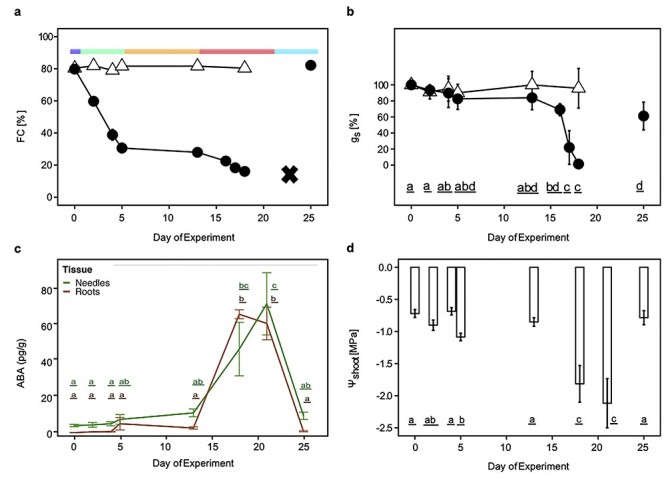
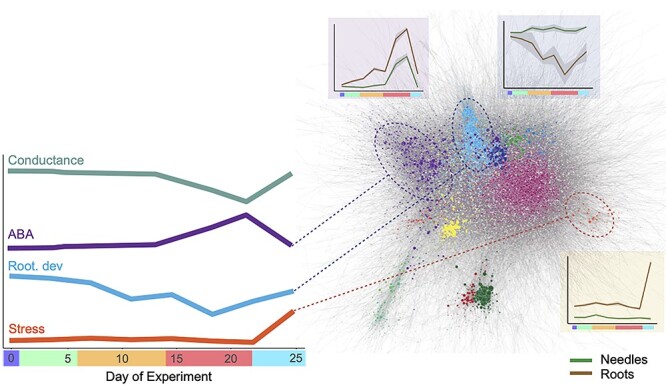
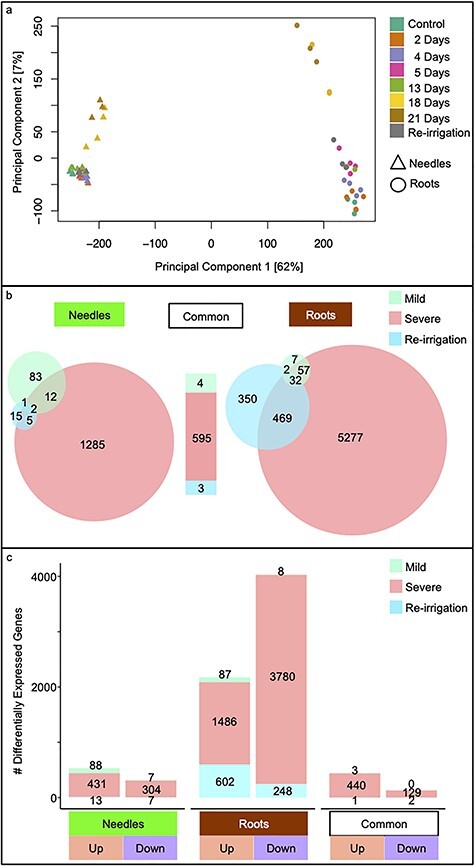
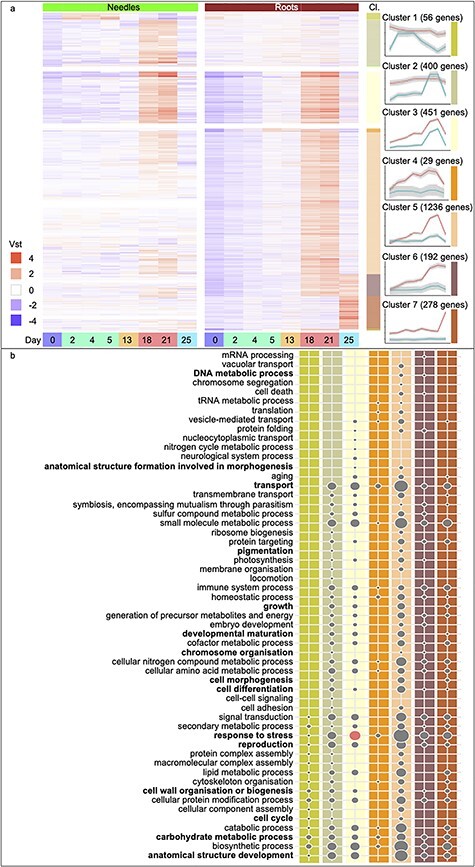
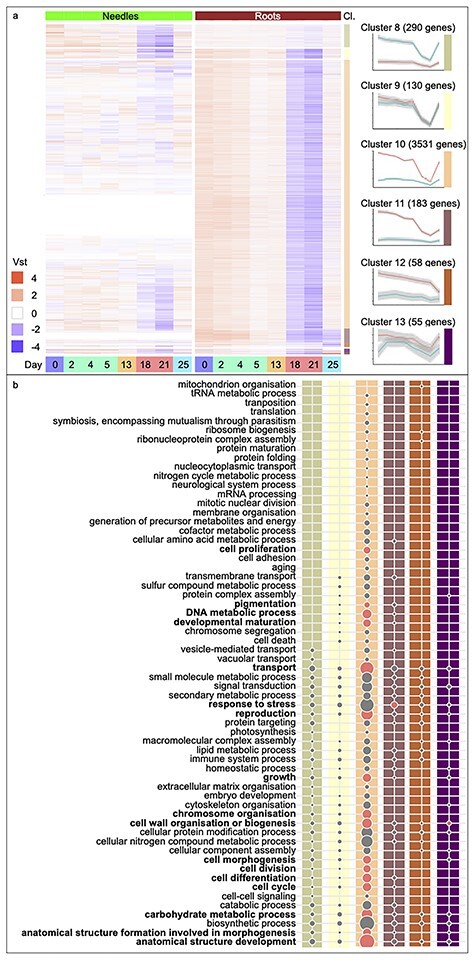
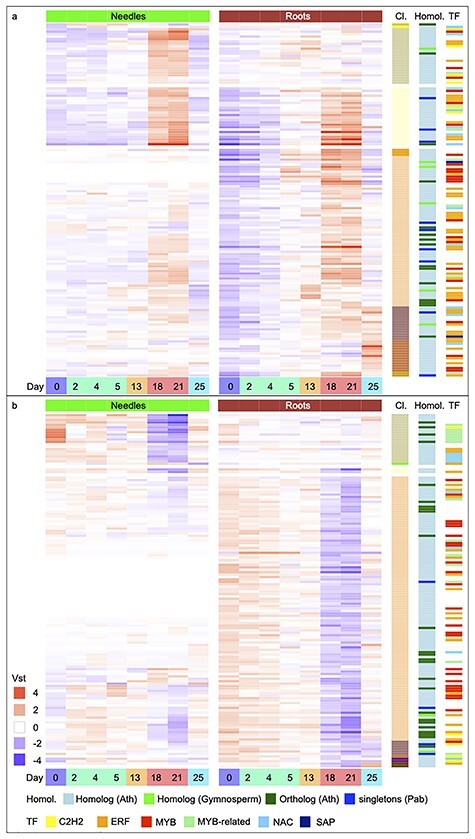
Drought stress impacts seedling establishment, survival and whole-plant productivity. Molecular responses to drought stress have been most extensively studied in herbaceous species, mostly considering only aboveground tissues. Coniferous tree species dominate boreal forests, which are predicted to be exposed to more frequent and acute drought as a result of ongoing climate change. The associated impact at all stages of the forest tree life cycle is expected to have large-scale ecological and economic impacts. However, the molecular response to drought has not been comprehensively profiled for coniferous species. We assayed the physiological and transcriptional response of Picea abies (L.) H. Karst seedling needles and roots after exposure to mild and severe drought. Shoots and needles showed an extensive reversible plasticity for physiological measures indicative of drought-response mechanisms, including changes in stomatal conductance (gs), shoot water potential and abscisic acid (ABA). In both tissues, the most commonly observed expression profiles in response to drought were highly correlated with the ABA levels. Still, root and needle transcriptional responses contrasted, with extensive root-specific down-regulation of growth. Comparison between previously characterized Arabidopsis thaliana L. drought-response genes and P. abies revealed both conservation and divergence of transcriptional response to drought. In P. abies, transcription factors belonging to the ABA responsive element(ABRE) binding/ABRE binding factors ABA-dependent pathway had a more limited role. These results highlight the importance of profiling both above- and belowground tissues, and provide a comprehensive framework to advance the understanding of the drought response of P. abies. The results demonstrate that a short-term, severe drought induces severe physiological responses coupled to extensive transcriptome modulation and highlight the susceptibility of Norway spruce seedlings to such drought events.
干旱胁迫会影响幼苗的建立、存活和整株植物的生产力。草本物种的干旱胁迫分子响应已得到最广泛的研究,主要只考虑地上组织。针叶树种主导着北方森林,由于正在发生的气候变化,预计北方森林将更频繁、更剧烈地遭受干旱。这将对森林树木生命周期的所有阶段产生大规模的生态和经济影响。然而,针叶树种的干旱分子响应尚未得到全面描述。我们测定了云杉幼苗针叶和根在轻度和重度干旱暴露后的生理和转录响应。茎和针叶表现出广泛的可逆转的生理指标变化,表明存在干旱响应机制,包括气孔导度(gs)、茎水势和脱落酸(ABA)的变化。在这两种组织中,对干旱最常见的表达谱与 ABA 水平高度相关。然而,根和针叶的转录响应不同,根中存在广泛的生长特异性下调。与先前表征的拟南芥干旱响应基因进行比较,揭示了云杉对干旱的转录响应既有保守性又有差异性。在云杉中,属于 ABA 响应元件(ABRE)结合/ABRE 结合因子 ABA 依赖途径的转录因子的作用更有限。这些结果强调了对地上和地下组织进行分析的重要性,并提供了一个全面的框架来推进对云杉干旱响应的理解。结果表明,短期、剧烈的干旱会引起严重的生理反应,同时伴随着广泛的转录组调节,并突出了挪威云杉幼苗对这种干旱事件的敏感性。