Cognition, Action and Sensorimotor Plasticity [CAPS], Unité INSERM 1093, Université de Bourgogne-UFR STAPS, BP 27877, 21078, Dijon Cedex, France.
EA-4660 C3S Culture Sport Health Society, University of Bourgogne Franche-Comté, Besançon, France.
Eur J Appl Physiol. 2021 Mar;121(3):941-955. doi: 10.1007/s00421-020-04582-4. Epub 2021 Jan 8.
Training stimuli that partially activate the neuromuscular system, such as motor imagery (MI) or neuromuscular electrical stimulation (NMES), have been previously shown as efficient tools to induce strength gains. Here the efficacy of MI, NMES or NMES + MI trainings has been compared.
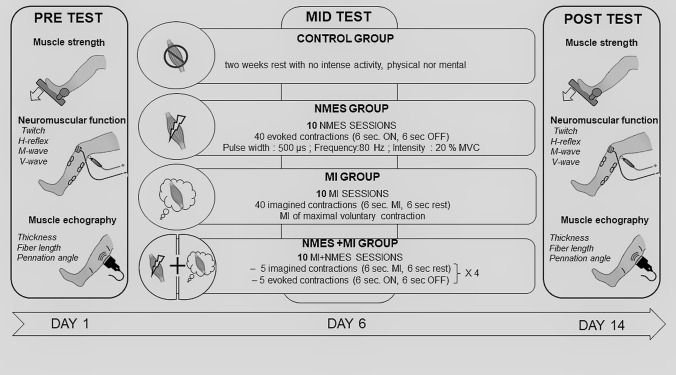
Thirty-seven participants were enrolled in a training program of ten sessions in 2 weeks targeting plantar flexor muscles, distributed in four groups: MI, NMES, NMES + MI and control. Each group underwent forty contractions in each session, NMES + MI group doing 20 contractions of each modality. Before and after, the neuromuscular function was tested through the recording of maximal voluntary contraction (MVC), but also electrophysiological and mechanical responses associated with electrical nerve stimulation. Muscle architecture was assessed by ultrasonography.
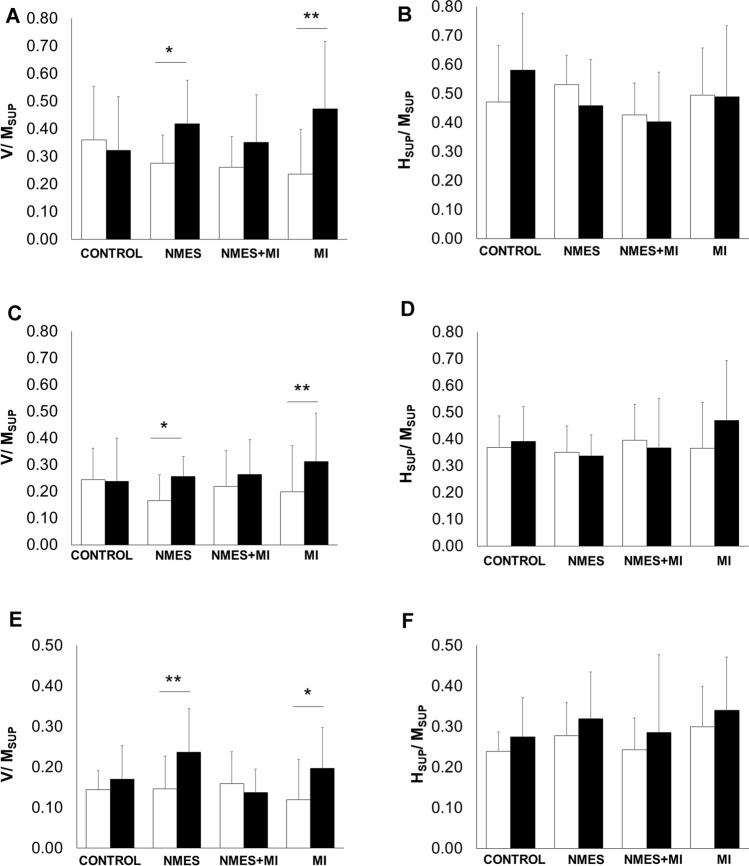
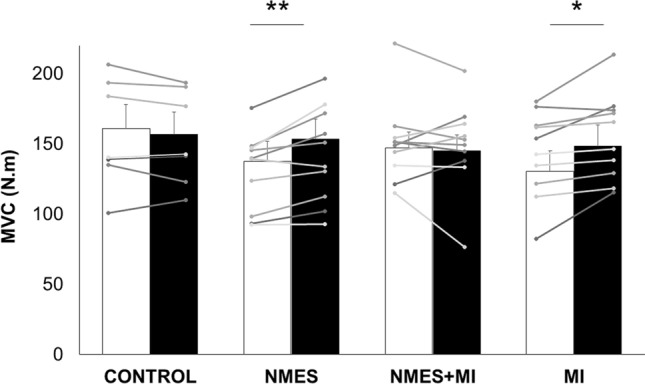
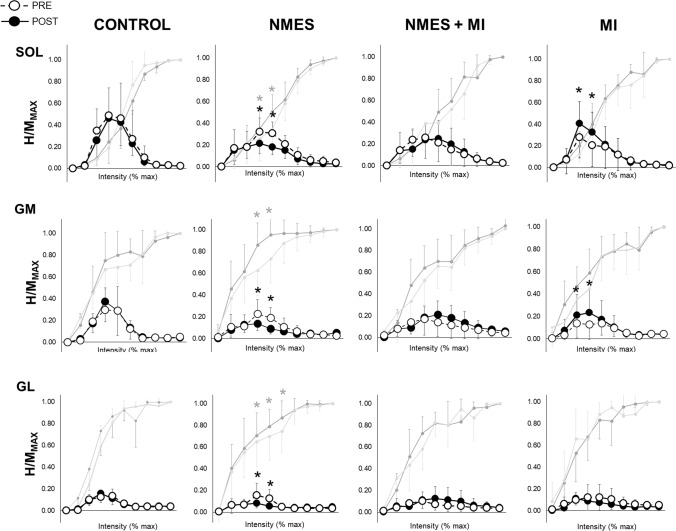
MVC increased by 11.3 ± 3.5% in NMES group, by 13.8 ± 5.6% in MI, while unchanged for NMES + MI and control. During MVC, a significant increase in V-wave without associated changes in superimposed H-reflex has been observed for NMES and MI, suggesting that neural adaptations occurred at supraspinal level. Rest spinal excitability was increased in the MI group while decreased in the NMES group. No change in muscle architecture (pennation angle, fascicle length) has been found in any group but muscular peak twitch and soleus maximal M-wave increased in the NMES group only.
Finally, MI and NMES seem to be efficient stimuli to improve strength, although both exhibited different and specific neural plasticity. On its side, NMES + MI combination did not provide the expected gains, suggesting that their effects are not simply cumulative, or even are competitive.
部分激活神经肌肉系统的训练刺激,如运动想象(MI)或神经肌肉电刺激(NMES),已被证明是诱导力量增加的有效工具。这里比较了 MI、NMES 或 NMES+MI 训练的效果。
37 名参与者参加了一项为期 2 周、10 次的针对足底屈肌的训练计划,分为 4 组:MI、NMES、NMES+MI 和对照组。每组在每次训练中进行 40 次收缩,NMES+MI 组进行 20 次每种模式的收缩。在训练前后,通过记录最大自主收缩(MVC)来测试神经肌肉功能,同时还记录与电神经刺激相关的电生理和机械反应。肌肉结构通过超声评估。
NMES 组的 MVC 增加了 11.3±3.5%,MI 组增加了 13.8±5.6%,而 NMES+MI 组和对照组则没有变化。在 MVC 期间,NMES 和 MI 组观察到 V 波显著增加,而叠加的 H 反射没有变化,表明在脊髓上水平发生了神经适应。MI 组的静息脊髓兴奋性增加,而 NMES 组则降低。除 NMES 组外,各组的肌肉结构(羽状角、肌束长度)均无变化,但 NMES 组的肌肉峰值 twitch 和比目鱼肌最大 M 波增加。
最后,MI 和 NMES 似乎是有效刺激,可以提高力量,尽管它们表现出不同和特定的神经可塑性。另一方面,NMES+MI 组合并没有提供预期的收益,这表明它们的效果不是简单的累加,甚至是相互竞争的。