Department of Pharmacological and Biomolecular Sciences, University of Milan, Milan, Italy.
Department of Pharmacological and Biomolecular Sciences, University of Milan, Milan, Italy.
Neoplasia. 2021 Feb;23(2):234-245. doi: 10.1016/j.neo.2020.12.009. Epub 2021 Jan 6.
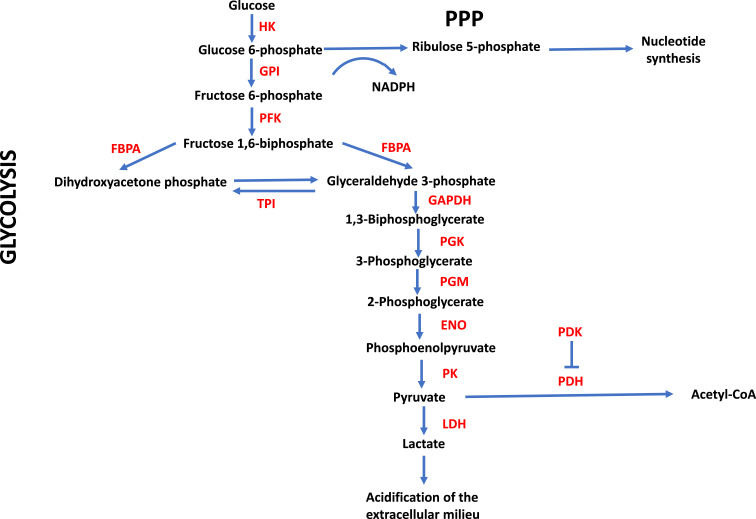
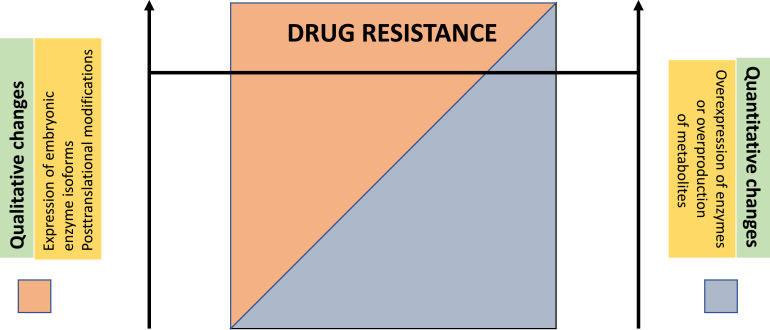
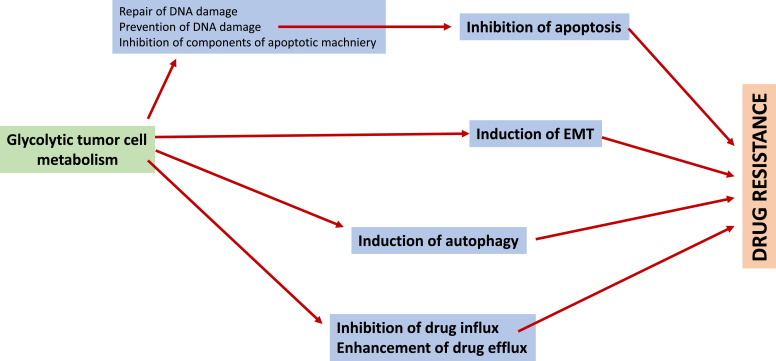
Tumor cells often switch from mitochondrial oxidative metabolism to glycolytic metabolism even under aerobic conditions. Tumor cell glycolysis is accompanied by several nonenzymatic activities among which induction of drug resistance has important therapeutic implications. In this article, we review the main aspects of glycolysis-induced drug resistance. We discuss the classes of antitumor drugs that are affected and the components of the glycolytic pathway (transporters, enzymes, metabolites) that are involved in the induction of drug resistance. Glycolysis-associated drug resistance occurs in response to stimuli, either cell-autonomous (e.g., oncoproteins) or deriving from the tumor microenvironment (e.g., hypoxia or pseudohypoxia, mechanical cues, etc.). Several mechanisms mediate the induction of drug resistance in response to glycolytic metabolism: inhibition of apoptosis, induction of epithelial-mesenchymal transition, induction of autophagy, inhibition of drug influx and increase of drug efflux. We suggest that drug resistance in response to glycolysis comes into play in presence of qualitative (e.g., expression of embryonic enzyme isoforms, post-translational enzyme modifications) or quantitative (e.g., overexpression of enzymes or overproduction of metabolites) alterations of glycolytic metabolism. We also discern similarities between changes occurring in tumor cells in response to stimuli inducing glycolysis-associated drug resistance and those occurring in cells of the innate immune system in response to danger signals and that have been referred to as danger-associated metabolic modifications. Eventually, we briefly address that also mitochondrial oxidative metabolism may induce drug resistance and discuss the therapeutic implications deriving from the fact that the main energy-generating metabolic pathways may be both at the origin of antitumor drug resistance.
肿瘤细胞在有氧条件下经常从线粒体氧化代谢转换为糖酵解代谢。肿瘤细胞糖酵解伴随着几种非酶活性,其中诱导耐药性具有重要的治疗意义。本文综述了糖酵解诱导耐药性的主要方面。我们讨论了受影响的抗肿瘤药物类别以及参与诱导耐药性的糖酵解途径的组成部分(转运蛋白、酶、代谢物)。糖酵解相关的耐药性是对刺激的反应,无论是细胞自主性的(例如癌蛋白)还是源自肿瘤微环境的(例如缺氧或假性缺氧、机械线索等)。几种机制介导了对糖酵解代谢的耐药性诱导:抑制细胞凋亡、诱导上皮-间充质转化、诱导自噬、抑制药物内流和增加药物外排。我们认为,对糖酵解的耐药性是由于糖酵解代谢的定性(例如胚胎酶同工酶的表达、酶的翻译后修饰)或定量(例如酶的过表达或代谢物的过度产生)改变而产生的。我们还发现,在响应诱导糖酵解相关耐药性的刺激的肿瘤细胞中发生的变化与在响应危险信号的先天免疫系统细胞中发生的变化之间存在相似性,这些变化被称为与危险相关的代谢修饰。最后,我们简要讨论了线粒体氧化代谢也可能诱导耐药性,并讨论了主要能量生成代谢途径可能既是抗肿瘤药物耐药性的起源的事实所带来的治疗意义。