Department of Anesthesia and Intensive Care Unit, Università degli Studi di Foggia, Azienda Ospedaliero Universitaria "Ospedali Riuniti di Foggia", Viale Pinto, 1, 71122, Foggia, Italy.
BMC Anesthesiol. 2021 Jan 8;21(1):9. doi: 10.1186/s12871-020-01221-5.
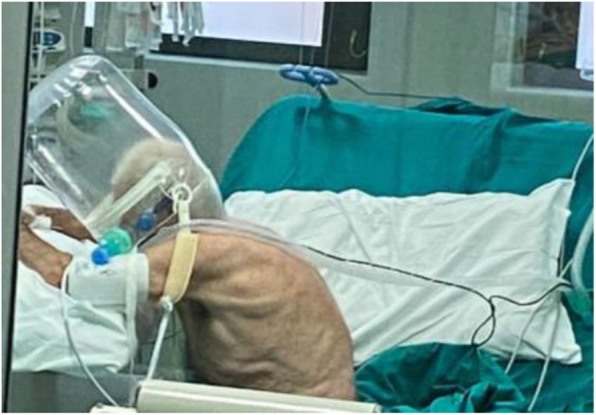
Pneumonia induced by 2019 Coronavirus (COVID-19) is characterized by hypoxemic respiratory failure that may present with a broad spectrum of clinical phenotypes. At the beginning, patients may have normal lung compliance and be responsive to noninvasive ventilatory support, such as CPAP. However, the transition to more severe respiratory failure - Severe Acute Respiratory Syndrome (SARS-CoV-2), necessitating invasive ventilation is often abrupt and characterized by a severe V/Q mismatch that require cycles of prone positioning. The aim of this case is to report the effect on gas exchange, respiratory mechanics and hemodynamics of tripod (or orthopneic sitting position) used as an alternative to prone position in a patient with mild SARS-CoV-2 pneumonia ventilated with helmet CPAP.
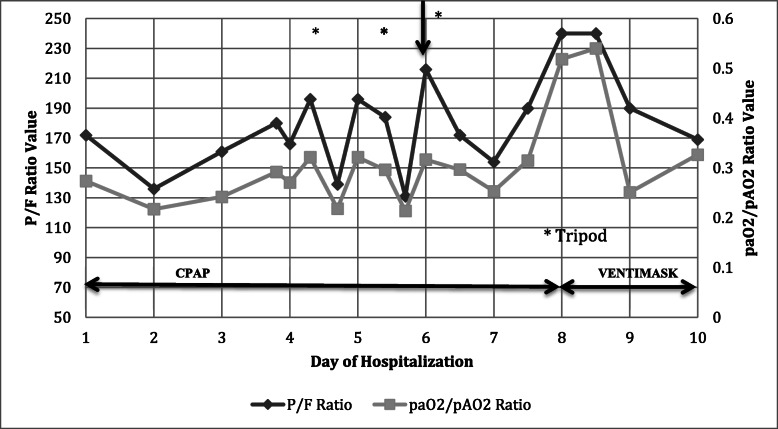
A 77-year-old awake and collaborating male patient with mild SARS-CoV-2 pneumonia and ventilated with Helmet CPAP, showed sudden worsening of gas exchange without dyspnea. After an unsuccessful attempt of prone positioning, we alternated three-hours cycles of semi-recumbent and tripod position, still keeping him in CPAP. Arterial blood gases (PaO2/FiO2, PaO2, SaO2, PaCO2 and A/a gradient), respiratory (VE, VT, RR) and hemodynamic parameters (HR, MAP) were collected in the supine and tripod position. Cycles of tripod position were continued for 3 days. The patient had a clinically important improvement in arterial blood gases and respiratory parameters, with stable hemodynamic and was successfully weaned and discharged to ward 10 days after pneumonia onset.
Tripod position during Helmet CPAP can be applied safely in patients with mild SARS-CoV-2 pneumonia, with improvement of oxygenation and V/Q matching, thus reducing the need for intubation.
由 2019 年冠状病毒(COVID-19)引起的肺炎表现为低氧性呼吸衰竭,可能呈现出广泛的临床表型。起初,患者可能具有正常的肺顺应性,并对 CPAP 等无创通气支持有反应。然而,向更严重的呼吸衰竭(严重急性呼吸综合征,SARS-CoV-2)的转变通常是突然的,其特征是严重的 V/Q 不匹配,需要反复进行俯卧位通气。本病例旨在报告在轻度 SARS-CoV-2 肺炎患者中使用三脚架(或端坐位)替代俯卧位对气体交换、呼吸力学和血流动力学的影响,该患者使用头盔 CPAP 通气。
一名 77 岁清醒且能合作的男性患者患有轻度 SARS-CoV-2 肺炎,并用头盔 CPAP 通气,在无呼吸困难的情况下突然出现气体交换恶化。在俯卧位通气尝试失败后,我们交替进行了 3 小时的半卧位和三脚架位循环,同时仍保持 CPAP 通气。收集仰卧位和三脚架位时的动脉血气(PaO2/FiO2、PaO2、SaO2、PaCO2 和 A/a 梯度)、呼吸(VE、VT、RR)和血流动力学参数(HR、MAP)。三脚架位循环持续了 3 天。患者的动脉血气和呼吸参数有临床意义的改善,血流动力学稳定,在肺炎发病 10 天后成功脱机并出院到病房。
在轻度 SARS-CoV-2 肺炎患者中,头盔 CPAP 期间使用三脚架位可以安全应用,可改善氧合和 V/Q 匹配,从而减少插管的需求。