Department of Epidemiology and Clinical Research, The Research Institute of Tuberculosis, 3-1-24, Matsuyama Kiyose, Tokyo, Japan.
BMC Infect Dis. 2021 Jan 9;21(1):42. doi: 10.1186/s12879-020-05712-1.
Screening for latent tuberculosis infection (LTBI) among migrant population has become a critical issue for many low tuberculosis (TB) burden countries. Evidence regarding effectiveness of LTBI programs are limited, however, partly because of paucity of national data on treatment outcomes for LTBI. In Japan, notification of LTBI is mandatory, and its treatment outcome is reported as part of Japan's national TB surveillance system. We thus conducted a detailed analysis of LTBI among foreign-born persons, to update the epidemiological trend of newly notified LTBI between 2007 and 2018, and to examine the treatment regimen and outcome of those notified in 2016 and 2017, focusing specifically on the potential risk factors for lost to follow-up.
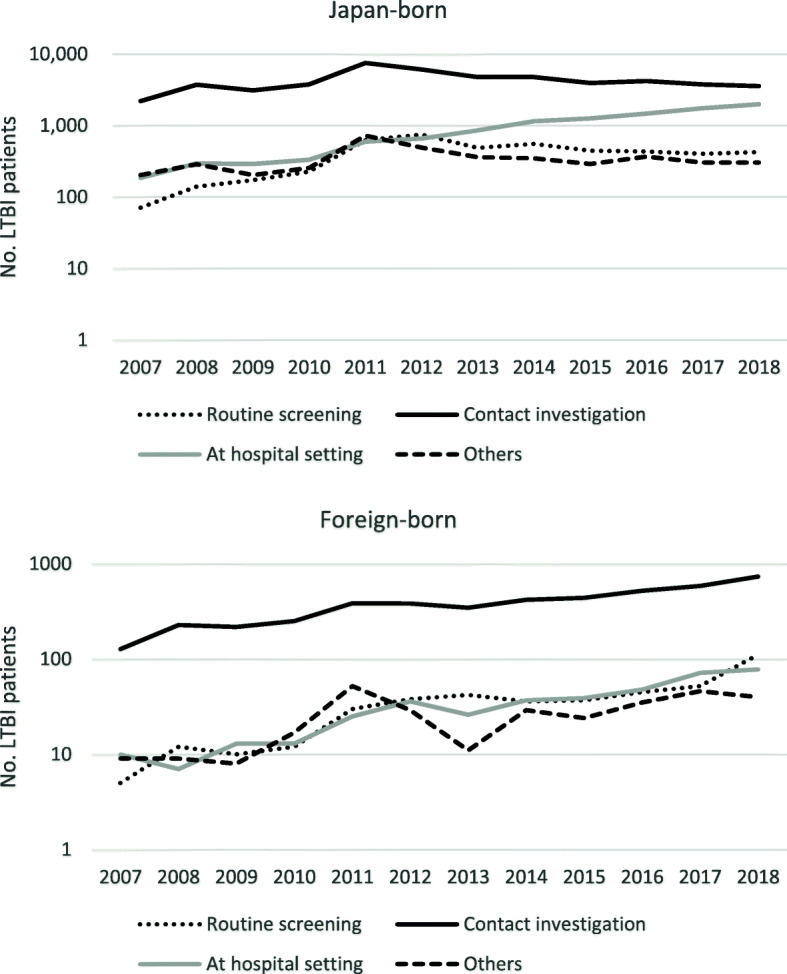
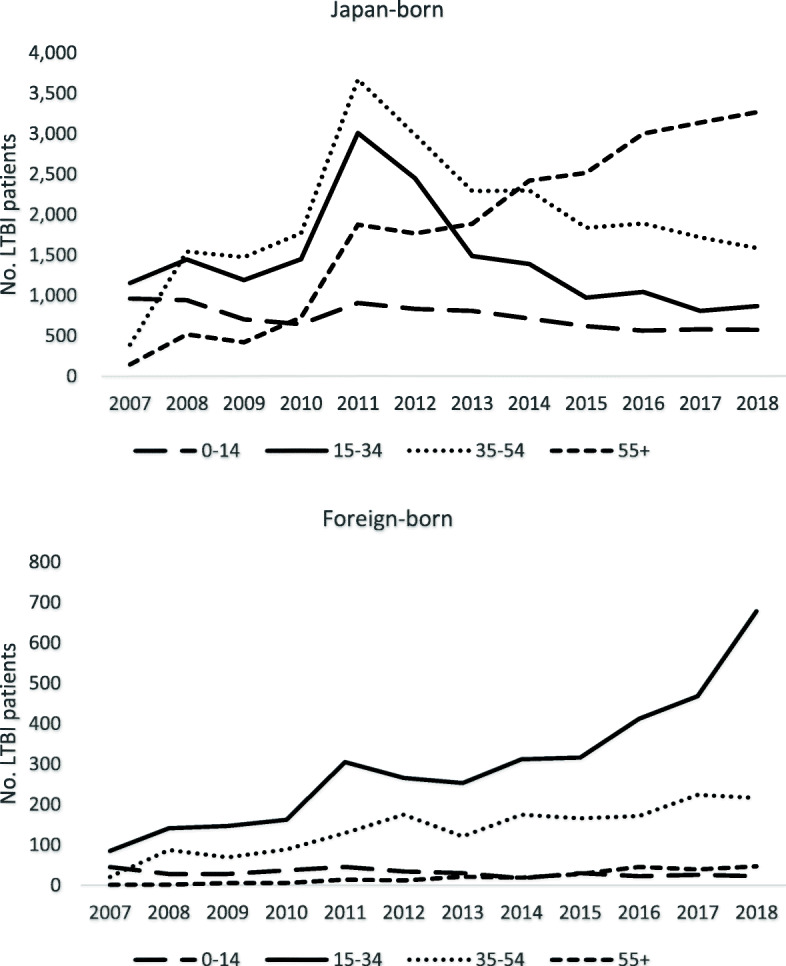
We extracted and analyzed the data of newly notified LTBI patients from the Japan Tuberculosis Surveillance System to examine the overall trend of notification and by age groups and modes of detection between 2007 and 2018, and the cohort data for treatment regimen and outcomes of foreign-born persons notified with LTBI in 2016 and 2017. Trends and proportions were summarized descriptively, and logistic regression analysis was conducted to identify potential risk factors for lost to follow-up. Comparisons were made with the Japan-born patients where appropriate, using chi-squared tests.
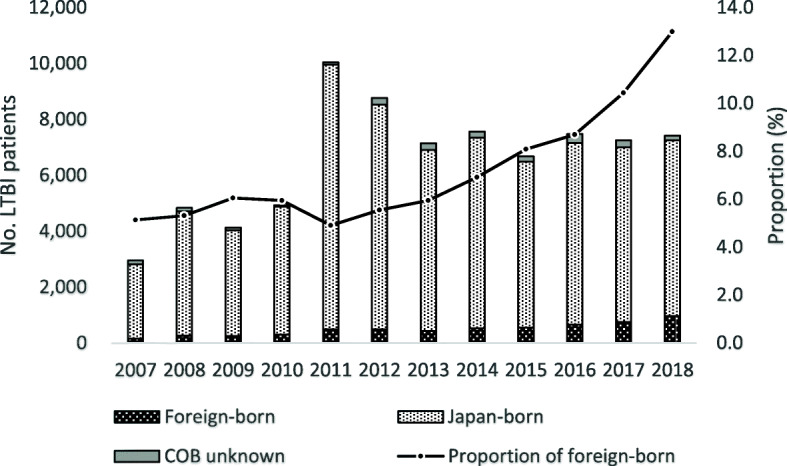
Both the number and proportion of LTBI among foreign-born persons have been constantly increasing, reaching 963 cases in 2018. Cohort analysis of the surveillance data indicated that the proportion of those on shorter regimen was higher among the foreign- than Japan-born patients (5.5% vs. 1.8%, p < 0.001). The proportion of those who have been lost to follow-up and transferred outside of Japan combined was higher among the foreign- than Japan-born patients (12.0% vs, 8.2%, p < 0.001). Risk factors for lost to follow-up were being employed on a temporal basis, and job status unknown (adjusted odds ratios 3.11 and 4.09, 95% confidence intervals 1.34-7.26 and 1.60-10.48, respectively).
Migrant population face greater risk of interrupting LTBI treatment, and interventions to improve adherence are a critical component of programmatic management of LTBI. Further studies are needed to explore the cultural and socioeconomic situation in which foreign-born persons undergo LTBI treatment in Japan.
在结核病负担较低的国家,对移民人群进行潜伏性结核病感染(LTBI)筛查已成为一个关键问题。然而,LTBI 项目的有效性证据有限,部分原因是缺乏关于 LTBI 治疗结果的国家数据。在日本,LTBI 的通报是强制性的,其治疗结果作为日本国家结核病监测系统的一部分进行报告。因此,我们对外国出生者的 LTBI 进行了详细分析,以更新 2007 年至 2018 年期间新通报的 LTBI 的流行病学趋势,并检查 2016 年和 2017 年通报的 LTBI 患者的治疗方案和结果,特别关注失访的潜在风险因素。
我们从日本结核病监测系统中提取和分析了新通报的 LTBI 患者的数据,以检查 2007 年至 2018 年期间的总体通报趋势以及按年龄组和检测方式的趋势,并对 2016 年和 2017 年通报的 LTBI 的外国出生者的治疗方案和结果进行了队列研究。趋势和比例采用描述性总结,采用逻辑回归分析确定失访的潜在风险因素。在适当的情况下,与日本出生的患者进行了卡方检验比较。
外国出生者的 LTBI 人数和比例一直在不断增加,2018 年达到 963 例。监测数据的队列分析表明,与日本出生的患者相比,较短疗程的患者比例更高(5.5%比 1.8%,p<0.001)。失访和转移到日本境外的患者比例在外国出生者中更高(12.0%比 8.2%,p<0.001)。失访的风险因素包括临时工和未知工作状态(调整后的优势比分别为 3.11 和 4.09,95%置信区间分别为 1.34-7.26 和 1.60-10.48)。
移民人群中断 LTBI 治疗的风险更高,改善依从性的干预措施是 LTBI 项目管理的重要组成部分。需要进一步研究探索在日本接受 LTBI 治疗的外国出生者的文化和社会经济状况。