Saw Swee Hock School of Public Health, National University of Singapore and National University Health System, Singapore, Singapore.
Faculty of Medicine and Health, University of Sydney, Sydney, NSW, Australia.
BMC Public Health. 2023 Feb 21;23(1):370. doi: 10.1186/s12889-023-15197-7.
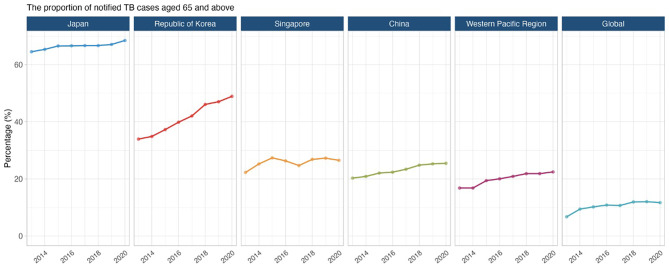
The Western Pacific Region has one of the fastest-growing populations of older adults (≥ 65 years) globally, among whom tuberculosis (TB) poses a particular concern. This study reports country case studies from China, Japan, the Republic of Korea, and Singapore reflecting on their experiences in managing TB among older adults.
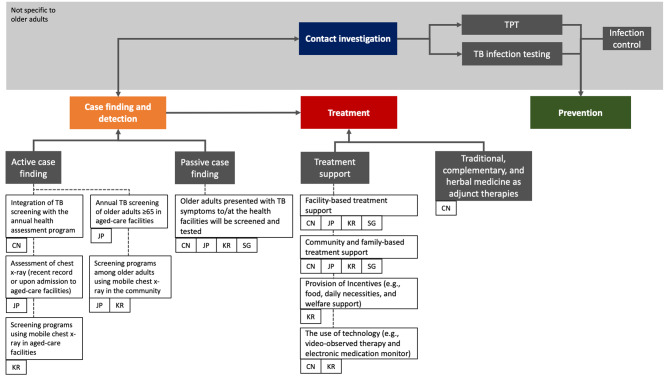
Across all four countries, TB case notification and incidence rates were highest among older adults, but clinical and public health guidance focused on this population was limited. Individual country reports illustrated a range of practices and challenges. Passive case finding remains the norm, with limited active case finding (ACF) programs implemented in China, Japan, and the Republic of Korea. Different approaches have been trialled to assist older adults in securing an early diagnosis, as well as adhering to their TB treatment. All countries emphasised the need for person-centred approaches that include the creative application of new technology and tailored incentive programs, as well as reconceptualisation of how we provide treatment support. The use of traditional medicines was found to be culturally entrenched among older adults, with a need for careful consideration of their complementary use. TB infection testing and the provision of TB preventive treatment (TPT) were underutilised with highly variable practice.
Older adults require specific consideration in TB response policies, given the burgeoning aging population and their high TB risk. Policymakers, TB programs and funders must invest in and develop locally contextualised practice guidelines to inform evidence-based TB prevention and care practices for older adults.
西太平洋区域是全球老年人口(≥65 岁)增长最快的区域之一,而结核病(TB)对该人群构成了特殊的挑战。本研究报告了来自中国、日本、韩国和新加坡的国家案例研究,反映了这些国家在管理老年结核病患者方面的经验。
在这四个国家中,TB 的病例报告和发病率在老年人中最高,但针对这一人群的临床和公共卫生指导有限。个别国家的报告说明了一系列实践和挑战。被动病例发现仍然是常态,中国、日本和韩国仅实施了有限的主动病例发现(ACF)计划。已经尝试了不同的方法来帮助老年人尽早诊断和坚持他们的 TB 治疗。所有国家都强调需要以人为本的方法,包括创造性地应用新技术和定制激励计划,以及重新思考我们提供治疗支持的方式。发现传统药物在老年人中根深蒂固,需要仔细考虑其补充使用。TB 感染检测和提供 TB 预防性治疗(TPT)的使用率较低,实践情况差异很大。
鉴于不断增长的老龄化人口和他们的高 TB 风险,老年人在 TB 应对政策中需要特别考虑。政策制定者、TB 项目和资助者必须投资并制定符合当地情况的实践指南,为老年人提供基于证据的 TB 预防和护理实践。