Division of Endocrinology and Metabolism, Chang Gung Memorial Hospital at Linkou, 5, Fusing St., Guishan Dist, 333, Taoyuan City, Taiwan.
College of Medicine, Chang Gung University, Taoyuan City, Taiwan.
BMC Fam Pract. 2021 Jan 9;22(1):16. doi: 10.1186/s12875-020-01363-y.
Diabetic foot infection (DFI) is a limb- and life-threatening complication for diabetic patients needing immediate and comprehensive treatment. Early referral of DFI patients to a diabetic foot center is recommended but there appears limited validated evidence, with the association between referral time and clinical outcomes of limb- preservation or in-hospital mortality still lacking.
This retrospective research studied consecutive type 2 diabetic patients with DFI treated at the major diabetic foot center in Taiwan from 2014 to 2017. Six hundred and sixty-eight patients presented with limb-threatening DFI. After stratifying their referral days into quartiles, the demographic information and clinical outcomes were analyzed.
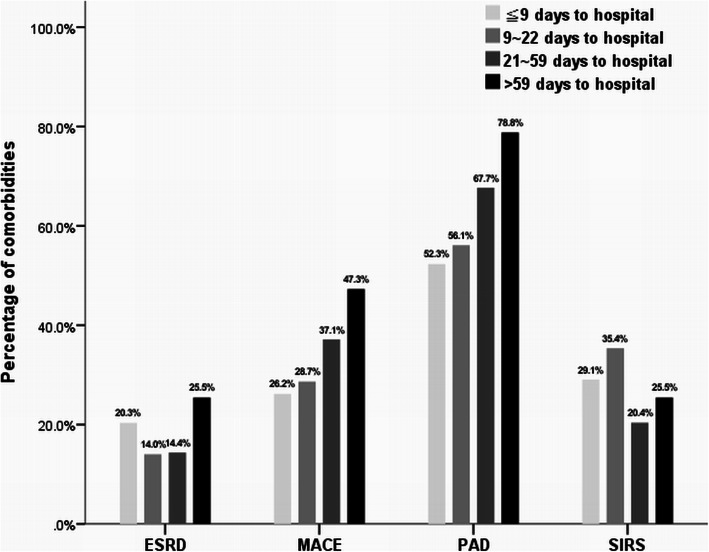
One hundred and seventy-two patients were placed in the first quartile (Q1) with less than 9 days of referral time; 164 in the second quartile (Q2) with 9-21 days; 167 in the third quartile (Q3) with 21-59 days; and 165 in the fourth quartile (Q4) with >59 days. End-stage renal disease (ESRD), major adverse cardiac events (MACE) and peripheral arterial disease (PAD) were noted as being higher in the Q4 group compared with the Q1 group (25.45% vs 20.35% in ESRD, 47.27% vs 26.16% in MACE and 78.79% vs 52.33% in PAD respectively). The Q1 group had more patients presenting with systemic inflammatory responsive syndrome (SIRS) (29.07% in Q1 vs 25.45% in Q4 respectively, P=0.019). Regarding poor outcome (major lower-extremity amputation (LEA) or in-hospital mortality), the Q4 group had 21.21% of patients in this category and the Q1 group had 10.47%. The odds ratio of each increased referral day on poor prognosis was 1.006 with 95% confidence interval 1.003-1.010 (P=<0.001). In subgroups, the impact on poor prognosis by day was most obvious in patients with SIRS (OR 1.011, 95% CI 1.004-1.018, P=0.003) and those with PAD (OR 1.004, 95% CI 1.001-1.008, P=0.028).
The deferred referral of DFI patients to the diabetic foot center might be associated with poor treatment outcome either in major LEA or mortality, particularly in patients with SIRS or PAD. Both physician and patient awareness of disease severity and overcoming the referral barrier is suggested.
Not applicable.
糖尿病足感染(DFI)是糖尿病患者肢体和生命受到威胁的并发症,需要立即进行全面治疗。建议将 DFI 患者尽早转至糖尿病足中心,但目前证据有限,DFI 患者的转诊时间与保肢或院内死亡率等临床结局之间的关系仍不明确。
本回顾性研究纳入了 2014 年至 2017 年在台湾一家主要糖尿病足中心接受治疗的 2 型糖尿病伴 DFI 的连续患者。668 例患者出现肢端威胁性 DFI。将转诊天数分为四分位距后,分析患者的人口统计学信息和临床结局。
172 例患者被归入第 1 四分位距(Q1),转诊时间<9 天;164 例归入第 2 四分位距(Q2),转诊时间 9-21 天;167 例归入第 3 四分位距(Q3),转诊时间 21-59 天;165 例归入第 4 四分位距(Q4),转诊时间>59 天。Q4 组中终末期肾病(ESRD)、主要不良心脏事件(MACE)和外周动脉疾病(PAD)的发生率高于 Q1 组(ESRD 分别为 25.45%和 20.35%,MACE 分别为 47.27%和 26.16%,PAD 分别为 78.79%和 52.33%)。Q1 组中出现全身炎症反应综合征(SIRS)的患者比例更高(29.07%比 Q4 组的 25.45%,P=0.019)。在不良结局(主要下肢截肢(LEA)或院内死亡)方面,Q4 组有 21.21%的患者属于这一类,Q1 组有 10.47%。每增加一天的转诊时间,不良预后的比值比为 1.006,95%置信区间为 1.003-1.010(P<0.001)。在亚组分析中,SIRS(OR 1.011,95%CI 1.004-1.018,P=0.003)和 PAD(OR 1.004,95%CI 1.001-1.008,P=0.028)患者的预后不良受转诊天数的影响最为明显。
DFI 患者向糖尿病足中心的延迟转诊可能与重大 LEA 或死亡率的不良治疗结局有关,特别是在出现 SIRS 或 PAD 的患者中。建议医生和患者都要认识到疾病的严重程度,并克服转诊障碍。
不适用。