Department of Renal Medicine, Eastern Health, 3128, Box Hill, Victoria, Australia.
Eastern Health Clinical School, Monash University, 3128, Box Hill, Victoria, Australia.
BMC Nephrol. 2021 Jan 10;22(1):21. doi: 10.1186/s12882-020-02219-4.
Damage to the endothelial glycocalyx is an early indicator of vascular damage and a potential marker of endothelial dysfunction. This study aimed to assess the relationship between markers of glycocalyx damage, endothelial dysfunction, and uraemic toxins in patients with chronic kidney disease.
Healthy controls, CKD patients, dialysis patients, and kidney transplant recipients had biochemical markers of glycocalyx damage (syndecan-1 and hyaluronan), endothelial dysfunction (von Willebrand factor; vWF and vascular cell adhesion molecule; VCAM-1), and uraemic toxins (indoxyl sulphate and p-cresyl sulphate) measured. In addition, Sidestream Darkfield imaging was performed using the novel GlycoCheck™ device to measure glycocalyx width by the perfused boundary region (PBR) in the sublingual microcirculation.
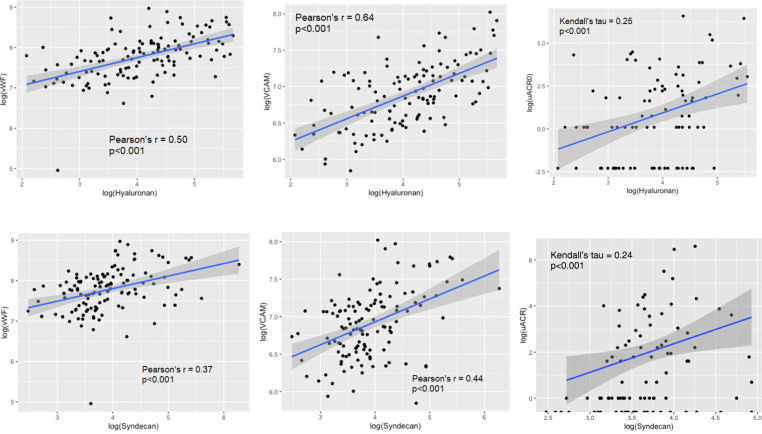
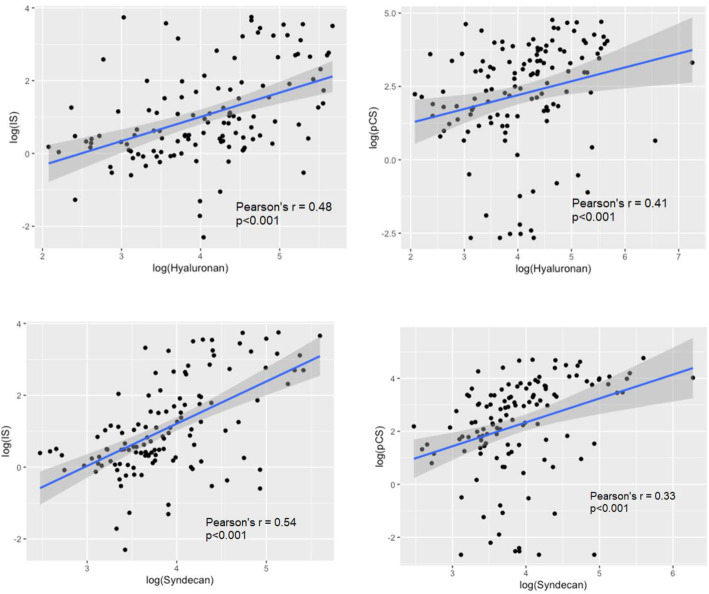
Serum markers of glycocalyx damage were highest in the dialysis group (n = 33), followed by CKD patients (n = 32) and kidney transplant recipients (n = 30) compared to controls (n = 30): hyaluronan: 137 (16-1414), 79 (11-257), 57 (14-218) and 23 (8-116) ng/mL, respectively, p < 0.0001; syndecan-1: 81 (40-529), 46 (21-134), 39 (23-72), and 30 (12-138) ng/mL, respectively, p < 0.0001. Markers of endothelial dysfunction followed a similar pattern. No difference in the width of the PBR was detected between these groups (2.01 ± 0.35, 2.07 ± 0.27, 2.06 ± 0.28, and 2.05 ± 0.3 µm, respectively, p = 0.89). Glycocalyx damage correlated with markers of endothelial dysfunction (log-hyaluronan and log-VCAM-1: r = 0.64, p < 0.001) and levels of uraemic toxins (log-hyaluronan and log-indoxyl sulphate: r = 0.48, p < 0.001).
Levels of biochemical markers of glycocalyx and endothelial cell damage are highest in patients receiving dialysis. Glycocalyx and endothelial damage markers correlated with each other, and with uraemic toxins. Although we could not demonstrate a change in PBR, the biochemical markers suggest that glycocalyx damage is most marked in patients with higher levels of uraemic toxins.
内皮糖萼损伤是血管损伤的早期指标,也是内皮功能障碍的潜在标志物。本研究旨在评估慢性肾脏病患者中糖萼损伤标志物、内皮功能障碍和尿毒症毒素之间的关系。
健康对照组、慢性肾脏病患者、透析患者和肾移植受者检测糖萼损伤的生化标志物(硫酸乙酰肝素和透明质酸)、内皮功能障碍(血管性血友病因子;vWF 和血管细胞黏附分子;VCAM-1)和尿毒症毒素(硫酸吲哚酚和对甲酚硫酸盐)。此外,使用新型 GlycoCheck™ 设备通过舌下微循环的灌注边界区域(PBR)进行侧流暗场成像,以测量糖萼宽度。
与对照组(n=30)相比,透析组(n=33)、慢性肾脏病患者(n=32)和肾移植受者(n=30)的血清糖萼损伤标志物水平最高:硫酸乙酰肝素:137(16-1414)、79(11-257)、57(14-218)和 23(8-116)ng/mL,p<0.0001;硫酸乙酰肝素:81(40-529)、46(21-134)、39(23-72)和 30(12-138)ng/mL,p<0.0001。内皮功能障碍标志物也呈现出类似的模式。这些组之间的 PBR 宽度没有差异(2.01±0.35、2.07±0.27、2.06±0.28 和 2.05±0.3 µm,p=0.89)。糖萼损伤与内皮功能障碍标志物(log-硫酸乙酰肝素和 log-VCAM-1:r=0.64,p<0.001)和尿毒症毒素水平(log-硫酸乙酰肝素和 log-吲哚酚硫酸盐:r=0.48,p<0.001)相关。
接受透析的患者的糖萼和内皮细胞损伤的生化标志物水平最高。糖萼和内皮损伤标志物相互关联,且与尿毒症毒素相关。尽管我们未能证明 PBR 发生变化,但生化标志物表明,在尿毒症毒素水平较高的患者中,糖萼损伤最为明显。