Pacheco Inês, Ferreira Rodolfo, Correia Patrícia, Carvalho Luís, Dias Teresa, Cruz Cristina
Centre for Ecology, Evolution and Environmental Changes (cE3c), Faculdade de Ciências, Universidade de Lisboa, Campo Grande, 1749-016 Lisboa, Portugal.
Soilvitae Lda., Tec Labs - Centro de Inovação Campus da Faculdade de Ciências, Universidade de Lisboa, Campo Grande, 1749-016 Lisboa, Portugal.
Saudi J Biol Sci. 2021 Jan;28(1):232-237. doi: 10.1016/j.sjbs.2020.09.053. Epub 2020 Oct 8.
The use of microbes that improve plant phosphorus (P) use efficiency is an avenue to boost crop yields while alleviating environmental impacts. We tested three microbial inoculants ( alone - designated AMF; alone - designated PSB; and and in consortium - designated AMF+PSB), combined with chemical fertilizers, in an intensive maize agricultural system.
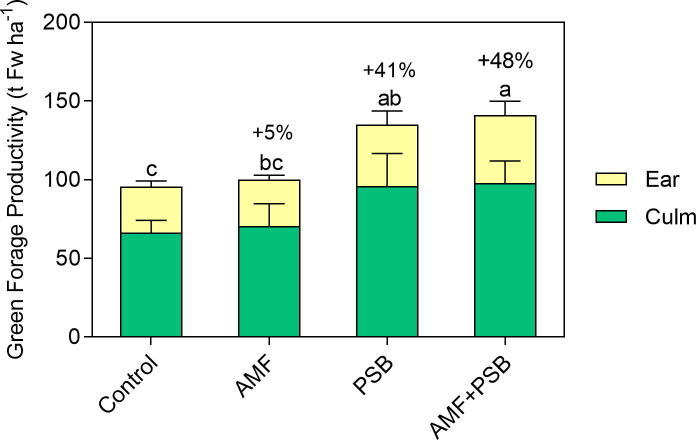
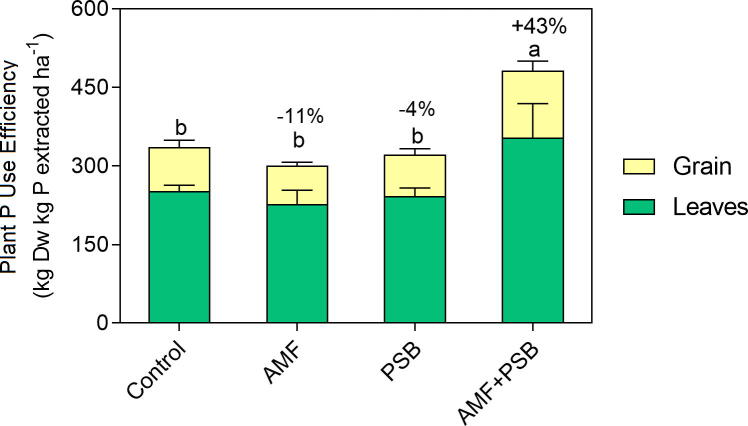
As hypothesized: (i) despite the native soil microbial community and the application of P fertilizer, the microbial inoculants enhanced plant P uptake from the soil by 14-60%, and consequently improved P acquisition efficiency; (ii) PSB and AMF+PSB plants produced ±50% more biomass per unit of P taken up, and consequently enhanced plant internal P use efficiency (i.e. the biomass produced per unit of P); and (iii) the combined inoculation of AMF and PSB provided the best results in terms of productivity and P use efficiency. Further, the microbial inoculants altered P allocation within the plant, reducing grain P concentration.
By testing the microbial inoculants under field conditions, our study clearly shows that the microbial consortium (AMF+PSB) increased maize productivity, and at the same time improved P use efficiency. Further, the use of these microbial inoculants was shown to be compatible with conventional agricultural management practices.
利用能够提高植物磷(P)利用效率的微生物是在提高作物产量的同时减轻环境影响的一条途径。我们在集约化玉米农业系统中测试了三种微生物接种剂(单独使用——指定为AMF;单独使用——指定为PSB;以及联合使用——指定为AMF+PSB),并与化肥相结合。
正如所假设的:(i)尽管存在原生土壤微生物群落且施用了磷肥,但微生物接种剂使植物从土壤中吸收的磷增加了14%至60%,从而提高了磷获取效率;(ii)PSB和AMF+PSB处理的植物每吸收单位磷产生的生物量增加了约50%,从而提高了植物内部磷利用效率(即每单位磷产生的生物量);(iii)就生产力和磷利用效率而言,AMF和PSB联合接种效果最佳。此外,微生物接种剂改变了植物体内磷的分配,降低了籽粒磷浓度。
通过在田间条件下测试微生物接种剂,我们的研究清楚地表明,微生物组合(AMF+PSB)提高了玉米生产力,同时提高了磷利用效率。此外,这些微生物接种剂的使用被证明与传统农业管理实践兼容。