Lu Zitong, Ku Yixuan
Guangdong Provincial Key Laboratory of Social Cognitive Neuroscience and Mental Health, Department of Psychology, Sun Yat-sen University, Guangzhou, China.
Peng Cheng Laboratory, Shenzhen, China.
Front Neuroinform. 2020 Dec 23;14:563669. doi: 10.3389/fninf.2020.563669. eCollection 2020.
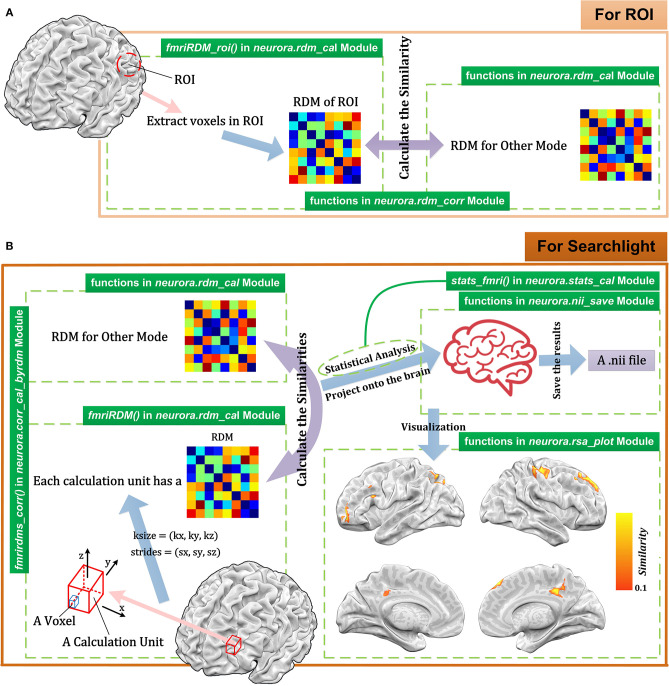
In studies of cognitive neuroscience, multivariate pattern analysis (MVPA) is widely used as it offers richer information than traditional univariate analysis. Representational similarity analysis (RSA), as one method of MVPA, has become an effective decoding method based on neural data by calculating the similarity between different representations in the brain under different conditions. Moreover, RSA is suitable for researchers to compare data from different modalities and even bridge data from different species. However, previous toolboxes have been made to fit specific datasets. Here, we develop NeuroRA, a novel and easy-to-use toolbox for representational analysis. Our toolbox aims at conducting cross-modal data analysis from multi-modal neural data (e.g., EEG, MEG, fNIRS, fMRI, and other sources of neruroelectrophysiological data), behavioral data, and computer-simulated data. Compared with previous software packages, our toolbox is more comprehensive and powerful. Using NeuroRA, users can not only calculate the representational dissimilarity matrix (RDM), which reflects the representational similarity among different task conditions and conduct a representational analysis among different RDMs to achieve a cross-modal comparison. Besides, users can calculate neural pattern similarity (NPS), spatiotemporal pattern similarity (STPS), and inter-subject correlation (ISC) with this toolbox. NeuroRA also provides users with functions performing statistical analysis, storage, and visualization of results. We introduce the structure, modules, features, and algorithms of NeuroRA in this paper, as well as examples applying the toolbox in published datasets.
在认知神经科学研究中,多变量模式分析(MVPA)被广泛使用,因为它比传统的单变量分析提供了更丰富的信息。表征相似性分析(RSA)作为MVPA的一种方法,通过计算大脑在不同条件下不同表征之间的相似性,已成为一种基于神经数据的有效解码方法。此外,RSA适合研究人员比较来自不同模态的数据,甚至连接来自不同物种的数据。然而,以前的工具箱是为特定数据集量身定制的。在这里,我们开发了NeuroRA,一个用于表征分析的新颖且易于使用的工具箱。我们的工具箱旨在对多模态神经数据(如脑电图、脑磁图、功能近红外光谱、功能磁共振成像和其他神经电生理数据来源)、行为数据和计算机模拟数据进行跨模态数据分析。与以前的软件包相比,我们的工具箱更全面、更强大。使用NeuroRA,用户不仅可以计算反映不同任务条件之间表征相似性的表征差异矩阵(RDM),并在不同的RDM之间进行表征分析以实现跨模态比较。此外,用户可以使用此工具箱计算神经模式相似性(NPS)、时空模式相似性(STPS)和受试者间相关性(ISC)。NeuroRA还为用户提供了对结果进行统计分析、存储和可视化的功能。在本文中,我们介绍了NeuroRA的结构、模块、功能和算法,以及在已发表数据集中应用该工具箱的示例。