Bicker Gerd, Stern Michael
Division of Cell Biology, Institute of Physiology and Cell Biology, University of Veterinary Medicine Hannover, Hannover, Germany.
Front Physiol. 2020 Dec 3;11:608661. doi: 10.3389/fphys.2020.608661. eCollection 2020.
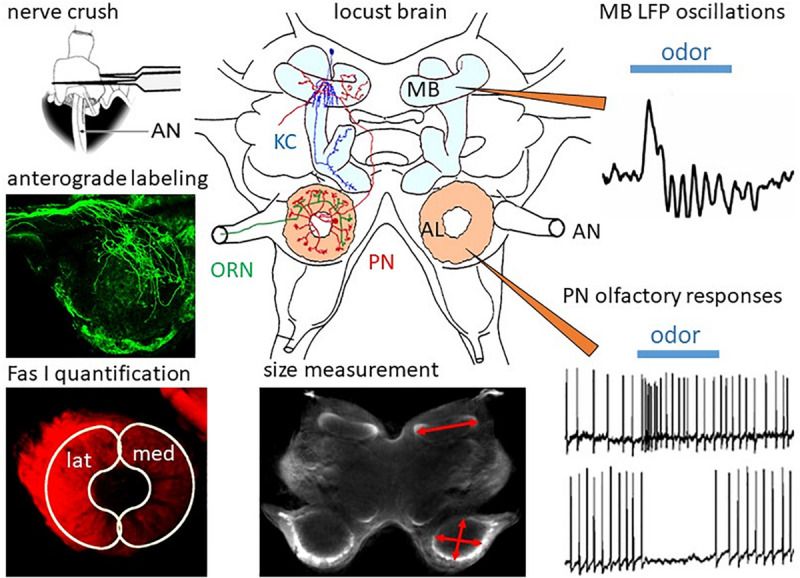
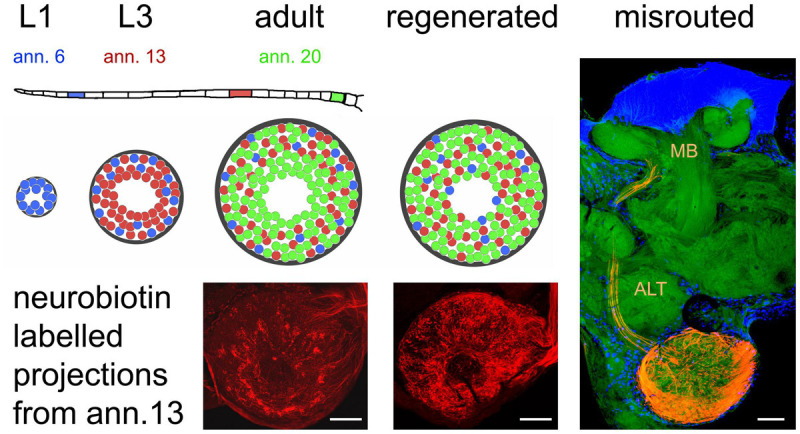
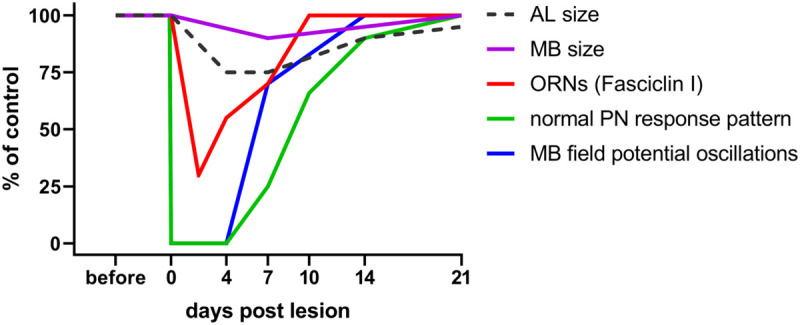
Regeneration after injury is accompanied by transient and lasting changes in the neuroarchitecture of the nervous system and, thus, a form of structural plasticity. In this review, we introduce the olfactory pathway of a particular insect as a convenient model to visualize neural regeneration at an anatomical level and study functional recovery at an electrophysiological level. The olfactory pathway of the locust () is characterized by a multiglomerular innervation of the antennal lobe by olfactory receptor neurons. These olfactory afferents were axotomized by crushing the base of the antenna. The resulting degeneration and regeneration in the antennal lobe could be quantified by size measurements, dye labeling, and immunofluorescence staining of cell surface proteins implicated in axonal guidance during development. Within 3 days post lesion, the antennal lobe volume was reduced by 30% and from then onward regained size back to normal by 2 weeks post injury. The majority of regenerating olfactory receptor axons reinnervated the glomeruli of the antennal lobe. A few regenerating axons project erroneously into the mushroom body on a pathway that is normally chosen by second-order projection neurons. Based on intracellular responses of antennal lobe output neurons to odor stimulation, regenerated fibers establish functional synapses again. Following complete absence after nerve crush, responses to odor stimuli return to control level within 10-14 days. On average, regeneration of afferents, and re-established synaptic connections appear faster in younger fifth instar nymphs than in adults. The initial degeneration of olfactory receptor axons has a trans-synaptic effect on a second order brain center, leading to a transient size reduction of the mushroom body calyx. Odor-evoked oscillating field potentials, absent after nerve crush, were restored in the calyx, indicative of regenerative processes in the network architecture. We conclude that axonal regeneration in the locust olfactory system appears to be possible, precise, and fast, opening an avenue for future mechanistic studies. As a perspective of biomedical importance, the current evidence for nitric oxide/cGMP signaling as positive regulator of axon regeneration in connectives of the ventral nerve cord is considered in light of particular regeneration studies in vertebrate central nervous systems.
损伤后的再生伴随着神经系统神经结构的短暂和持久变化,因此是一种结构可塑性的形式。在本综述中,我们介绍一种特定昆虫的嗅觉通路,作为在解剖学水平可视化神经再生并在电生理水平研究功能恢复的便捷模型。蝗虫的嗅觉通路的特征是嗅觉受体神经元对触角叶进行多小球支配。通过挤压触角基部将这些嗅觉传入神经切断。触角叶中由此产生的退化和再生可以通过大小测量、染料标记以及对发育过程中涉及轴突导向的细胞表面蛋白进行免疫荧光染色来量化。损伤后3天内,触角叶体积减少30%,此后到损伤后2周时大小恢复正常。大多数再生的嗅觉受体轴突重新支配触角叶的小球。少数再生轴突错误地投射到蘑菇体中,而该通路通常是由二级投射神经元选择的。基于触角叶输出神经元对气味刺激的细胞内反应,再生纤维再次建立功能性突触。在神经挤压后完全消失后,对气味刺激的反应在10 - 14天内恢复到对照水平。平均而言,幼龄五龄若虫的传入神经再生和重新建立的突触连接比成虫更快。嗅觉受体轴突的初始退化对二级脑中枢有跨突触作用,导致蘑菇体花萼短暂缩小。神经挤压后消失的气味诱发振荡场电位在花萼中恢复,表明网络结构中有再生过程。我们得出结论,蝗虫嗅觉系统中的轴突再生似乎是可能的、精确的和快速的,为未来的机制研究开辟了一条途径。从生物医学重要性的角度来看,根据脊椎动物中枢神经系统的特定再生研究,考虑了目前关于一氧化氮/cGMP信号作为腹神经索连接中轴突再生的正调节因子的证据。