de Assis Lage Camila Flavia, Räisänen Susanna Elizabeth, Melgar Audino, Nedelkov Krum, Chen Xianjiang, Oh Joonpyo, Fetter Molly Elizabeth, Indugu Nagaraju, Bender Joseph Samuel, Vecchiarelli Bonnie, Hennessy Meagan Leslie, Pitta Dipti, Hristov Alexander Nikolov
The Pennsylvania State University, University Park, PA, United States.
Department of Clinical Studies-New Bolton Center, School of Veterinary Medicine, University of Pennsylvania, Kennett Square, PA, United States.
Front Microbiol. 2020 Dec 23;11:618032. doi: 10.3389/fmicb.2020.618032. eCollection 2020.
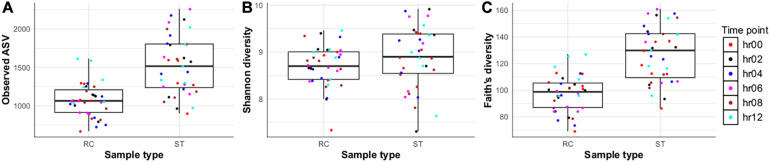
The objective of this experiment was to compare ruminal fluid samples collected through rumen cannula (RC) or using an oral stomach tube (ST) for measurement of ruminal fermentation and microbiota variables. Six ruminally cannulated lactating Holstein cows fed a standard diet were used in the study. Rumen samples were collected at 0, 2, 4, 6, 8, and 12 h after the morning feeding on two consecutive days using both RC and ST techniques. Samples were filtered through two layers of cheesecloth and the filtered ruminal fluid was used for further analysis. Compared with RC, ST samples had 7% greater pH; however, the pattern in pH change after feeding was similar between sampling methods. Total volatile fatty acids (VFA), acetate and propionate concentrations in ruminal fluid were on average 23% lower for ST compared with RC. There were no differences between RC and ST in VFA molar proportions (except for isobutyrate), ammonia and dissolved hydrogen (dH) concentrations, or total protozoa counts, and there were no interactions between sampling technique and time of sampling. Bacterial ASV richness was higher in ST compared with RC samples; however, no differences were observed for Shannon diversity. Based on Permanova analysis, bacterial community composition was influenced by sampling method and there was an interaction between sampling method and time of sampling. A core microbiota comprised of , , unclassified and unclassified , , unclassified , unclassified , , and was present in both ST and RC samples, although their relative abundance varied and was influenced by an interaction between sampling time and sampling method. Overall, our results suggest that ruminal fluid samples collected using ST (at 180 to 200 cm depth) are not representative of rumen pH, absolute values of VFA concentrations, or bacterial communities >2 h post-feeding when compared to samples of ruminal fluid collected using RC. However, ST can be a feasible sampling technique if the purpose is to study molar proportions of VFA, protozoa counts, dH, and ammonia concentrations.
本实验的目的是比较通过瘤胃瘘管(RC)或使用口腔胃管(ST)采集的瘤胃液样本,以测量瘤胃发酵和微生物群变量。本研究使用了6头装有瘤胃瘘管的泌乳荷斯坦奶牛,给它们饲喂标准日粮。在连续两天的早晨喂食后0、2、4、6、8和12小时,使用RC和ST技术采集瘤胃样本。样本通过两层粗棉布过滤,过滤后的瘤胃液用于进一步分析。与RC相比,ST样本的pH值高7%;然而,两种采样方法喂食后pH值的变化模式相似。与RC相比,ST采集的瘤胃液中总挥发性脂肪酸(VFA)、乙酸盐和丙酸盐浓度平均低23%。RC和ST在VFA摩尔比例(异丁酸除外)、氨和溶解氢(dH)浓度或原生动物总数方面没有差异,采样技术和采样时间之间也没有相互作用。与RC样本相比,ST样本中的细菌扩增子序列变体(ASV)丰富度更高;然而,香农多样性没有差异。基于置换多元方差分析(Permanova),细菌群落组成受采样方法影响,采样方法和采样时间之间存在相互作用。尽管它们的相对丰度有所不同,并受采样时间和采样方法之间相互作用影响,但ST和RC样本中均存在由未分类的、未分类的、未分类的、未分类的、和组成的核心微生物群。总体而言,我们的结果表明,与使用RC采集的瘤胃液样本相比,使用ST(在180至200 cm深度)采集的瘤胃液样本在喂食后2小时以上不能代表瘤胃pH值、VFA浓度绝对值或细菌群落。然而,如果目的是研究VFA摩尔比例、原生动物计数、dH和氨浓度,ST可能是一种可行的采样技术。