Guangdong Provincial Key Laboratory of New Drug Screening, School of Pharmaceutical Sciences, Southern Medical University, Guangzhou, China.
19th grade, Pharmacy Major, School of Pharmaceutical Sciences, Southern Medical University, Guangzhou, China.
Front Immunol. 2020 Dec 7;11:609441. doi: 10.3389/fimmu.2020.609441. eCollection 2020.
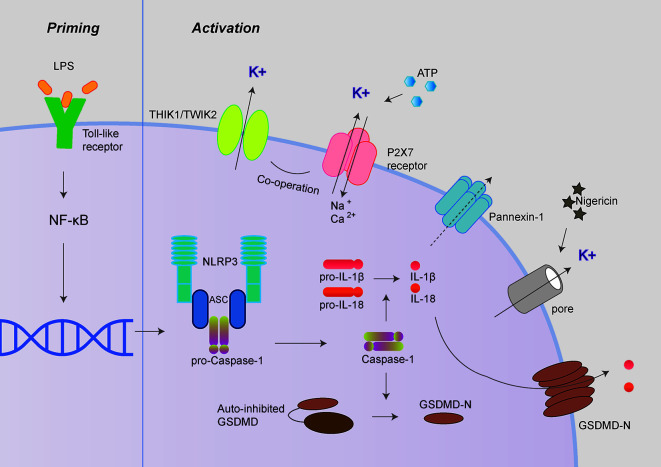
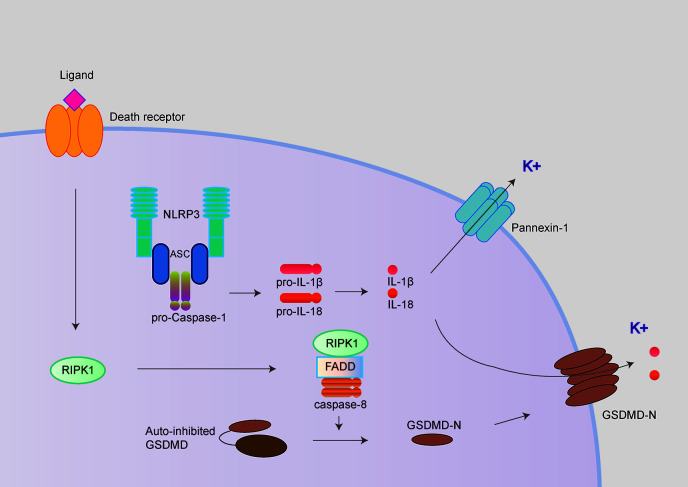
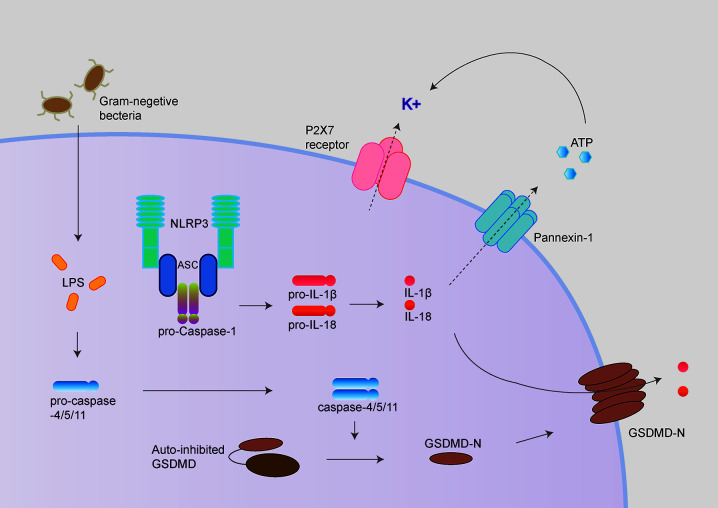
The NLRP3 inflammasome is a core component of innate immunity, and dysregulation of NLRP3 inflammasome involves developing autoimmune, metabolic, and neurodegenerative diseases. Potassium efflux has been reported to be essential for NLRP3 inflammasome activation by structurally diverse pathogen-associated molecular patterns (PAMPs) or danger-associated molecular patterns (DAMPs). Thus, the molecular mechanisms underlying potassium efflux to activate NLRP3 inflammasome are under extensive investigation. Here, we review current knowledge about the distinction channels or pore-forming proteins underlying potassium efflux for NLRP3 inflammasome activation with canonical/non-canonical signaling or following caspase-8 induced pyroptosis. Ion channels and pore-forming proteins, including P2X7 receptor, Gasdermin D, pannexin-1, and K2P channels involved present viable therapeutic targets for NLRP3 inflammasome related diseases.
NLRP3 炎性小体是先天免疫的核心组成部分,NLRP3 炎性小体的失调涉及到自身免疫、代谢和神经退行性疾病的发生。已经有报道表明,钾离子外流对于结构多样的病原体相关分子模式(PAMPs)或危险相关分子模式(DAMPs)激活 NLRP3 炎性小体是必需的。因此,钾离子外流激活 NLRP3 炎性小体的分子机制正在广泛研究中。在这里,我们综述了目前关于钾离子外流激活 NLRP3 炎性小体的通道或孔形成蛋白的知识,包括经典/非经典信号通路或 caspase-8 诱导的细胞焦亡。涉及到的离子通道和孔形成蛋白,包括 P2X7 受体、Gasdermin D、pannexin-1 和 K2P 通道,为 NLRP3 炎性小体相关疾病提供了可行的治疗靶点。