Salas Hair, Castrejon Andrés, Fuentes Dante, Luque Alexandra, Luque Edson
DDs, MSc, PhD. Facultad de Odontología de Universidad Católica de Santa María, Arequipa, Perú.
DDS. Práctica privada exclusiva a la endodoncia.
J Clin Exp Dent. 2021 Jan 1;13(1):e37-e42. doi: 10.4317/jced.57065. eCollection 2021 Jan.
Various procedures and techniques have been developed to increase the effectiveness and penetration of irrigants into the dentinal tubules and anatomical anfractuosities. Objective: The purpose of this in vitro study was to compare the effect of different irrigation techniques such as conventional irrigation with a syringe, sonic activation irrigation with EDDY and Passive Ultrasonic Irrigation. All these on dentinal tubule penetration using Chlorhexidine.
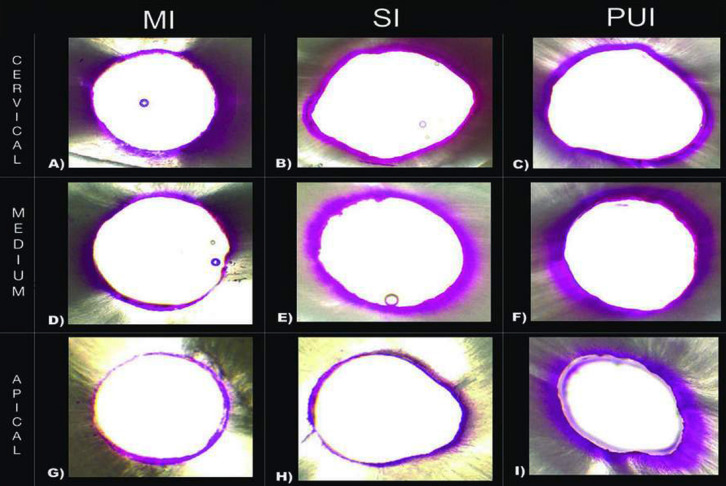
45 lower premolar teeth extracted for orthodontic reasons were used. These teeth were decoronated to a length of 18mm. This working length was achieved by inserting a size 15 K file into the root canal until it was observed in the ápex. Then the length was reduced to 1 mm. The instrumentation was performed with the Wave One Gold system up to a file # 45. Irrigated with 2mL of CHX between instruments. A final irrigation was performed using 5 mL of 17% EDTA with an E1 - Irrisonic insert for 30 seconds. Then, the root canal was irrigated with 5 mL of distilled water and dried with paper tips. The final irrigation of the 2% CHX with Rhodamine B was carried out with the different techniques of irrigation. Syringe irrigation with 5 mL, sonic irrigation and passive ultrasonic activation activated for 30 seconds in two stages. Axial cuts were made at 200 microns, the observation was done with stereomicroscope and image analysis in Image J software.
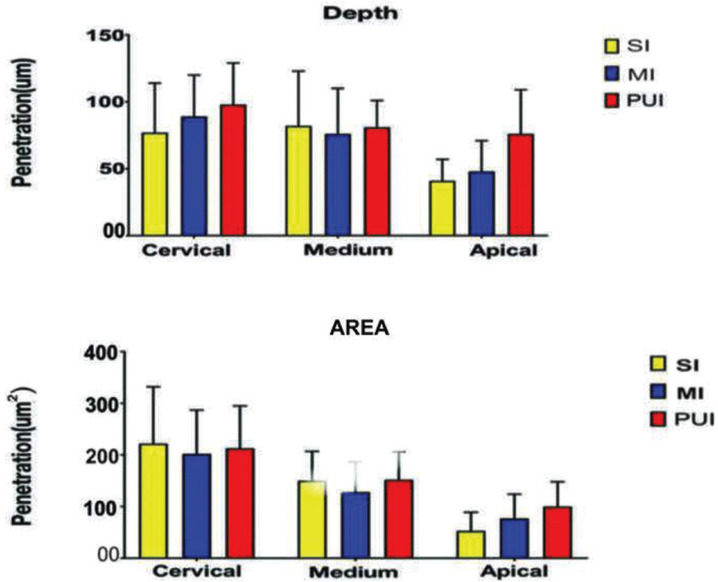
Statistically significant differences were found only in the apical region, where the depth penetration in the PUI group was 76 µm, MI 48 µm and SI 41 µm, while in the penetration area, the PUI group was 99 µm2, MI 77 µm2 and finally SI 53 µm2.
The CHX was able to penetrate the dentinal tubules of three-thirds of the roots, for which the technique that showed the greatest penetration capacity was the ultrasonic activation. Clorhexidine. Dentinal tubule. Dentinal penetration. Passive ultrasonic irrigation. Eddy. Manual irrigation.
已开发出各种程序和技术,以提高冲洗剂进入牙本质小管和解剖学不规则区域的有效性和渗透深度。目的:本体外研究的目的是比较不同冲洗技术的效果,如用注射器进行传统冲洗、用EDDY进行声波激活冲洗和被动超声冲洗。所有这些技术均使用氯己定进行牙本质小管渗透实验。
使用因正畸原因拔除的45颗下颌前磨牙。将这些牙齿冠部截短至18mm长度。通过将15号K锉插入根管直至在根尖处可见来达到此工作长度。然后将长度缩短至1mm。使用Wave One Gold系统进行根管预备至45号锉。器械之间用2mL氯己定冲洗。最后使用5mL 17%乙二胺四乙酸(EDTA)和E1 - Irrisonic冲洗头冲洗30秒。然后,用5mL蒸馏水冲洗根管并用纸尖干燥。用不同冲洗技术进行2%含罗丹明B氯己定的最终冲洗。注射器冲洗5mL,声波冲洗和被动超声激活分两个阶段激活30秒。在200微米处进行轴向切片,用体视显微镜观察并用Image J软件进行图像分析。
仅在根尖区域发现统计学上的显著差异,被动超声冲洗组的深度渗透为76μm,声波冲洗组为48μm,注射器冲洗组为41μm,而在渗透面积方面,被动超声冲洗组为99μm²,声波冲洗组为77μm²,最后注射器冲洗组为53μm²。
氯己定能够渗透到三分之二牙根的牙本质小管中,其中显示出最大渗透能力的技术是超声激活。氯己定。牙本质小管。牙本质渗透。被动超声冲洗。涡旋冲洗。手动冲洗。