Tungsawat Pakit, Arunrukthavorn Pondpun, Phuntusuntorn Phawinee, Opatragoon Suphakit, Sirirangsee Pharsiri, Inklub Surat
Department of Endodontics, College of Dental Medicine, Rangsit University, Pathum Thani, Thailand.
Int J Dent. 2021 Mar 31;2021:6612588. doi: 10.1155/2021/6612588. eCollection 2021.
This study aims to compare the effects of conventional syringe irrigation (CSI), passive ultrasonic irrigation (PUI), and innovative sonic-powered irrigation (EDDY) on the penetration of sodium hypochlorite (NaOCl) solutions into root canal dentinal tubules at different levels of the root canal.
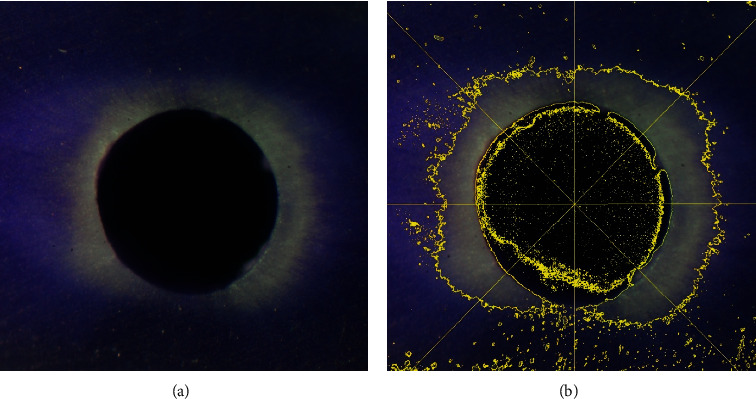
One hundred ninety-two extracted first mandibular premolars of 17- to 25-year-old patients were decoronated 13 mm from the root apices and separated into two groups according to apical preparation sizes (APS) 25 and 40. The root canals were dried with a paper point and stained in crystal violet for 72 hours. Each APS group was separated into three groups according to irrigation techniques, as follows: CSI, PUI, and EDDY. Roots were perpendicularly resected to the long axis at three levels (coronal, middle, and apical). Photomicrographs were taken of all three cross-sections of each tooth under a stereomicroscope. The depth of the bleached zone was measured with ImageJ software. The data were analyzed by Welch's analysis of variance and an independent -test ( = 0.05).
No penetration was found at the apical level in the CSI25, CSI40, and PUI25 groups. The EDDY25 and EDDY40 groups showed the most significant penetration at the middle and apical levels compared to the other groups ( < 0.05).
Within the limitations of this study, irrigation techniques and APS affect the penetration depth of NaOCl into the root canal dentinal tubules. In terms of irrigation techniques, the penetration was deepest when EDDY was used, followed by PUI and CSI. In terms of APS, NaOCl penetrated deeper into APS40 than APS25. The use of the EDDY irrigation technique in APS25 can improve the penetration of NaOCl into root canal dentinal tubules at the apical level.
本研究旨在比较传统注射器冲洗(CSI)、被动超声冲洗(PUI)和创新的声波动力冲洗(EDDY)对次氯酸钠(NaOCl)溶液在根管不同深度渗入根管牙本质小管的效果。
选取192颗17至25岁患者拔除的下颌第一前磨牙,从根尖处截冠13 mm,并根据根尖预备尺寸(APS)25和40分为两组。用纸尖干燥根管,并用结晶紫染色72小时。每个APS组根据冲洗技术分为三组,如下:CSI、PUI和EDDY。将牙根沿长轴在三个水平(冠部、中部和根尖部)垂直切除。在体视显微镜下对每颗牙齿的所有三个横截面拍摄显微照片。用ImageJ软件测量漂白区的深度。数据采用韦尔奇方差分析和独立t检验进行分析(α = 0.05)。
CSI25、CSI40和PUI25组在根尖水平未发现渗入。与其他组相比,EDDY25和EDDY40组在中部和根尖水平显示出最显著的渗入(P < 0.05)。
在本研究的局限性内,冲洗技术和APS会影响NaOCl渗入根管牙本质小管的深度。就冲洗技术而言,使用EDDY时渗入最深,其次是PUI和CSI。就APS而言,NaOCl渗入APS40比APS25更深。在APS25中使用EDDY冲洗技术可提高NaOCl在根尖水平渗入根管牙本质小管的程度。