Rangel-Zuñiga Oriol Alberto, Vals-Delgado Cristina, Alcala-Diaz Juan Francisco, Quintana-Navarro Gracia M, Krylova Yelizaveta, Leon-Acuña Ana, Luque Raul Miguel, Gomez-Delgado Francisco, Delgado-Lista Javier, Ordovas Jose Maria, Perez-Martinez Pablo, Camargo Antonio, Lopez-Miranda Jose
Lipids and Atherosclerosis Unit, Internal Medicine Unit, Reina Sofia University Hospital, 14004 Cordoba, Spain.
Department of Medicine (Medicine, Dermatology, and Otorhinolaryngology), University of Cordoba, 14004 Cordoba, Spain.
Mol Ther Nucleic Acids. 2020 Nov 11;23:255-263. doi: 10.1016/j.omtn.2020.11.001. eCollection 2021 Mar 5.
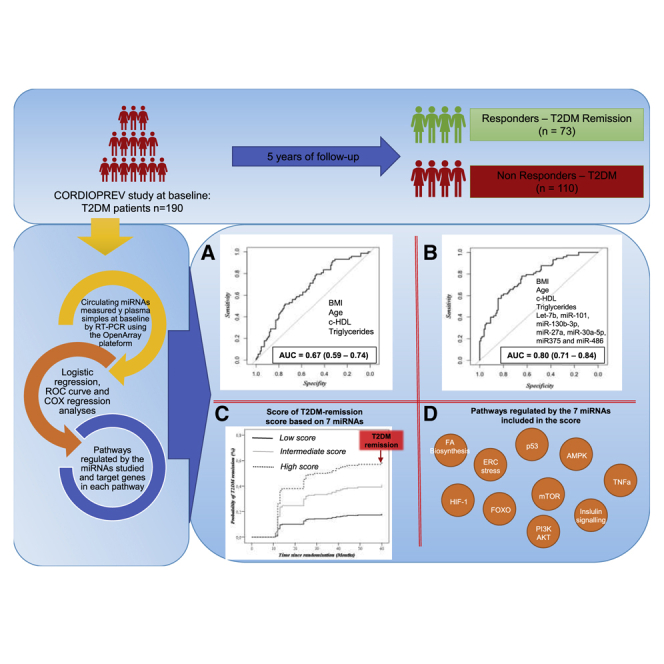
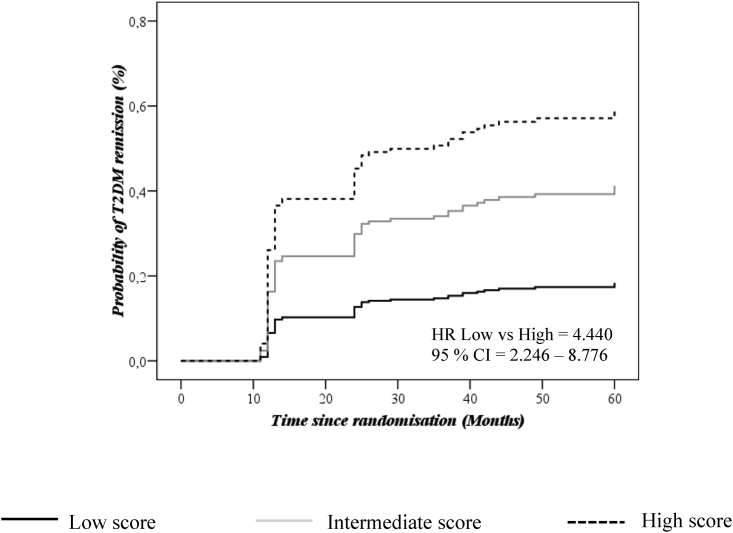
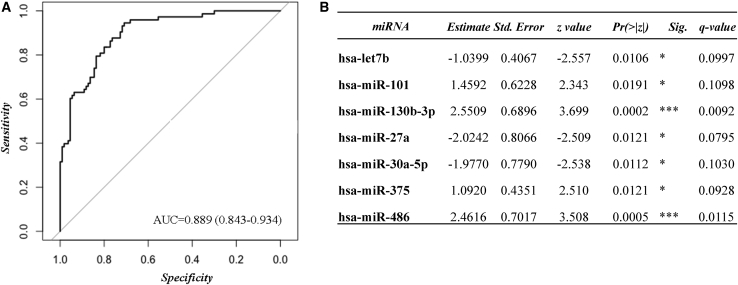
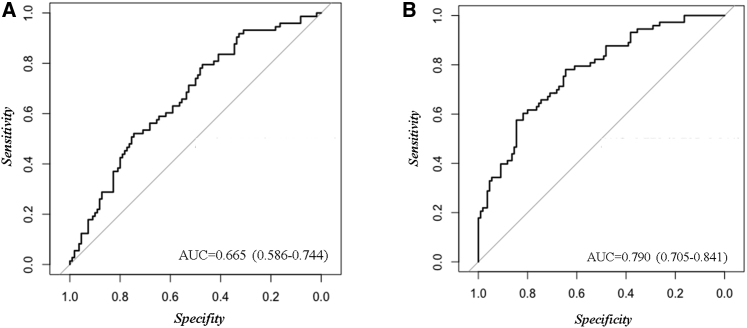
MicroRNAs (miRNAs) regulate the expression of genes associated with the development of diseases, including type 2 diabetes mellitus (T2DM). However, the use of miRNAs to predict T2DM remission has been poorly studied. Therefore, we aimed to investigate whether circulating miRNAs could be used to predict the probability of T2DM remission in patients with coronary heart disease. We included the newly diagnosed T2DM (n = 190) of the 1,002 patients from the CORDIOPREV study. Seventy-three patients reverted from T2DM after 5 years of dietary intervention with a low-fat or Mediterranean diet. Plasma levels of 56 miRNAs were measured by OpenArray. Generalized linear model, receiver operating characteristic (ROC), Cox regression, and pathway analyses were performed. ROC analysis based on clinical variables showed an area under the curve (AUC) of 0.66. After a linear regression analysis, seven miRNAs were identified as the most important variables in the group's differentiation. The addition of these miRNAs to clinical variables showed an AUC of 0.79. Cox regression analysis using a T2DM remission score including miRNAs showed that high-score patients have a higher probability of T2DM remission (hazard ratio [HR], 4.44). Finally, 26 genes involved in 10 pathways were related to the miRNAs. We have identified miRNAs (hsa-let-7b, hsa-miR-101, hsa-miR-130b-3p, hsa-miR-27a, hsa-miR-30a-5p, hsa-miR-375, and hsa-miR-486) that contribute to the prediction of T2DM remission in patients with coronary heart disease.
微小RNA(miRNA)可调节与疾病发展相关的基因表达,包括2型糖尿病(T2DM)。然而,利用miRNA预测T2DM缓解情况的研究较少。因此,我们旨在研究循环miRNA是否可用于预测冠心病患者T2DM缓解的可能性。我们纳入了CORDIOPREV研究中1002例患者中的新诊断T2DM患者(n = 190)。73例患者在接受低脂或地中海饮食的饮食干预5年后从T2DM逆转。通过OpenArray检测56种miRNA的血浆水平。进行了广义线性模型、受试者工作特征(ROC)、Cox回归和通路分析。基于临床变量的ROC分析显示曲线下面积(AUC)为0.66。经过线性回归分析,7种miRNA被确定为该组区分中的最重要变量。将这些miRNA添加到临床变量中显示AUC为0.79。使用包括miRNA的T2DM缓解评分进行的Cox回归分析表明,高分患者T2DM缓解的可能性更高(风险比[HR],4.44)。最后,10条通路中的26个基因与这些miRNA相关。我们已经鉴定出有助于预测冠心病患者T2DM缓解的miRNA(hsa-let-7b、hsa-miR-101、hsa-miR-130b-3p、hsa-miR-27a、hsa-miR-30a-5p、hsa-miR-375和hsa-miR-486)。