Katsyv Alexander, Müller Volker
Department of Molecular Microbiology & Bioenergetics, Institute of Molecular Biosciences, Johann Wolfgang Goethe University, Frankfurt am Main, Germany.
Front Bioeng Biotechnol. 2020 Dec 23;8:621166. doi: 10.3389/fbioe.2020.621166. eCollection 2020.
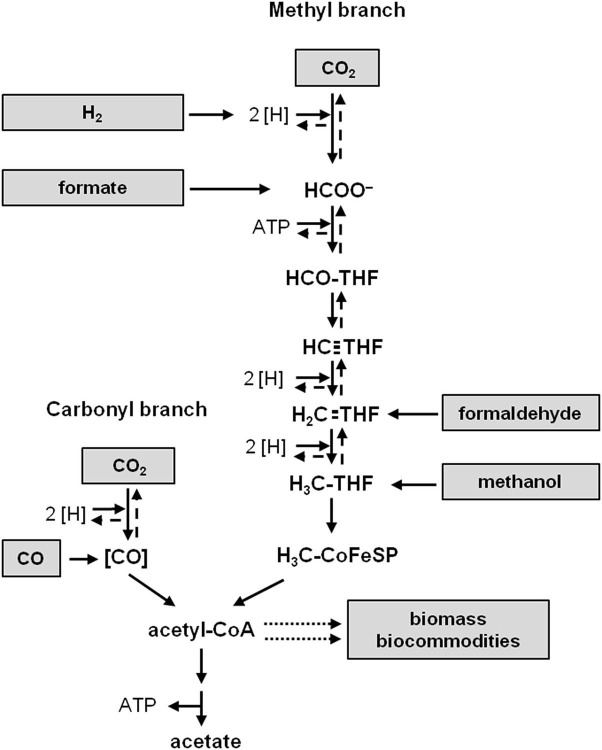
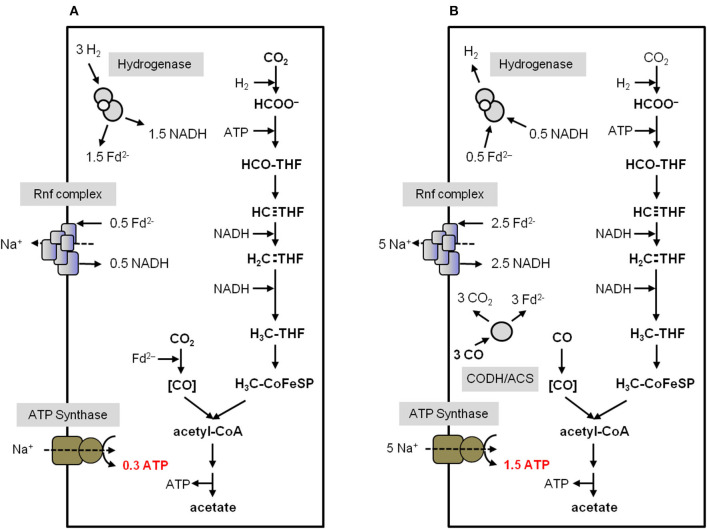
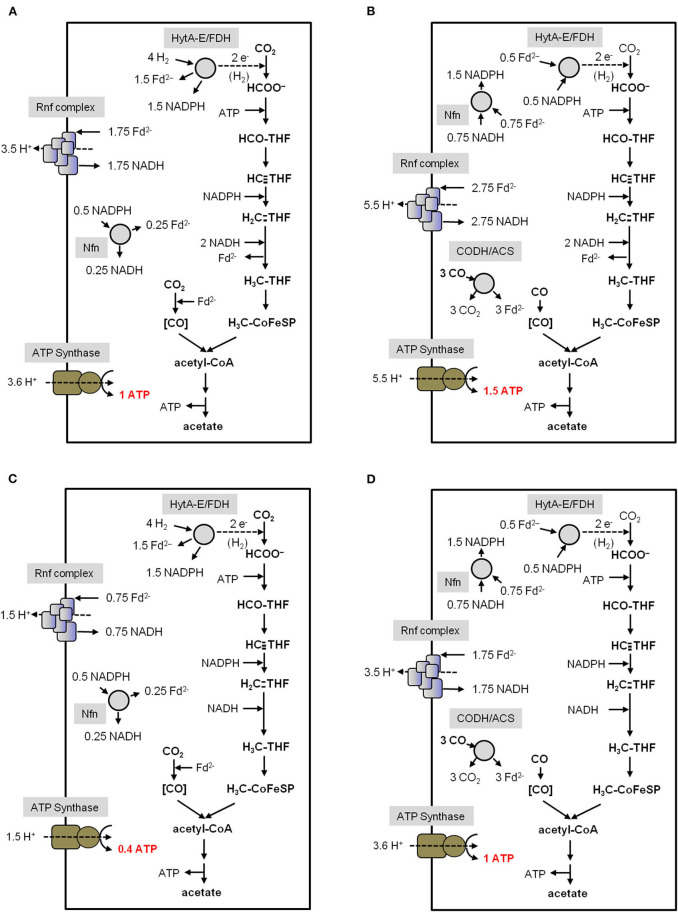
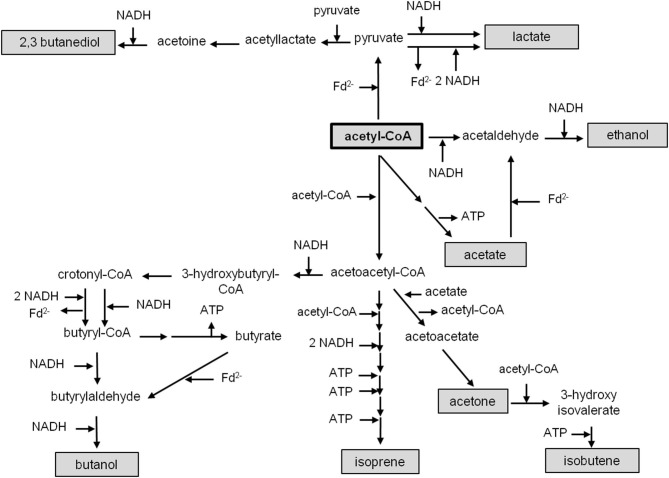
Currently one of the biggest challenges for society is to combat global warming. A solution to this global threat is the implementation of a CO-based bioeconomy and a H-based bioenergy economy. Anaerobic lithotrophic bacteria such as the acetogenic bacteria are key players in the global carbon and H cycle and thus prime candidates as driving forces in a H- and CO-bioeconomy. Naturally, they convert two molecules of CO the Wood-Ljungdahl pathway (WLP) to one molecule of acetyl-CoA which can be converted to different C2-products (acetate or ethanol) or elongated to C4 (butyrate) or C5-products (caproate). Since there is no net ATP generation from acetate formation, an electron-transport phosphorylation (ETP) module is hooked up to the WLP. ETP provides the cell with additional ATP, but the ATP gain is very low, only a fraction of an ATP per mol of acetate. Since acetogens live at the thermodynamic edge of life, metabolic engineering to obtain high-value products is currently limited by the low energy status of the cells that allows for the production of only a few compounds with rather low specificity. To set the stage for acetogens as production platforms for a wide range of bioproducts from CO, the energetic barriers have to be overcome. This review summarizes the pathway, the energetics of the pathway and describes ways to overcome energetic barriers in acetogenic C1 conversion.
当前,社会面临的最大挑战之一是应对全球变暖。解决这一全球威胁的一个办法是实施基于一氧化碳的生物经济和基于氢气的生物能源经济。厌氧自养细菌,如产乙酸细菌,是全球碳和氢循环的关键参与者,因此是氢和一氧化碳生物经济的主要驱动力候选者。自然情况下,它们通过伍德-Ljungdahl途径(WLP)将两分子一氧化碳转化为一分子乙酰辅酶A,后者可转化为不同的C2产物(乙酸或乙醇),或延长为C4(丁酸)或C5产物(己酸)。由于乙酸形成过程中没有净ATP生成,一个电子传递磷酸化(ETP)模块与WLP相连。ETP为细胞提供额外的ATP,但ATP增益非常低,每摩尔乙酸仅产生一小部分ATP。由于产乙酸菌生活在生命的热力学边缘,目前通过代谢工程获得高价值产品受到细胞低能量状态的限制,这种状态仅允许生产少数特异性较低的化合物。为了将产乙酸菌打造成为从一氧化碳生产多种生物产品的平台,必须克服能量障碍。本综述总结了该途径、途径的能量学,并描述了克服产乙酸菌C1转化中能量障碍的方法。