Schwarz Fabian M, Müller Volker
Molecular Microbiology & Bioenergetics, Institute of Molecular Biosciences, Johann Wolfgang Goethe University, Max-von-Laue-Str. 9, 60438 Frankfurt am Main, Germany.
Biotechnol Biofuels. 2020 Feb 28;13:32. doi: 10.1186/s13068-020-1670-x. eCollection 2020.
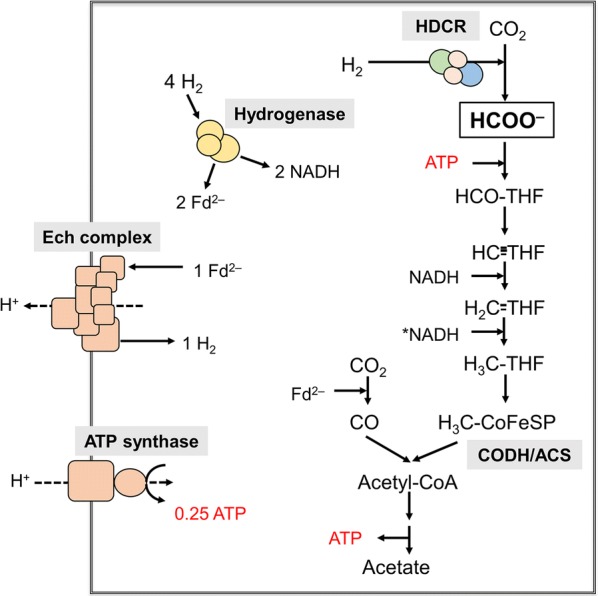
In times of global climate change, the conversion and capturing of inorganic CO have gained increased attention because of its great potential as sustainable feedstock in the production of biofuels and biochemicals. CO is not only the substrate for the production of value-added chemicals in CO-based bioprocesses, it can also be directly hydrated to formic acid, a so-called liquid organic hydrogen carrier (LOHC), by chemical and biological catalysts. Recently, a new group of enzymes were discovered in the two acetogenic bacteria and which catalyze the direct hydrogenation of CO to formic acid with exceptional high rates, the hydrogen-dependent CO reductases (HDCRs). Since these enzymes are promising biocatalysts for the capturing of CO and the storage of molecular hydrogen in form of formic acid, we designed a whole-cell approach for to take advantage of using whole cells from a thermophilic organism as H/CO storage platform. Additionally, cells were used as microbial cell factories for the production of formic acid from syngas.
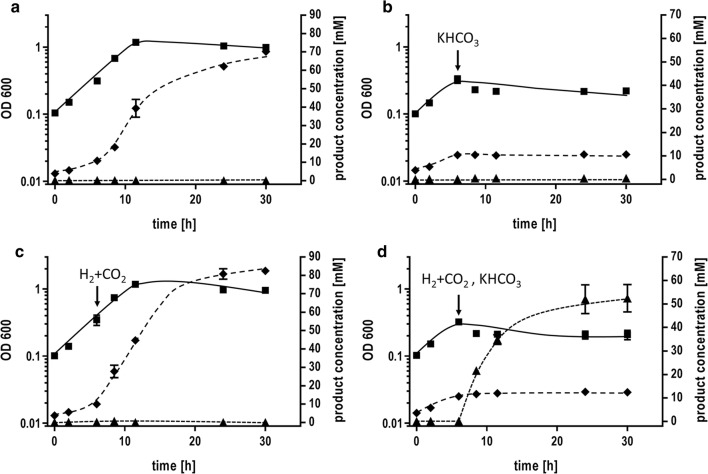
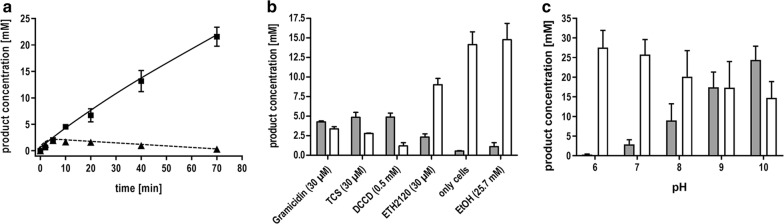
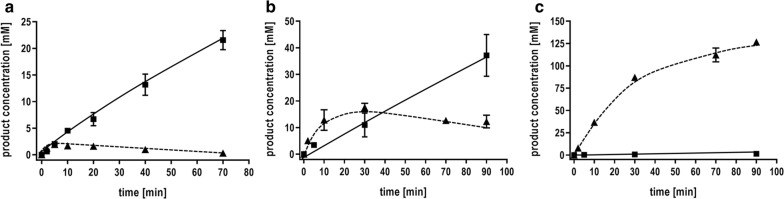
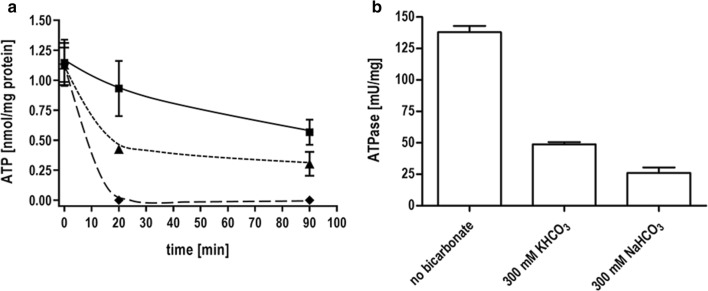
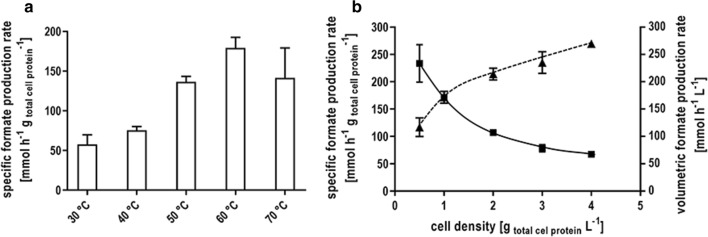
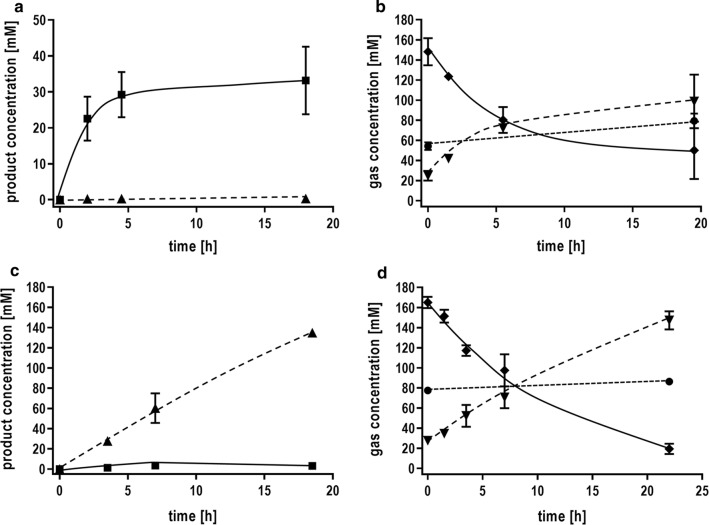
This study demonstrates the efficient whole-cell biocatalysis for the conversion of H + CO to formic acid in the presence of bicarbonate by . Interestingly, the addition of KHCO not only stimulated formate formation dramatically but it also completely abolished unwanted side product formation (acetate) under these conditions and bicarbonate was shown to inhibit the membrane-bound ATP synthase. Cell suspensions reached specific formate production rates of 234 mmol g h (152 mmol g h), the highest rates ever reported in closed-batch conditions. The volumetric formate production rate was 270 mmol L h at 4 mg mL. Additionally, this study is the first demonstration that syngas can be converted exclusively to formate using an acetogenic bacterium and high titers up to 130 mM of formate were reached.
The thermophilic acetogenic bacterium is an efficient biocatalyst which makes this organism a promising candidate for future biotechnological applications in hydrogen storage, CO capturing and syngas conversion to formate.
在全球气候变化的时代,无机CO的转化和捕获因其作为生物燃料和生物化学品生产中可持续原料的巨大潜力而受到越来越多的关注。CO不仅是基于CO的生物过程中生产增值化学品的底物,还可以通过化学和生物催化剂直接水合形成甲酸,一种所谓的液态有机氢载体(LOHC)。最近,在两种产乙酸细菌中发现了一组新的酶,它们能以极高的速率催化CO直接氢化为甲酸,即氢依赖型CO还原酶(HDCRs)。由于这些酶是捕获CO和以甲酸形式储存分子氢的有前景的生物催化剂,我们设计了一种全细胞方法,利用嗜热生物的全细胞作为H/CO储存平台。此外,[具体细菌名称]细胞被用作微生物细胞工厂,用于从合成气生产甲酸。
本研究证明了[具体细菌名称]在碳酸氢盐存在下将H + CO高效全细胞生物催化转化为甲酸。有趣的是,添加KHCO₃不仅显著刺激了甲酸盐的形成,而且在这些条件下还完全消除了不需要的副产物(乙酸盐)的形成,并且表明碳酸氢盐会抑制膜结合的ATP合酶。细胞悬浮液的甲酸盐特定生产率达到234 mmol g⁻¹ h⁻¹(152 mmol g⁻¹ h⁻¹),这是在封闭批次条件下报道的最高速率。在4 mg mL⁻¹时,甲酸盐的体积生产率为270 mmol L⁻¹ h⁻¹。此外,本研究首次证明了使用产乙酸细菌可以将合成气仅转化为甲酸盐,并且达到了高达130 mM的高甲酸盐滴度。
嗜热产乙酸细菌[具体细菌名称]是一种高效的生物催化剂,这使得该生物体成为未来在储氢、CO捕获以及合成气转化为甲酸盐方面生物技术应用的有前景的候选者。