Sills E Scott, Rickers Natalie S, Wood Samuel H
Reproductive Biology Group IVF, FertiGen CAG; San Clemente, California USA.
Department of Obstetrics and Gynecology, Palomar Medical Center; Escondido, California USA.
Int J Reprod Biomed. 2020 Dec 21;18(12):1081-1086. doi: 10.18502/ijrm.v18i12.8030. eCollection 2020 Dec.
The use of autologous platelet-rich plasma as an ovarian treatment has not been standardized and remains controversial.
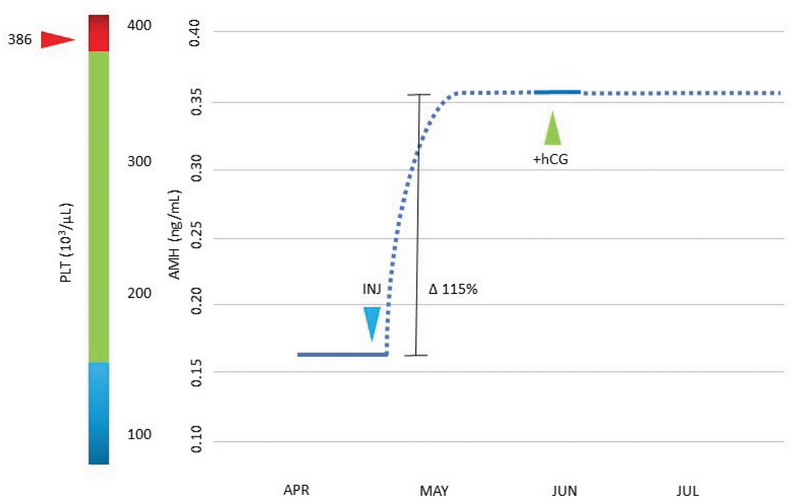
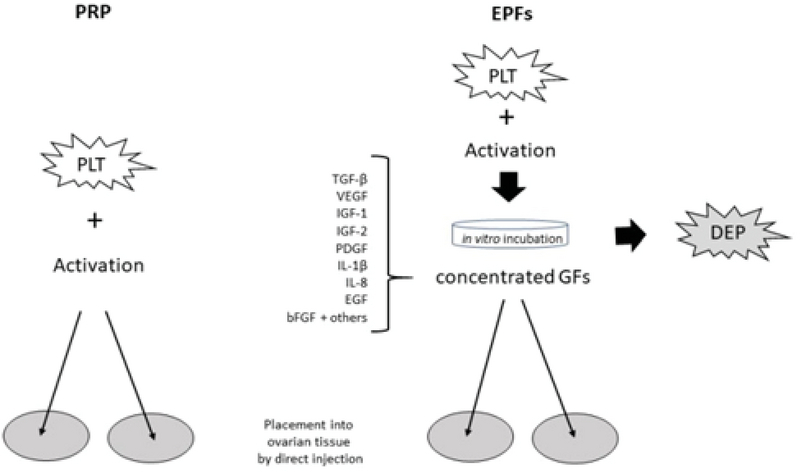
A 41½-year old woman with diminished ovarian reserve (serum anti- Müllerian hormone = 0.163 mg/mL) and a history of 10 unsuccessful in vitro fertilization cycles presented for reproductive endocrinology consult. She and her partner declined donor oocyte in vitro fertilization. They were both in good general health and laboratory tests were unremarkable, except for mild thrombocytosis (platelets = 386K; normal range 150-379K) discovered in the female. The patient underwent intraovarian injection of fresh platelet-derived growth factor concentrate administered as an enriched cell-free substrate. Serum anti- Müllerian hormone increased by 115% within 6 wks of treatment. Spontaneous ovulation occurred the month after injection and subsequently the serum human chorionic gonadotropin was noted at 804 mIU/mL. Following an uneventful obstetrical course, a male infant was delivered at term without complication.
This is the first description of intraovarian injection of enriched platelet-derived growth factors followed by unassisted pregnancy and live birth. As a refinement of conventional ovarian platelet-rich plasma therapy, this procedure may be particularly valuable for refractory cases where prognosis for pregnancy appears especially bleak. A putative role for thrombocytosis is also viewed in parallel with mechanisms of action as advanced earlier. With continued experience in ovarian application of autologous platelet growth factors, additional research will evaluate laboratory protocol/sample preparation, injection technique, and patient selection.
自体富血小板血浆作为一种卵巢治疗方法尚未标准化,仍存在争议。
一名41.5岁的女性,卵巢储备功能减退(血清抗苗勒管激素=0.163mg/mL),有10次体外受精周期失败的病史,前来生殖内分泌科咨询。她和她的伴侣拒绝接受供体卵母细胞体外受精。他们的一般健康状况良好,实验室检查无异常,只是女性患者发现有轻度血小板增多症(血小板=386K;正常范围150 - 379K)。患者接受了卵巢内注射新鲜的血小板衍生生长因子浓缩物,作为富含无细胞基质给药。治疗6周内血清抗苗勒管激素增加了115%。注射后一个月出现自发排卵,随后血清人绒毛膜促性腺激素水平达到804mIU/mL。经过顺利的产科过程,足月产下一名男婴,无并发症。
这是首次描述卵巢内注射富含血小板衍生生长因子后自然受孕并活产的病例。作为传统卵巢富血小板血浆疗法的改进,该方法对于妊娠预后似乎特别渺茫的难治性病例可能特别有价值。血小板增多症的假定作用也与之前提出的作用机制一并被考虑。随着自体血小板生长因子在卵巢应用方面经验的不断积累,更多研究将评估实验室方案/样本制备、注射技术和患者选择。