Faculty of Life Sciences, Institute of Biochemistry, Leipzig University, Brüderstrasse 34, 04103, Leipzig, Germany.
Faculty of Mathematics and Natural Sciences, Department of Chemistry, Humboldt-Universität zu Berlin, Brook-Taylor-Str. 2, 12489, Berlin, Germany.
Chembiochem. 2021 May 14;22(10):1717-1732. doi: 10.1002/cbic.202000797. Epub 2021 Feb 26.
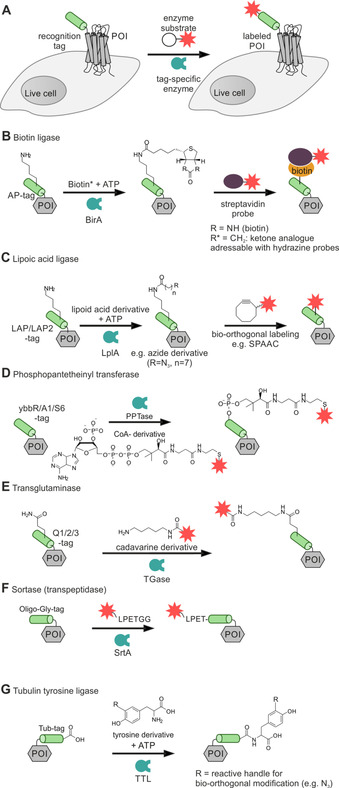
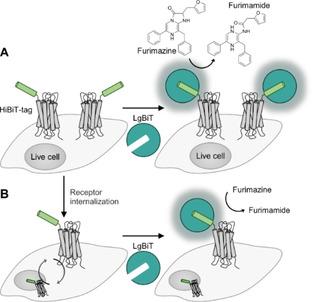
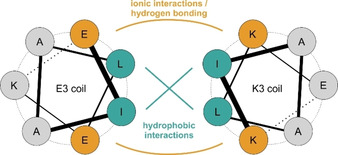
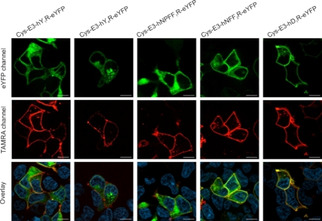
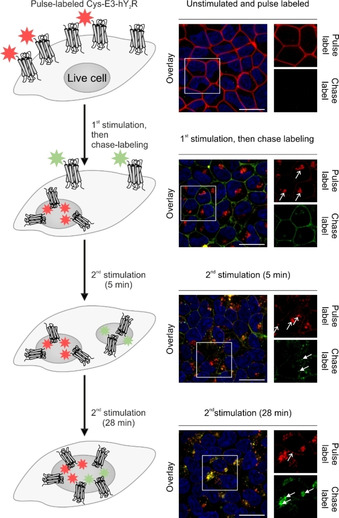
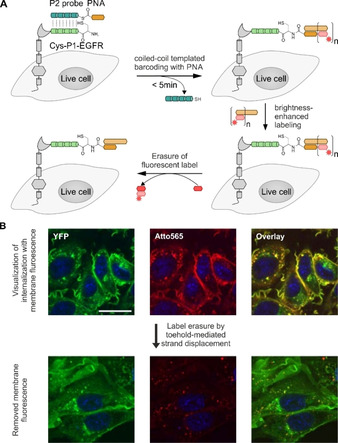
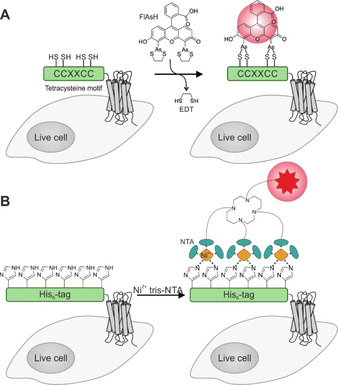
Fluorescence microscopy imaging enables receptor proteins to be investigated within their biological context. A key challenge is to site-specifically incorporate reporter moieties into proteins without interfering with biological functions or cellular networks. Small peptide tags offer the opportunity to combine inducible labeling with small tag sizes that avoid receptor perturbation. Herein, we review the current state of live-cell labeling of peptide-tagged cell-surface proteins. Considering their importance as targets in medicinal chemistry, we focus on membrane receptors such as G protein-coupled receptors (GPCRs) and receptor tyrosine kinases (RTKs). We discuss peptide tags that i) are subject to enzyme-mediated modification reactions, ii) guide the complementation of reporter proteins, iii) form coiled-coil complexes, and iv) interact with metal complexes. Given our own contributions in the field, we place emphasis on peptide-templated labeling chemistry.
荧光显微镜成像使受体蛋白能够在其生物环境中进行研究。一个关键的挑战是特异性地将报告分子掺入蛋白质中,而不干扰其生物功能或细胞网络。小肽标签提供了机会,可将诱导标记与避免受体干扰的小标签尺寸结合使用。本文综述了目前用于细胞表面蛋白肽标记的活细胞标记方法。考虑到它们作为药物化学靶标的重要性,我们重点介绍了膜受体,如 G 蛋白偶联受体(GPCRs)和受体酪氨酸激酶(RTKs)。我们讨论了 i)受酶介导的修饰反应调控的肽标签,ii)指导报告蛋白互补的肽标签,iii)形成卷曲螺旋复合物的肽标签,以及 iv)与金属复合物相互作用的肽标签。鉴于我们在该领域的贡献,我们重点介绍了基于肽模板的标记化学。