Climate Change Cluster, Faculty of Science, University of Technology Sydney, Ultimo, NSW, Australia.
Wavelength Reef Cruises, Port Douglas, QLD, Australia.
PLoS One. 2021 Jan 11;16(1):e0244961. doi: 10.1371/journal.pone.0244961. eCollection 2021.
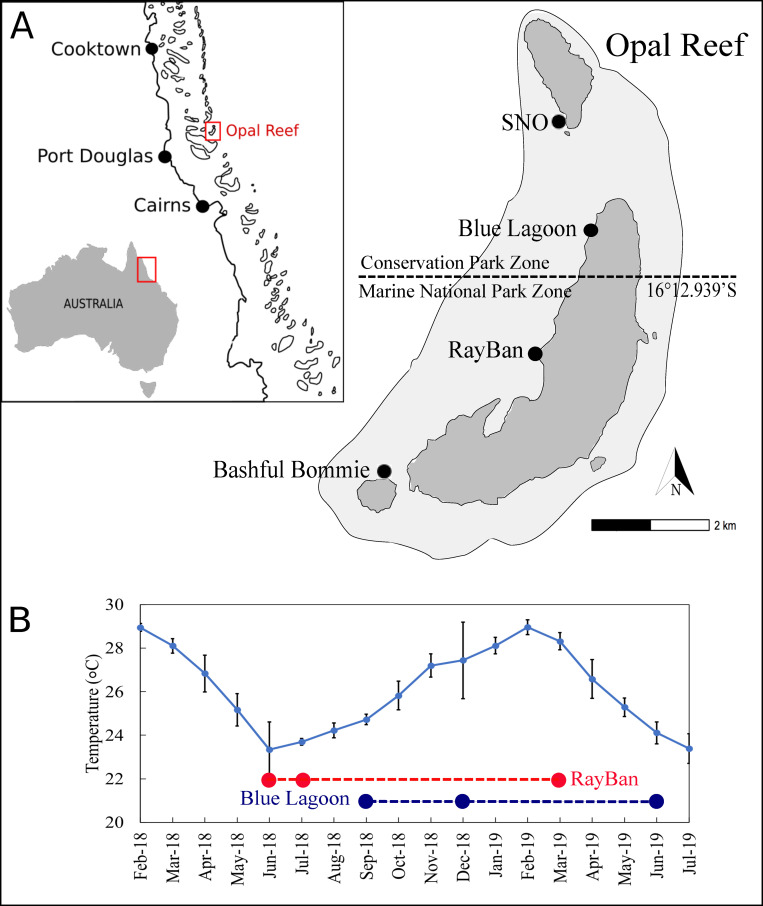
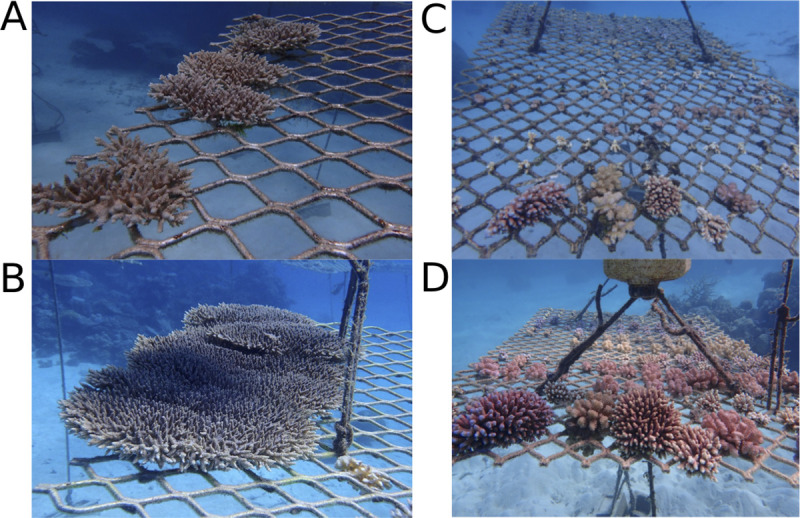
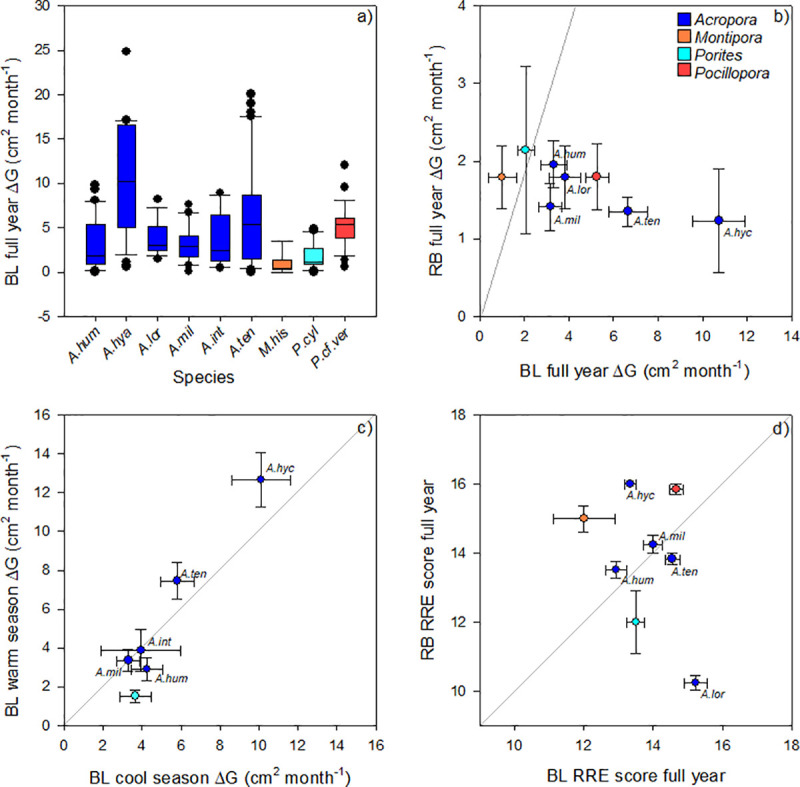
Coral reefs are deteriorating worldwide prompting reef managers and stakeholders to increasingly explore new management tools. Following back-to-back bleaching in 2016/2017, multi-taxa coral nurseries were established in 2018 for the first time on the Great Barrier Reef (GBR) to aid reef maintenance and restoration at a "high-value" location-Opal Reef-frequented by the tourism industry. Various coral species (n = 11) were propagated within shallow water (ca. 4-7m) platforms installed across two sites characterised by differing environmental exposure-one adjacent to a deep-water channel (Blue Lagoon) and one that was relatively sheltered (RayBan). Growth rates of coral fragments placed onto nurseries were highly variable across taxa but generally higher at Blue Lagoon (2.1-10.8 cm2 month-1 over 12 months) compared to RayBan (0.6-6.6 cm2 month-1 over 9 months). Growth at Blue Lagoon was largely independent of season, except for Acropora tenuis and Acropora hyacinthus, where growth rates were 15-20% higher for December 2018-July 2019 ("warm season") compared to August-December 2018 ("cool season"). Survivorship across all 2,536 nursery fragments was ca. 80-100%, with some species exhibiting higher survivorship at Blue Lagoon (Acropora loripes, Porites cylindrica) and others at RayBan (A. hyacinthus, Montipora hispida). Parallel measurements of growth and survivorship were used to determine relative return-on-effort (RRE) scores as an integrated metric of "success" accounting for life history trade-offs, complementing the mutually exclusive assessment of growth or survivorship. RRE scores within sites (across species) were largely driven by growth, whereas RRE scores between sites were largely driven by survivorship. The initial nursery phase of coral propagation therefore appears useful to supplement coral material naturally available for stewardship of frequently visited Great Barrier Reef tourism (high-value) sites, but further assessment is needed to evaluate how well the growth rates and survival for nursery grown corals translate once material is outplanted.
世界各地的珊瑚礁正在恶化,促使珊瑚礁管理者和利益相关者越来越多地探索新的管理工具。在 2016/2017 年连续两次白化之后,2018 年首次在大堡礁(GBR)建立了多生物珊瑚苗圃,以帮助在一个“高价值”的地方——欧泊礁(Opal Reef)进行珊瑚礁维护和恢复,该地点是旅游业经常光顾的地方。各种珊瑚物种(n=11)在浅海水域(约 4-7m)平台内繁殖,这些平台安装在两个具有不同环境暴露特征的地点——一个靠近深水区航道(蓝礁湖),另一个相对遮蔽(RayBan)。放置在苗圃中的珊瑚碎片的增长率在各个分类群之间差异很大,但在蓝礁湖(12 个月内 2.1-10.8cm2 月-1)普遍高于 RayBan(9 个月内 0.6-6.6cm2 月-1)。蓝礁湖的生长基本上与季节无关,但 Acropora tenuis 和 Acropora hyacinthus 的生长速度在 2018 年 12 月至 2019 年 7 月(“暖季”)比 2018 年 8 月至 12 月(“凉季”)高 15-20%。所有 2536 个苗圃碎片的存活率约为 80-100%,某些物种在蓝礁湖(Acropora loripes、Porites cylindrica)的存活率更高,而在 RayBan 的其他物种(A. hyacinthus、Montipora hispida)的存活率更高。生长和存活率的平行测量用于确定相对回报效率(RRE)评分,作为一种综合的“成功”指标,考虑到生活史权衡,补充了对生长或存活率的相互排斥的评估。(在各物种之间)各地点内的 RRE 评分主要受生长驱动,而各地点之间的 RRE 评分主要受存活率驱动。因此,珊瑚繁殖的初始苗圃阶段似乎有助于补充经常光顾的大堡礁旅游(高价值)地点自然可用的珊瑚材料的管理,但需要进一步评估,以评估一旦材料被移植,苗圃中生长的珊瑚的增长率和存活率的翻译效果。