Department of Ophthalmology, Pusan National University School of Medicine, Yangsan, South Korea.
Department of Ophthalmology, Research Institute for Convergence of Biomedical Science and Technology, Pusan National University Yangsan Hospital, Yangsan, South Korea.
PLoS One. 2021 Jan 11;16(1):e0245329. doi: 10.1371/journal.pone.0245329. eCollection 2021.
To quantitatively evaluate the effects of 0.05% cyclosporine A (CsA) on lipid layer thickness (LLT) and meibomian glands after cataract surgery using the LipiView® ocular surface interferometer.
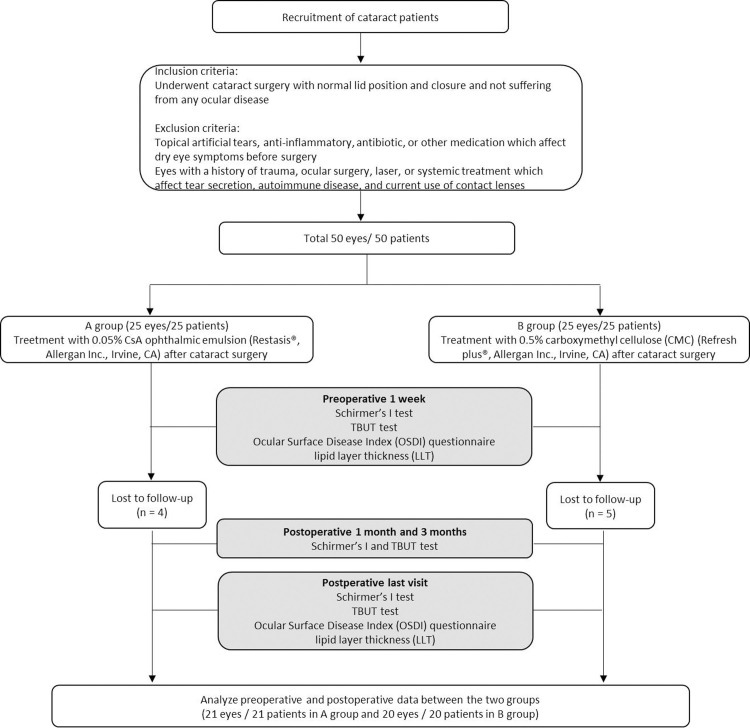
This study was a prospective randomized double-masked clinical trial conducted by Pusan National University Yangsan Hospital between April 04, 2019, and November 31, 2019. Sixty-two participants were recruited, and 12 of them were not enrolled because they had undergone previous treatments for ocular surface diseases. The participants were adult patients with cataract, exhibiting normal lid position; they did not present any other ocular disease and did not meet the exclusion criteria of the clinical trial. Fifty subjects were enrolled in the study. The randomized subjects received treatment with 0.05% CsA (group A) or 0.5% carboxymethyl cellulose (CMC) (group B) over the 3 months following the cataract surgery. Subjective and objective assessments were performed at preoperative and postoperative visits. Ocular Surface Disease Index (OSDI), tear breakup time (TBUT), and Schirmer's I test were performed by the same surgeon, and LLT and meiboscore were determined using the LipiView® interferometer.
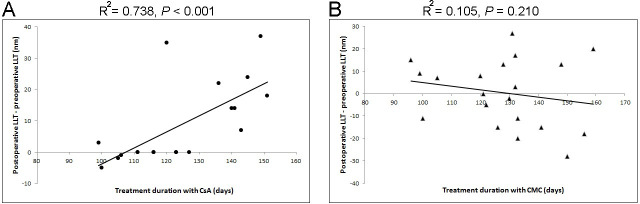
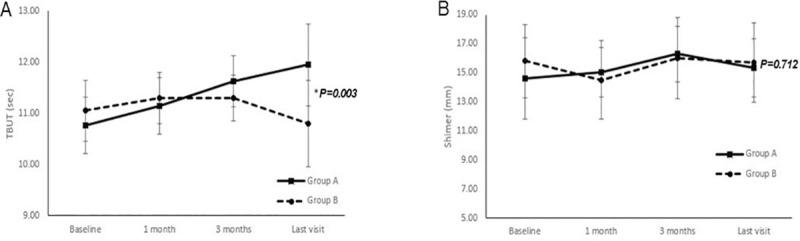
Fifty subjects subjects enrolled consisted of men (50%) and women (50%), with a mean (SD) age of 65.94 (10.35) years. Four subjects in group A and five in group B were excluded from the analysis as they were lost to follow-up within 1 month after cataract surgery. Thus, the study comprised 41 eyes of 41 subjects; 21 subjects were treated with CsA and 20 subjects with CMC. Comparing the clinical measurements between groups A and B taken at the last visit, while controlling the effects of the preoperative values, TBUT and LLT showed significant differences (p = 0.035 and p = 0.047, respectively, by ANCOVA). The TBUT between the subjects using CsA and those using CMC after cataract surgery showed a significant difference during follow up (p = 0.003 by repeated measures ANOVA). In the multivariate analysis, preoperative LLT and the use of CsA were found to be independent parameters for postoperative LLT (R2 = 0.303; p = 0.008 and p = 0.045, respectively), whereas the follow-up duration exhibited a positive correlation with the difference between the preoperative and postoperative values of LLT in the group treated with CsA (R2 = 0.738 and p < 0.001).
Treatment with 0.05% CsA following cataract surgery is effective in improving TBUT and LLT in comparison with 0.5% CMC. A higher preoperative value of LLT and the postoperative use of CsA could be significant determinants of a higher postoperative LLT value.
ISRCTN registry with ISRCTN 10173448.
使用 LipiView® 眼表面干涉仪定量评估白内障手术后 0.05%环孢素 A(CsA)对脂质层厚度(LLT)和睑板腺的影响。
本研究是 2019 年 4 月 4 日至 2019 年 11 月 31 日期间釜山大学牙山医院进行的一项前瞻性随机双盲临床试验。共招募了 62 名参与者,但其中 12 名因先前接受过眼表面疾病治疗而未被纳入。参与者为患有白内障的成年患者,表现为正常的睑位;他们没有任何其他眼部疾病,也不符合临床试验的排除标准。共有 50 名受试者入组。随机分组的受试者在白内障手术后的 3 个月内接受 0.05%CsA(A 组)或 0.5%羧甲基纤维素(CMC)(B 组)治疗。术前和术后访视时进行主观和客观评估。由同一位外科医生进行眼表面疾病指数(OSDI)、泪膜破裂时间(TBUT)和 Schirmer 试验,使用 LipiView®干涉仪确定 LLT 和睑板腺评分。
50 名入组受试者中,男性(50%)和女性(50%)各占一半,平均(SD)年龄为 65.94(10.35)岁。A 组有 4 名和 B 组有 5 名受试者在白内障手术后 1 个月内失访,因此,研究包括 41 名受试者的 41 只眼;21 名受试者接受 CsA 治疗,20 名受试者接受 CMC 治疗。比较 A 组和 B 组在最后一次随访时的临床测量值,同时控制术前值的影响,TBUT 和 LLT 显示出显著差异(p=0.035 和 p=0.047,分别通过协方差分析)。白内障手术后使用 CsA 的受试者与使用 CMC 的受试者之间的 TBUT 在随访期间存在显著差异(p=0.003,通过重复测量方差分析)。在多变量分析中,术前 LLT 和使用 CsA 被发现是术后 LLT 的独立参数(R2=0.303;p=0.008 和 p=0.045),而随访时间与使用 CsA 治疗的组中术前和术后 LLT 值之间的差异呈正相关(R2=0.738,p<0.001)。
与 0.5%CMC 相比,白内障手术后使用 0.05%CsA 治疗可有效改善 TBUT 和 LLT。较高的术前 LLT 值和术后使用 CsA 可能是术后 LLT 值较高的显著决定因素。
ISRCTN 注册,ISRCTN 63413242。