Department of Individualized Cancer Management, H. Lee Moffitt Cancer Center and Research Institute, Tampa, Florida, USA.
Department of Pharmacotherapy & Translational Research, University of Florida, Gainesville, Florida, USA.
Clin Pharmacol Ther. 2021 Jul;110(1):179-188. doi: 10.1002/cpt.2161. Epub 2021 Feb 16.
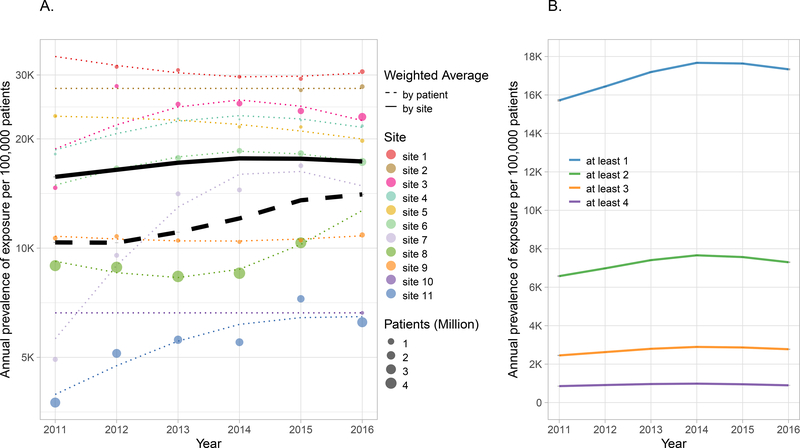
The value of utilizing a multigene pharmacogenetic panel to tailor pharmacotherapy is contingent on the prevalence of prescribed medications with an actionable pharmacogenetic association. The Clinical Pharmacogenetics Implementation Consortium (CPIC) has categorized over 35 gene-drug pairs as "level A," for which there is sufficiently strong evidence to recommend that genetic information be used to guide drug prescribing. The opportunity to use genetic information to tailor pharmacotherapy among adult patients was determined by elucidating the exposure to CPIC level A drugs among 11 Implementing Genomics In Practice Network (IGNITE)-affiliated health systems across the US. Inpatient and/or outpatient electronic-prescribing data were collected between January 1, 2011 and December 31, 2016 for patients ≥ 18 years of age who had at least one medical encounter that was eligible for drug prescribing in a calendar year. A median of ~ 7.2 million adult patients was available for assessment of drug prescribing per year. From 2011 to 2016, the annual estimated prevalence of exposure to at least one CPIC level A drug prescribed to unique patients ranged between 15,719 (95% confidence interval (CI): 15,658-15,781) in 2011 to 17,335 (CI: 17,283-17,386) in 2016 per 100,000 patients. The estimated annual exposure to at least 2 drugs was above 7,200 per 100,000 patients in most years of the study, reaching an apex of 7,660 (CI: 7,632-7,687) per 100,000 patients in 2014. An estimated 4,748 per 100,000 prescribing events were potentially eligible for a genotype-guided intervention. Results from this study show that a significant portion of adults treated at medical institutions across the United States is exposed to medications for which genetic information, if available, should be used to guide prescribing.
利用多基因药物遗传学检测来定制药物治疗的价值取决于具有可操作药物遗传学关联的处方药物的流行程度。临床药物遗传学实施联盟 (CPIC) 将超过 35 个基因-药物对归类为“A级”,这些药物有足够强有力的证据表明应该使用遗传信息来指导药物处方。通过阐明在美国 11 个实施基因组学实践网络 (IGNITE) 附属健康系统中成年人患者中使用遗传信息来定制药物治疗的机会,确定了这一机会。收集了 2011 年 1 月 1 日至 2016 年 12 月 31 日期间至少 18 岁的患者的住院和/或门诊电子处方数据,这些患者在一个日历年内至少有一次符合药物处方条件的医疗就诊。每年平均有~720 万成年患者可用于评估药物处方。从 2011 年到 2016 年,每年估计有独特患者接受至少一种 CPIC 级别的药物暴露的流行率在 2011 年为 15719(95%置信区间(CI):15658-15781),在 2016 年为 17335(CI:17283-17386)/100000 名患者。在研究的大多数年份中,每年估计至少有 2 种药物的暴露率超过 7200/100000 名患者,在 2014 年达到顶峰,为 7660(CI:7632-7687)/100000 名患者。估计每 100000 个处方事件中就有 4748 个可能需要基因型指导干预。这项研究的结果表明,在美国医疗机构接受治疗的成年人中,有相当一部分人接触到了药物,如果有遗传信息,应该用于指导处方。