Division of Hospital Medicine, Cincinnati Children's Hospital Medical Center, Cincinnati, Ohio.
Division of Translational and Clinical Pharmacology, Cincinnati Children's Hospital Medical Center, Cincinnati, Ohio.
JAMA Netw Open. 2024 Feb 5;7(2):e2355707. doi: 10.1001/jamanetworkopen.2023.55707.
There are an increasing number of medications with a high level of evidence for pharmacogenetic-guided dosing (PGx drugs). Knowledge of the prevalence of dispensings of PGx drugs and their associated genes may allow hospitals and clinical laboratories to determine which pharmacogenetic tests to implement.
To investigate the prevalence of outpatient dispensings of PGx drugs among Medicaid-insured youths, determine genes most frequently associated with PGx drug dispenses, and describe characteristics of youths who were dispensed at least 1 PGx drug.
DESIGN, SETTING, AND PARTICIPANTS: This serial cross-sectional study includes data from 2011 to 2019 among youths aged 0 to 17 years in the Marketscan Medicaid database. Data were analyzed from August to December 2022.
PGx drugs were defined as any medication with level A evidence as determined by the Clinical Pharmacogenetics Implementation Consortium (CPIC). The number of unique youths dispensed each PGx drug in each year was determined. PGx drugs were grouped by their associated genes for which there was CPIC level A evidence to guide dosing, and a dispensing rate (No. of PGx drugs/100 000 youths) was determined for each group for the year 2019. Demographics were compared between youths dispensed at least 1 PGx drug and those not dispensed any PGx drugs.
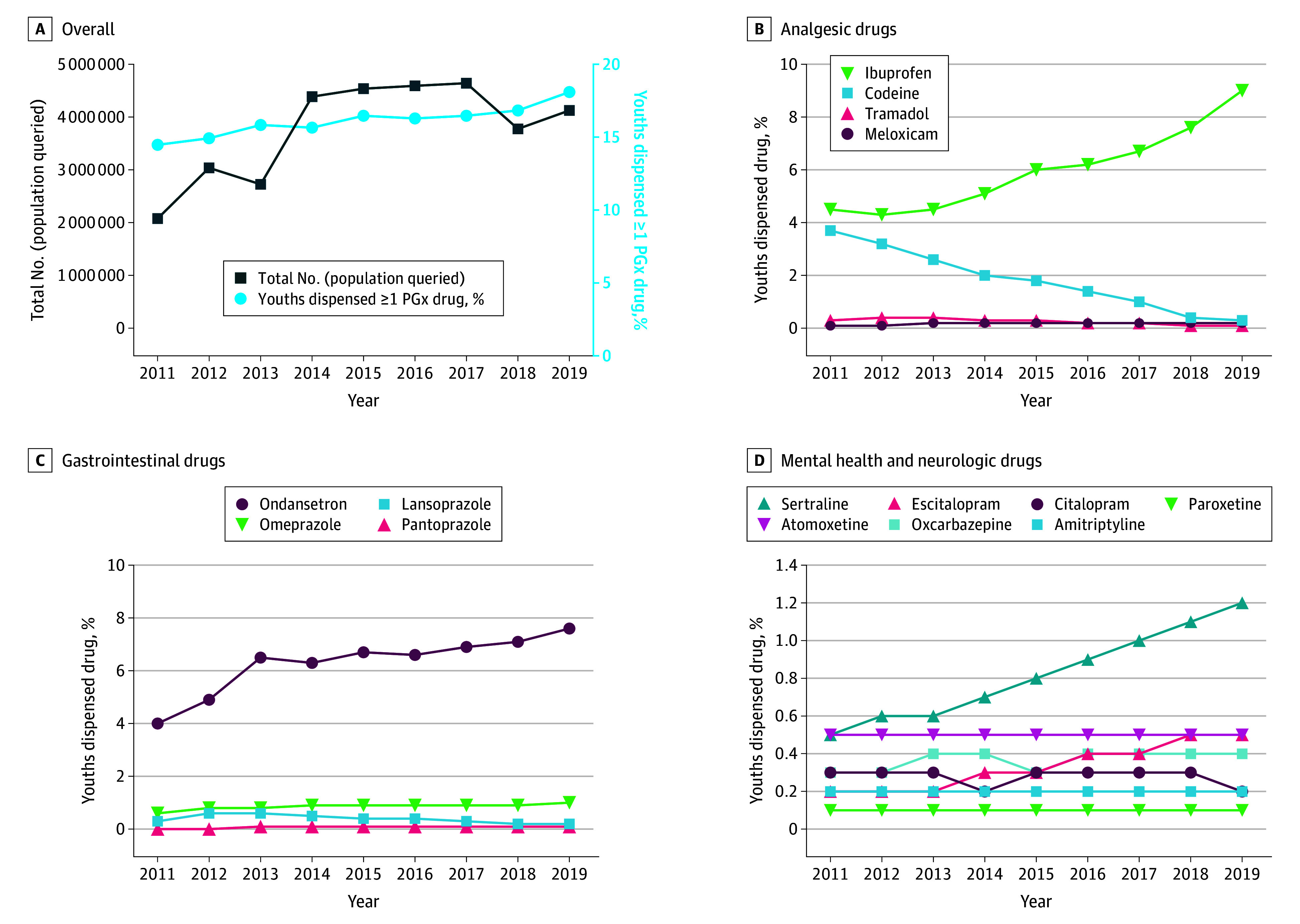
The number of Medicaid-insured youths queried ranged by year from 2 078 683 youths in 2011 to 4 641 494 youths in 2017, including 4 126 349 youths (median [IQR] age, 9 [5-13] years; 2 129 926 males [51.6%]) in 2019. The proportion of Medicaid-insured youths dispensed PGx drugs increased from 289 709 youths (13.9%; 95% CI, 13.8%-14.0%) in 2011 to 740 072 youths (17.9%; 95% CI, 17.9%-18.0%) in 2019. Genes associated with the most frequently dispensed medications were CYP2C9, CYP2D6, and CYP2C19 (9197.0 drugs [95% CI, 9167.7-9226.3 drugs], 8731.5 drugs [95% CI, 8702.5-8759.5 drugs], and 3426.8 drugs [95% CI, 3408.1-3443.9 drugs] per 100 000 youths, respectively). There was a higher percentage of youths with at least 1 chronic medical condition among youths dispensed at least 1 PGx drug (510 445 youths [69.0%; 95% CI, 68.8%-69.1%]) than among 3 386 277 youths dispensed no PGx drug (1 381 544 youths [40.8%; 95% CI, 40.7%-40.9%) (P < .001) in 2019.
In this study, there was an increasing prevalence of dispensings for PGx drugs. This finding suggests that pharmacogenetic testing of specific drug-gene pairs should be considered for frequently prescribed PGx drugs and their implicated genes.
具有高水平药物遗传学指导剂量证据的药物(PGx 药物)数量不断增加。了解 PGx 药物的配药频率及其相关基因,可能有助于医院和临床实验室确定要实施哪些药物遗传学检测。
调查 Medicaid 保险的青少年中 PGx 药物的门诊配药比例,确定与 PGx 药物配药最相关的基因,并描述至少配用 1 种 PGx 药物的青少年的特征。
设计、设置和参与者:这是一项在 Marketscan Medicaid 数据库中,2011 年至 2019 年期间 0 至 17 岁青少年的连续横断面研究。数据于 2022 年 8 月至 12 月进行分析。
PGx 药物定义为临床药物遗传学实施联盟(CPIC)确定的具有 A 级证据的任何药物。确定了每年每个 PGx 药物的独特青少年配药数量。根据 CPIC 指导剂量的相关基因,将 PGx 药物分组,并确定 2019 年每组的配药率(每 10 万名青少年的 PGx 药物数量)。比较了至少配用 1 种 PGx 药物的青少年和未配用任何 PGx 药物的青少年的特征。
查询的 Medicaid 保险的青少年人数每年有所不同,2011 年为 2078683 名,2017 年为 4641494 名,包括 2019 年的 4126349 名(中位数[IQR]年龄,9[5-13]岁;2129926 名男性[51.6%])。从 2011 年的 289709 名(13.9%;95%CI,13.8%-14.0%)增加到 2019 年的 740072 名(17.9%;95%CI,17.9%-18.0%), Medicaid 保险的青少年接受 PGx 药物治疗的比例有所增加。最常配药的药物相关基因是 CYP2C9、CYP2D6 和 CYP2C19(分别为 9197.0 种[95%CI,9167.7-9226.3 种]、8731.5 种[95%CI,8702.5-8759.5 种]和 3426.8 种[95%CI,3408.1-3443.9 种])。在至少接受 1 种 PGx 药物治疗的青少年中,患有至少 1 种慢性疾病的青少年比例(510445 名[69.0%;95%CI,68.8%-69.1%])高于未接受任何 PGx 药物治疗的 3386277 名青少年(1381544 名[40.8%;95%CI,40.7%-40.9%])(P < .001)。
在这项研究中,PGx 药物的配药比例呈上升趋势。这一发现表明,对于经常开处方的 PGx 药物及其相关基因,应考虑进行特定药物-基因对的药物遗传学检测。