• 文献检索
  • 文档翻译
  • 深度研究
  • 学术资讯
  • Suppr Zotero 插件Zotero 插件
  • 邀请有礼
  • 套餐&价格
  • 历史记录
应用&插件
Suppr Zotero 插件Zotero 插件浏览器插件Mac 客户端Windows 客户端微信小程序
定价
高级版会员购买积分包购买API积分包
服务
文献检索文档翻译深度研究API 文档MCP 服务
关于我们
关于 Suppr公司介绍联系我们用户协议隐私条款
关注我们

Suppr 超能文献

核心技术专利:CN118964589B侵权必究
粤ICP备2023148730 号-1Suppr @ 2026

文献检索

告别复杂PubMed语法,用中文像聊天一样搜索,搜遍4000万医学文献。AI智能推荐,让科研检索更轻松。

立即免费搜索

文件翻译

保留排版,准确专业,支持PDF/Word/PPT等文件格式,支持 12+语言互译。

免费翻译文档

深度研究

AI帮你快速写综述,25分钟生成高质量综述,智能提取关键信息,辅助科研写作。

立即免费体验

COVID-19 在多发性硬化症接受特立氟胺治疗的患者中的病例报告和文献复习。

COVID-19 in teriflunomide-treated patients with multiple sclerosis: A case report and literature review.

机构信息

Neurology, Neurophysiology and Neurobiology Unit, Department of Medicine, Università Campus Bio-Medico di Roma, Rome, Italy.

Neurology, Neurophysiology and Neurobiology Unit, Department of Medicine, Università Campus Bio-Medico di Roma, Rome, Italy.

出版信息

Mult Scler Relat Disord. 2021 Feb;48:102734. doi: 10.1016/j.msard.2020.102734. Epub 2021 Jan 2.

DOI:10.1016/j.msard.2020.102734
PMID:33429305
原文链接:https://pmc.ncbi.nlm.nih.gov/articles/PMC7836732/
Abstract

BACKGROUND

. Teriflunomide is an immunomodulatory drug approved for Multiple Sclerosis (MS) treatment that inhibits dihydroorotate dehydrogenase, a mitochondrial enzyme involved in the de novo pyrimidine synthesis pathway. This mechanism can produce antiviral effects, thus teriflunomide has gained attention during COVID-19 pandemic. Moreover, in the last months, some case-reports have been published describing MS patients treated with teriflunomide who developed mild and self-limiting forms of COVID-19.

METHODS

Here, we describe the case of a 57-year-old man affected by MS, and treated with teriflunomide, who developed a mild form of SARS-CoV-2 infection. Moreover, we provide a detailed literature review about the available cases of COVID-19 in MS patients treated with teriflunomide. We report clinical features, disease course and outcome, and we discuss similarities and differences among patients.

RESULTS

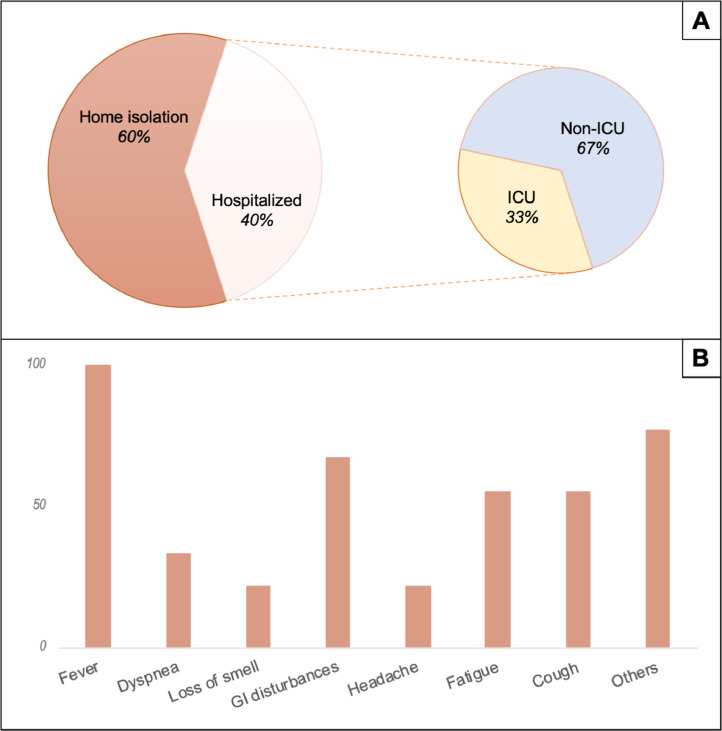
Apart from the present report, since February 2020, five papers have been published describing 14 MS patients who developed SARS-CoV-2 infection during teriflunomide treatment. Patients were mostly female (53%), with an average age of 50.5 (±11.3) years. Median EDSS was 2.25 (range 0-6). The average time on treatment with teriflunomide was 3.7 (± 1.6) years. Relevant comorbidities were present in 4 patients (27%). Regarding SARS-CoV-2 infection, the most common symptom was fever (100%) followed by gastrointestinal disturbances (67%), fatigue (55%) and cough (55%). 5 patients were hospitalized and 2 required oxygen support. In patient hospitalized (n=5) compared to the others (n=10), age was significantly higher (59.6 vs 45.9 years, p=0.025) while gender, EDSS, duration of teriflunomide therapy and comorbidities were not significantly different. Outcome was good for all patients with a variable recovery time, ranging from few days to some weeks. Teriflunomide was continued during the entire course of SARS-CoV-2 infection in all patients except for two. Compared to the patients already described, our patient was 7 years older, average time on teriflunomide treatment was about 2.5 years shorter, and median EDSS was 1.5 point lower. Despite significant comorbidities, the outcome was good since our patient was hospitalized but he did not require oxygen supplementation nor intensive care and was able to return at home after only 10 days. Teriflunomide therapy was continued throughout the period.

CONCLUSION

Available data suggest that teriflunomide therapy should not be discontinued in MS patients who develop SARS-CoV-2 infection, also in presence of significant comorbidities or clinical conditions requiring hospitalization. Additional studies are necessary to assess if the drug can also have a protective role against SARS-CoV-2.
摘要
https://cdn.ncbi.nlm.nih.gov/pmc/blobs/1253/7836732/362be736faa5/gr1_lrg.jpg

背景

特立氟胺是一种免疫调节药物,已被批准用于多发性硬化症(MS)的治疗,可抑制二氢乳清酸脱氢酶,这是一种参与从头嘧啶合成途径的线粒体酶。这种机制可以产生抗病毒作用,因此特立氟胺在 COVID-19 大流行期间引起了关注。此外,在过去的几个月中,已经发表了一些病例报告,描述了接受特立氟胺治疗的 MS 患者出现了 COVID-19 的轻度和自限性形式。

方法

在这里,我们描述了一名 57 岁男性的病例,该患者患有 MS,接受了特立氟胺治疗,出现了 SARS-CoV-2 感染的轻度形式。此外,我们还提供了关于接受特立氟胺治疗的 MS 患者中 COVID-19 的现有病例的详细文献综述。我们报告了临床特征、疾病过程和结果,并讨论了患者之间的相似点和不同点。

结果

除了本报告外,自 2020 年 2 月以来,已经发表了五篇描述了 14 名在接受特立氟胺治疗期间感染 SARS-CoV-2 的 MS 患者的论文。患者主要为女性(53%),平均年龄为 50.5(±11.3)岁。平均 EDSS 为 2.25(范围 0-6)。接受特立氟胺治疗的平均时间为 3.7(±1.6)年。4 名患者存在相关合并症(27%)。关于 SARS-CoV-2 感染,最常见的症状是发热(100%),其次是胃肠道紊乱(67%)、疲劳(55%)和咳嗽(55%)。5 名患者住院,2 名需要吸氧支持。在住院患者(n=5)与其他患者(n=10)相比,年龄明显更高(59.6 岁比 45.9 岁,p=0.025),而性别、EDSS、特立氟胺治疗持续时间和合并症无明显差异。所有患者的结局均良好,恢复时间不等,从数天到数周不等。除了两名患者外,所有患者在整个 SARS-CoV-2 感染期间都继续接受特立氟胺治疗。与已经描述的患者相比,我们的患者年龄大了 7 岁,接受特立氟胺治疗的平均时间缩短了约 2.5 年,EDSS 中位数低了 1.5 分。尽管存在显著的合并症,但由于我们的患者住院但不需要补充氧气或重症监护,并且仅 10 天后就能回家,因此结局良好。特立氟胺治疗在整个期间都在继续。

结论

现有数据表明,在患有 SARS-CoV-2 感染的 MS 患者中,即使存在显著合并症或需要住院治疗的临床情况,也不应停止特立氟胺治疗。需要进一步的研究来评估该药物是否也具有预防 SARS-CoV-2 的作用。

相似文献

1
COVID-19 in teriflunomide-treated patients with multiple sclerosis: A case report and literature review.COVID-19 在多发性硬化症接受特立氟胺治疗的患者中的病例报告和文献复习。
Mult Scler Relat Disord. 2021 Feb;48:102734. doi: 10.1016/j.msard.2020.102734. Epub 2021 Jan 2.
2
COVID-19 in Argentine teriflunomide-treated multiple sclerosis patients: First national case series.阿根廷接受特立氟胺治疗的多发性硬化症患者中的 COVID-19:首个全国病例系列。
Mult Scler Relat Disord. 2021 Aug;53:103049. doi: 10.1016/j.msard.2021.103049. Epub 2021 May 30.
3
Transient monocular visual impairment as an initial symptom of COVID-19 infection in an individual with multiple sclerosis receiving teriflunomide.新冠病毒感染个体在接受特立氟胺治疗多发性硬化症时,以一过性单眼视力障碍为首发症状。
Neurol Sci. 2021 May;42(5):1661-1664. doi: 10.1007/s10072-021-05097-2. Epub 2021 Feb 3.
4
Clinical course and outcome of SARS-CoV-2 infection in multiple sclerosis patients treated with disease-modifying therapies - the Polish experience.在接受疾病修正治疗的多发性硬化症患者中,SARS-CoV-2 感染的临床病程和结局-波兰经验。
Neurol Neurochir Pol. 2021;55(2):212-222. doi: 10.5603/PJNNS.a2021.0031. Epub 2021 Apr 15.
5
Oral teriflunomide for patients with a first clinical episode suggestive of multiple sclerosis (TOPIC): a randomised, double-blind, placebo-controlled, phase 3 trial.特立氟胺治疗首发临床提示多发性硬化症患者(TOPIC)的随机、双盲、安慰剂对照、3 期临床试验。
Lancet Neurol. 2014 Oct;13(10):977-86. doi: 10.1016/S1474-4422(14)70191-7. Epub 2014 Sep 2.
6
Teriflunomide for oral therapy in multiple sclerosis.特立氟胺用于多发性硬化的口服治疗。
Expert Rev Clin Pharmacol. 2012 Nov;5(6):617-28. doi: 10.1586/ecp.12.56.
7
COVID-19 in teriflunomide-treated patients with multiple sclerosis.新冠肺炎在多发性硬化症接受特立氟胺治疗的患者中。
J Neurol. 2020 Oct;267(10):2790-2796. doi: 10.1007/s00415-020-09944-8. Epub 2020 Jun 3.
8
Patient-reported outcomes in patients with relapsing forms of MS switching to teriflunomide from other disease-modifying therapies: Results from the global Phase 4 Teri-PRO study in routine clinical practice.在复发型多发性硬化症患者中,从其他疾病修正治疗药物转换为特立氟胺治疗的患者报告结局:来自特立氟胺在常规临床实践中的全球 4 期 Teri-PRO 研究的结果。
Mult Scler Relat Disord. 2018 Nov;26:211-218. doi: 10.1016/j.msard.2018.09.017. Epub 2018 Sep 15.
9
Teriflunomide for multiple sclerosis.特立氟胺用于治疗多发性硬化症。
Cochrane Database Syst Rev. 2012 Dec 12;12:CD009882. doi: 10.1002/14651858.CD009882.pub2.
10
Oral teriflunomide for patients with relapsing multiple sclerosis (TOWER): a randomised, double-blind, placebo-controlled, phase 3 trial.口服特立氟胺治疗复发型多发性硬化症(TOWER):一项随机、双盲、安慰剂对照的 3 期临床试验。
Lancet Neurol. 2014 Mar;13(3):247-56. doi: 10.1016/S1474-4422(13)70308-9. Epub 2014 Jan 23.

引用本文的文献

1
Unveiling the Antiviral Capabilities of Targeting Human Dihydroorotate Dehydrogenase against SARS-CoV-2.揭示靶向人类二氢乳清酸脱氢酶对严重急性呼吸综合征冠状病毒2的抗病毒能力。
ACS Omega. 2024 Feb 28;9(10):11418-11430. doi: 10.1021/acsomega.3c07845. eCollection 2024 Mar 12.
2
Case report: A novel case of COVID-19 triggered tumefactive demyelinating lesions in one multiple sclerosis patient.病例报告:1例新型冠状病毒肺炎引发1例多发性硬化症患者出现瘤样脱髓鞘病变。
Front Neurosci. 2023 Nov 21;17:1287480. doi: 10.3389/fnins.2023.1287480. eCollection 2023.
3
SARS-CoV-2 infection in multiple sclerosis patients: interaction with treatments, adjuvant therapies, and vaccines against COVID-19.
SARS-CoV-2 感染多发性硬化症患者:与 COVID-19 治疗、辅助疗法和疫苗的相互作用。
J Neurol. 2022 Sep;269(9):4581-4603. doi: 10.1007/s00415-022-11237-1. Epub 2022 Jul 5.
4
Real-world effectiveness and safety profile of teriflunomide in the management of multiple sclerosis in the Gulf Cooperation Council countries: An expert consensus narrative review.在海湾合作委员会国家中,特立氟胺治疗多发性硬化症的真实世界有效性和安全性概况:一项专家共识叙述性综述
Mult Scler J Exp Transl Clin. 2022 Mar 9;8(1):20552173221077185. doi: 10.1177/20552173221077185. eCollection 2022 Jan-Mar.
5
Multiple Sclerosis Patients and Disease Modifying Therapies: Impact on Immune Responses against COVID-19 and SARS-CoV-2 Vaccination.多发性硬化症患者与疾病修正疗法:对针对2019冠状病毒病和严重急性呼吸综合征冠状病毒2疫苗接种的免疫反应的影响
Vaccines (Basel). 2022 Feb 11;10(2):279. doi: 10.3390/vaccines10020279.
6
Teriflunomide: A possible effective drug for the comprehensive treatment of COVID-19.特立氟胺:一种可能有效用于新冠病毒病综合治疗的药物。
Curr Res Pharmacol Drug Discov. 2021;2:100055. doi: 10.1016/j.crphar.2021.100055. Epub 2021 Sep 11.
7
Teriflunomide Treatment of Multiple Sclerosis Selectively Modulates CD8 Memory T Cells.特立氟胺治疗多发性硬化症选择性调节 CD8 记忆 T 细胞。
Front Immunol. 2021 Oct 5;12:730342. doi: 10.3389/fimmu.2021.730342. eCollection 2021.
8
Multiple Sclerosis, Disease-Modifying Therapies and COVID-19: A Systematic Review on Immune Response and Vaccination Recommendations.多发性硬化症、疾病修正疗法与2019冠状病毒病:关于免疫反应和疫苗接种建议的系统综述
Vaccines (Basel). 2021 Jul 11;9(7):773. doi: 10.3390/vaccines9070773.
9
Disease-modifying therapies and SARS-CoV-2 vaccination in multiple sclerosis: an expert consensus.多发性硬化症的疾病修正治疗和 SARS-CoV-2 疫苗接种:专家共识。
J Neurol. 2021 Nov;268(11):3961-3968. doi: 10.1007/s00415-021-10545-2. Epub 2021 Apr 12.