School of Nutrition and Health Sciences, College of Nutrition, Taipei Medical University, Taipei 110, Taiwan.
Research Center of Geriatric Nutrition, College of Nutrition, Taipei Medical University, Taipei 11031, Taiwan.
Nutrients. 2021 Jan 8;13(1):175. doi: 10.3390/nu13010175.
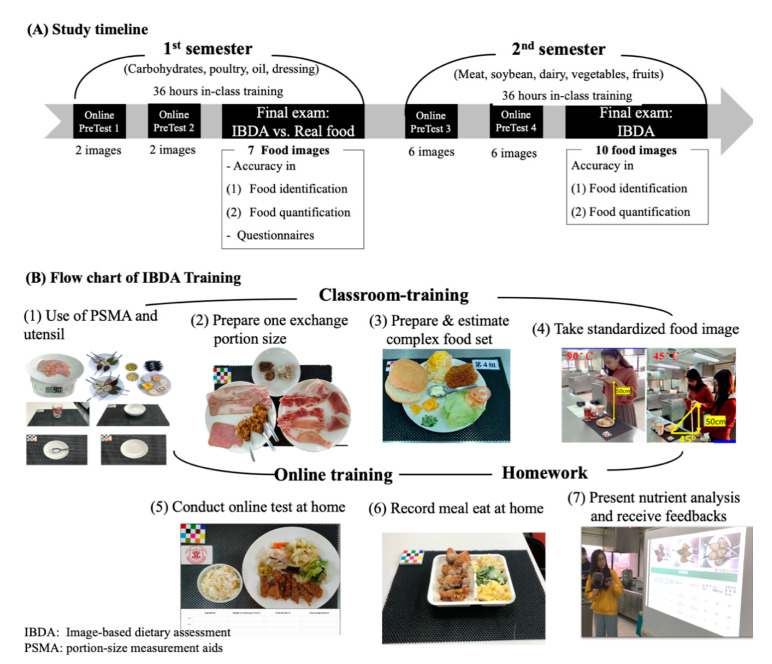
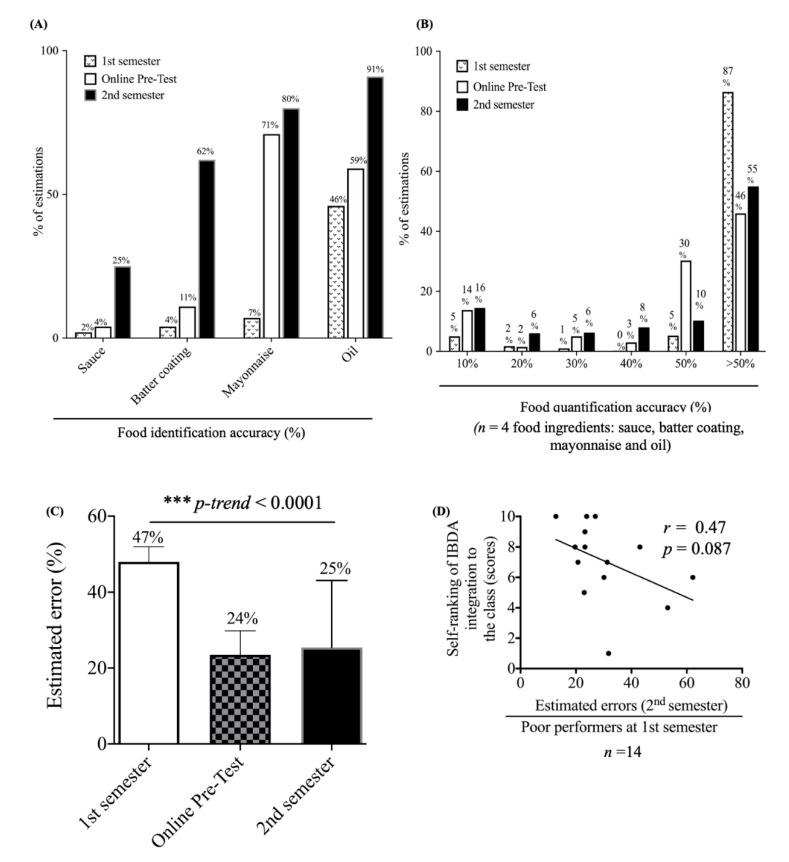
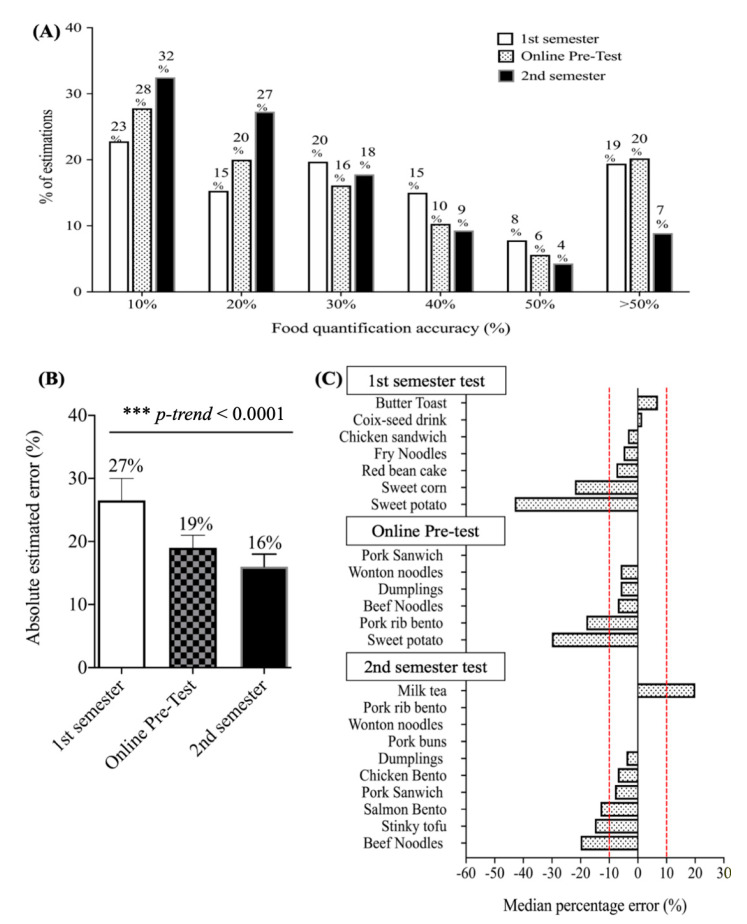
The use of image-based dietary assessments (IBDAs) has rapidly increased; however, there is no formalized training program to enhance the digital viewing skills of dieticians. An IBDA was integrated into a nutritional practicum course in the School of Nutrition and Health Sciences, Taipei Medical University Taiwan. An online IBDA platform was created as an off-campus remedial teaching tool to reinforce the conceptualization of food portion sizes. Dietetic students' receptiveness and response to the IBDA, and their performance in food identification and quantification, were compared between the IBDA and real food visual estimations (RFVEs). No differences were found between the IBDA and RFVE in terms of food identification (67% vs. 71%) or quantification (±10% of estimated calories: 23% vs. 24%). A Spearman correlation analysis showed a moderate to high correlation for calorie estimates between the IBDA and RFVE ( ≥ 0.33~0.75, all < 0.0001). Repeated IBDA training significantly improved students' image-viewing skills [food identification: first semester: 67%; pretest: 77%; second semester: 84%) and quantification [±10%: first semester: 23%; pretest: 28%; second semester: 32%; and ±20%: first semester: 38%; pretest: 48%; second semester: 59%] and reduced absolute estimated errors from 27% (first semester) to 16% (second semester). Training also greatly improved the identification of omitted foods (e.g., condiments, sugar, cooking oil, and batter coatings) and the accuracy of food portion size estimates. The integration of an IBDA into dietetic courses has the potential to help students develop knowledge and skills related to "e-dietetics".
基于图像的膳食评估(IBDAs)的使用迅速增加;然而,营养师的数字观察技能并没有正式的培训计划来提高。IBDA 被整合到台湾台北医学大学营养与健康科学学院的营养实习课程中。创建了一个在线 IBDA 平台作为校外辅导教学工具,以加强对食物份量概念的理解。比较了 IBDA 和真实食物视觉估计(RFVE)在饮食学生对 IBDA 的接受程度和反应,以及他们在食物识别和量化方面的表现。在食物识别(67%比 71%)或量化(估计卡路里的±10%:23%比 24%)方面,IBDA 和 RFVE 之间没有差异。Spearman 相关分析显示,IBDA 和 RFVE 之间的卡路里估计具有中等到高度相关性(≥0.33~0.75,均 < 0.0001)。重复的 IBDA 训练显著提高了学生的图像观察技能[食物识别:第一学期:67%;预测试:77%;第二学期:84%]和量化[±10%:第一学期:23%;预测试:28%;第二学期:32%;和±20%:第一学期:38%;预测试:48%;第二学期:59%],并将绝对估计误差从第一学期的 27%降低到第二学期的 16%。培训还大大提高了对遗漏食物(如调味料、糖、食用油和面糊涂层)的识别能力,以及对食物份量估计的准确性。将 IBDA 纳入饮食课程有潜力帮助学生发展与“电子饮食学”相关的知识和技能。