Department of Electrical and Computer Engineering, University of Pittsburgh, Pittsburgh, PA 15260, USA.
School of Health and Rehabilitation Sciences, University of Pittsburgh, Pittsburgh, PA 15260, USA.
Sensors (Basel). 2022 Feb 15;22(4):1493. doi: 10.3390/s22041493.
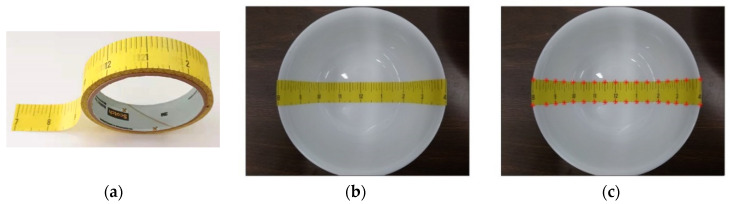
Knowing the amounts of energy and nutrients in an individual's diet is important for maintaining health and preventing chronic diseases. As electronic and AI technologies advance rapidly, dietary assessment can now be performed using food images obtained from a smartphone or a wearable device. One of the challenges in this approach is to computationally measure the volume of food in a bowl from an image. This problem has not been studied systematically despite the bowl being the most utilized food container in many parts of the world, especially in Asia and Africa. In this paper, we present a new method to measure the size and shape of a bowl by adhering a paper ruler centrally across the bottom and sides of the bowl and then taking an image. When observed from the image, the distortions in the width of the paper ruler and the spacings between ruler markers completely encode the size and shape of the bowl. A computational algorithm is developed to reconstruct the three-dimensional bowl interior using the observed distortions. Our experiments using nine bowls, colored liquids, and amorphous foods demonstrate high accuracy of our method for food volume estimation involving round bowls as containers. A total of 228 images of amorphous foods were also used in a comparative experiment between our algorithm and an independent human estimator. The results showed that our algorithm overperformed the human estimator who utilized different types of reference information and two estimation methods, including direct volume estimation and indirect estimation through the fullness of the bowl.
了解个体饮食中的能量和营养素含量对于保持健康和预防慢性病非常重要。随着电子和人工智能技术的飞速发展,现在可以使用智能手机或可穿戴设备获取的食物图像来进行饮食评估。这种方法面临的挑战之一是从图像中计算出碗中食物的体积。尽管碗是世界上许多地区(尤其是亚洲和非洲)最常用的食物容器,但这个问题尚未得到系统研究。在本文中,我们提出了一种新方法,通过在碗的底部和侧面中央贴上一张纸尺,并拍摄图像来测量碗的大小和形状。从图像中观察,纸尺宽度的扭曲和尺子标记之间的间距完全编码了碗的大小和形状。开发了一种计算算法,用于使用观察到的扭曲来重建三维碗内部。我们使用九个碗、彩色液体和无定形食物进行的实验证明了我们的方法在涉及圆形碗作为容器的食物体积估计方面具有很高的准确性。我们的算法还与独立的人工评估员进行了比较实验,使用了 228 张无定形食物的图像。结果表明,我们的算法在使用不同类型的参考信息和两种估计方法(包括直接体积估计和通过碗的饱满程度进行间接估计)的情况下,优于人工评估员。