Orthopaedics Central, Monash Avenue, Nedlands.
Barwon Centre of Orthopaedic Research and Education, Deakin University, Geelong.
Acta Orthop. 2021 Jun;92(3):258-263. doi: 10.1080/17453674.2020.1871559. Epub 2021 Jan 12.
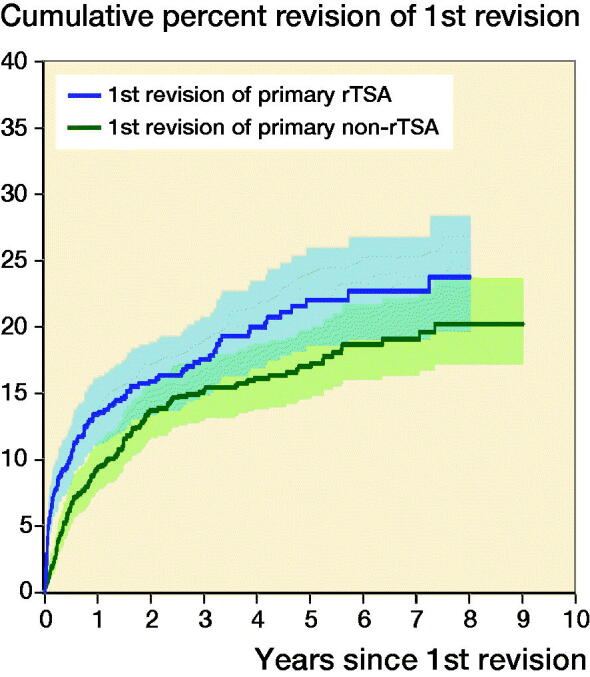
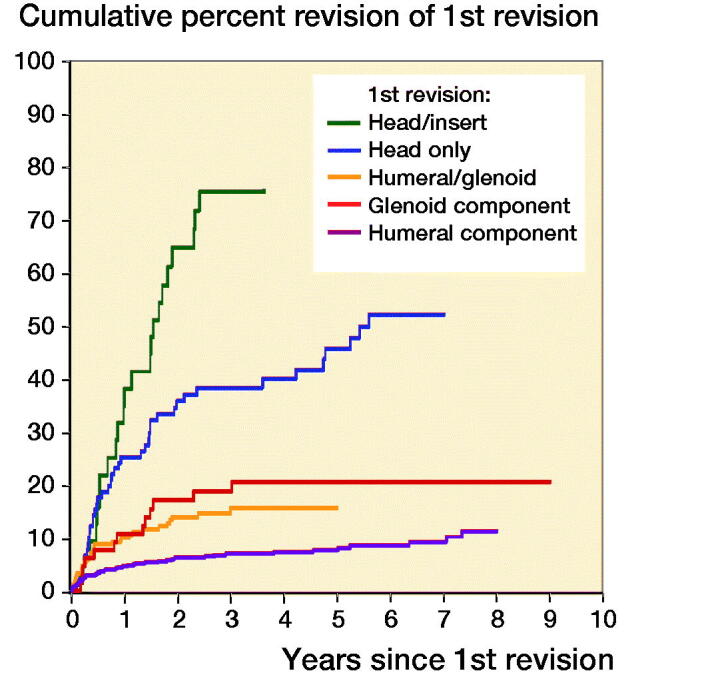
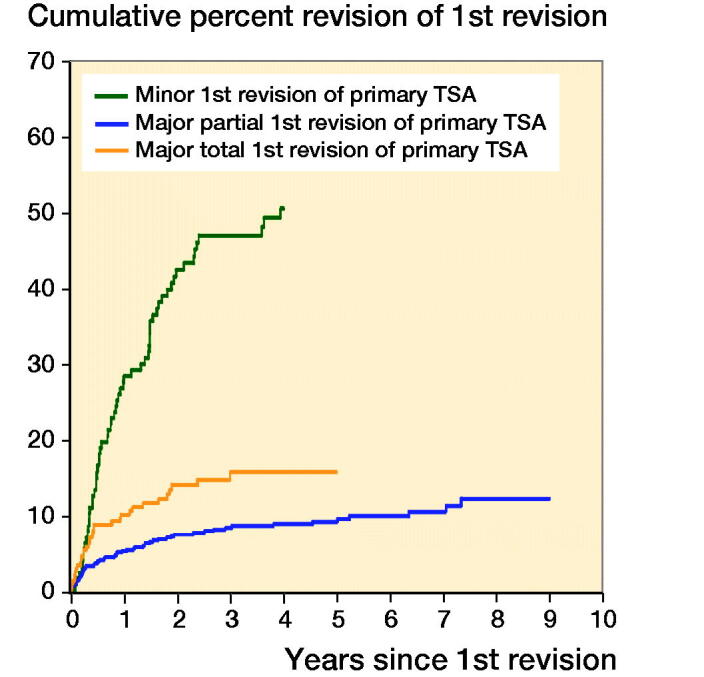
Background and purpose - The increase in shoulder arthroplasty may lead to a burden of revision surgery. This study compared the rate of (2nd) revision following aseptic 1st revision shoulder arthroplasty, considering the type of primary, and the class and type of the revision.Patients and methods - All aseptic 1st revisions of primary total reverse shoulder arthroplasty (rTSA group) and of primary total stemmed and stemless total shoulder arthroplasty (non-rTSA group) procedures reported to our national registry between April 2004 to December 2018 were included. The rate of 2nd revision was determined using Kaplan-Meier estimates and comparisons were made using Cox proportional hazards models.Results - There was an increased risk of 2nd revision in the 1st month only for the rTSA group (n = 700) compared with the non-rTSA group (n = 991); hazard ratio (HR) = 4.8 (95% CI 2.2-9). The cumulative percentage of 2nd revisions (CPR) was 24% in the rTSA group and 20% in the non-rTSA group at 8 years. There was an increased risk of 2nd revision for the type (cup vs. head) HR = 2.2 (CI 1.2-4.2), but not class of revision for the rTSA group. Minor (> 3 months) vs. major class revision, and humeral revision vs. all other revision types were second revision risk factors for the non-rTSA group.Interpretation - The CPR of revision shoulder arthroplasty was > 20% at 8 years and was influenced by the type of primary, the class, and the type of revision. The most common reasons for 2nd revision were instability/dislocation, loosening, and infection.
背景与目的-肩关节置换术的增加可能会导致翻修手术的负担。本研究比较了考虑初次置换的类型、翻修的类别和类型后,无菌初次肩关节翻修后(第 2 次)翻修的比率。
患者和方法-本研究纳入了 2004 年 4 月至 2018 年 12 月期间向我们的国家注册中心报告的所有初次全反肩关节置换术(rTSA 组)和初次全柄和无柄全肩关节置换术(非-rTSA 组)的无菌初次翻修手术。使用 Kaplan-Meier 估计来确定第 2 次翻修的比率,并使用 Cox 比例风险模型进行比较。
结果-rTSA 组(n = 700)与非-rTSA 组(n = 991)相比,仅在第 1 个月时第 2 次翻修的风险增加(HR = 4.8,95%CI 2.2-9)。rTSA 组的第 2 次翻修累积百分比(CPR)为 24%,非-rTSA 组为 20%,8 年后为 8 年。rTSA 组的第 2 次翻修的风险与类型(杯与头)有关(HR = 2.2,CI 1.2-4.2),但与翻修类别无关。rTSA 组中,次要(> 3 个月)翻修与主要翻修类别,以及肱骨头翻修与所有其他翻修类型相比,是第 2 次翻修的危险因素。
解释-8 年后,翻修肩关节置换术的 CPR> 20%,且受初次置换的类型、类别和类型的影响。第 2 次翻修的最常见原因是不稳定/脱位、松动和感染。