Key Research Laboratory of Osteoporosis Syndrome Genomics, Fujian Academy of Chinese Medical Sciences, No. 282 Wusi Road, Fuzhou, 350003, Fujian, China.
College of Traditional Chinese Medicine, Fujian University of Traditional Chinese Medicine, Fuzhou, 350122, China.
BMC Musculoskelet Disord. 2021 Jan 11;22(1):62. doi: 10.1186/s12891-020-03924-9.
Recent research has suggested that cardiotrophin-like cytokine factor 1 (CLCF1) may be an important regulator of bone homeostasis. Furthermore, a whole gene chip analysis suggested that the expression levels of CLCF1 in the peripheral blood mononuclear cells (PBMCs) were downregulated in postmenopausal women with osteoporosis. This study aimed to assess whether the expression levels of CLCF1 in PBMCs can reflect the severity of bone mass loss and the related fracture risk.
In all, 360 postmenopausal women, aged 50 to 80 years, were included in the study. A survey to evaluate the participants' health status, measurement of bone mineral density (BMD), routine blood test, and CLCF1 expression level test were performed.
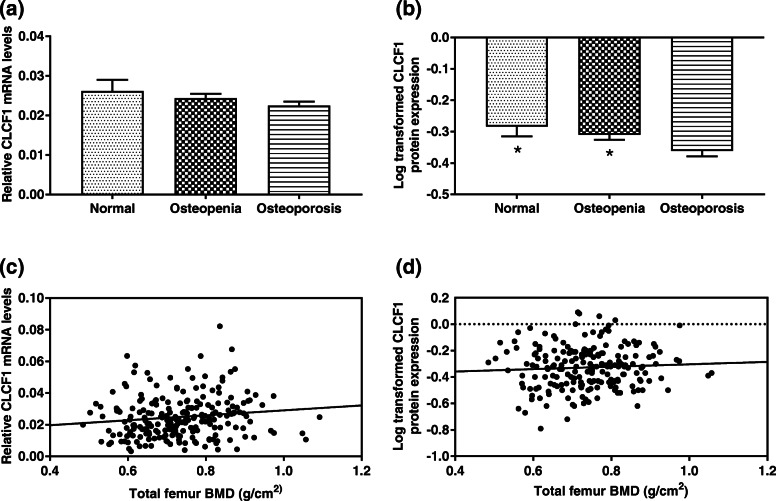
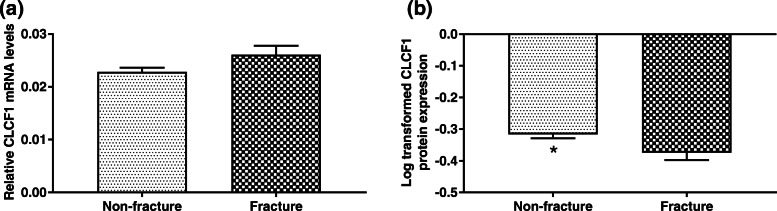
Based on the participants' bone health, 27 (7.5%), 165 (45.83%), and 168 (46.67%) participants were divided into the normal, osteopenia, and osteoporosis groups, respectively. CLCF1 protein levels in the normal and osteopenia groups were higher than those in the osteoporosis group. While the CLCF1 mRNA level was positively associated with the BMD of total femur (r = 0.169, p = 0.011) and lumbar spine (r = 0.176, p = 0.001), the protein level was positively associated with the BMD of the lumbar spine (r = 0.261, p < 0.001), femoral neck (r = 0.236, p = 0.001), greater trochanter (r = 0.228, p = 0.001), and Ward's triangle (r = 0.149, p = 0.036). Both the mRNA and protein levels were negatively associated with osteoporosis development (r = - 0.085, p = 0.011 and r = - 0.173, p = 0.014, respectively). The association between CLCF1 protein level and fracture risk was not significant after adjusting for BMD.
To our knowledge, this is the first clinical study to show that CLCF1 expression levels in the PBMCs of postmenopausal women can reflect the amount of bone mass or the severity of bone mass loss.
最近的研究表明,心营养素样细胞因子 1(CLCF1)可能是骨稳态的重要调节剂。此外,全基因芯片分析表明,骨质疏松症绝经后女性外周血单个核细胞(PBMC)中 CLCF1 的表达水平下调。本研究旨在评估 PBMC 中 CLCF1 的表达水平是否能反映骨量丢失的严重程度和相关骨折风险。
共纳入 360 名年龄在 50 至 80 岁的绝经后妇女。对参与者的健康状况进行调查,测量骨密度(BMD),进行常规血液检查和 CLCF1 表达水平检查。
根据参与者的骨骼健康状况,将 27 名(7.5%)、165 名(45.83%)和 168 名(46.67%)参与者分别分为正常、骨质疏松和骨质疏松症组。正常和骨质疏松前期组的 CLCF1 蛋白水平高于骨质疏松症组。而 CLCF1mRNA 水平与股骨总骨密度(r = 0.169,p = 0.011)和腰椎骨密度(r = 0.176,p = 0.001)呈正相关,蛋白水平与腰椎骨密度(r = 0.261,p < 0.001)、股骨颈(r = 0.236,p = 0.001)、大转子(r = 0.228,p = 0.001)和 Ward 三角(r = 0.149,p = 0.036)呈正相关。mRNA 和蛋白水平均与骨质疏松症的发生呈负相关(r = -0.085,p = 0.011 和 r = -0.173,p = 0.014)。调整 BMD 后,CLCF1 蛋白水平与骨折风险之间的相关性不显著。
据我们所知,这是第一项表明绝经后妇女 PBMC 中 CLCF1 表达水平可反映骨量或骨量丢失严重程度的临床研究。