Wang Mengjing, Ding Ding, Zhao Qianhua, Wu Wanqing, Xiao Zhenxu, Liang Xiaoniu, Luo Jianfeng, Chen Jing
Department of Nephrology, National Clinical Research Center for Aging and Medicine, Huashan Hospital, Fudan University, 12 Middle Wurumuqi Road, Shanghai, 200040, China.
National Clinical Research Center for Aging and Medicine, Huashan Hospital, Fudan University, 12 Middle Wurumuqi Road, Shanghai, 200040, China.
Alzheimers Res Ther. 2021 Jan 11;13(1):21. doi: 10.1186/s13195-020-00729-9.
Association between kidney dysfunction and dementia has been studied in western cohorts, but with inconsistent conclusions which may be due to the different measurements of kidney function. We aim to verify the hypothesis that lower levels of kidney function would be associated with increased risk of incident dementia in Chinese elderly.
One thousand four hundred twelve dementia-free participants aged 60 years or older from the Shanghai Aging Study were enrolled and followed up for 5.3 years on average. Glomerular filtration rate (GFR) was calculated by using combined creatinine-cystatin C CKD-EPI (Chronic Kidney Disease Epidemiology Collaboration) equation. Diagnoses of incident dementia and Alzheimer's disease (AD) were established using DSM-IV and NINCDS-ADRDA criteria based on medical, neurological, and neuropsychological examinations to each participant. Cox proportional regression was used to analyze the association of baseline GFR levels with incident dementia/AD, adjusting age, gender, education years, APOE-ε4, diabetes, hypertension, baseline Mini-Mental State Examination score, and proteinuria.
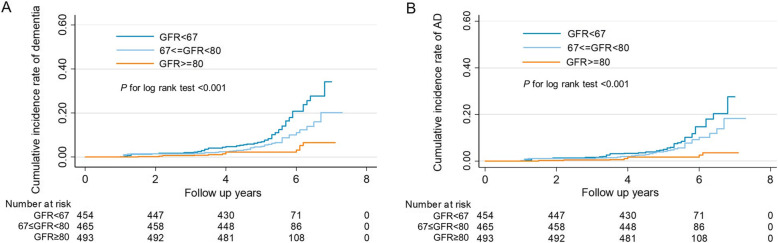
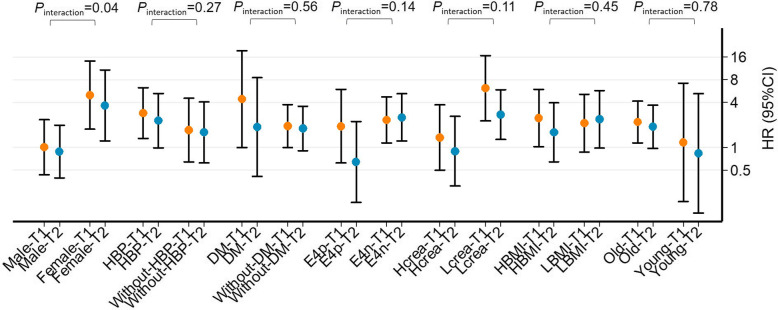
A total of 113 (8%) and 84 (7%) participants developed dementia and AD. Comparing to participants with high GFR (≥ 80 ml/min/1.73 m), participants with low (< 67 ml/min/1.73 m) and moderate GFR (67 ≤ GFR < 80 ml/min/1.73 m) had increased risk of incident dementia with hazard ratios (HRs) of 1.87 (95% CI 1.02-3.44) and 2.19 (95% CI 1.21-3.95) after adjustment for confounders, respectively. Low (HR = 2.27 [95%CI 1.10-4.68]) and moderate (HR = 2.14 [95% CI 1.04-4.40]) GFR at baseline was also independently associated with incident AD after adjustments when comparing to high GFR. The significant association between GFR and dementia risk was observed in female but not in male participants.
GFR may be considered as a marker of an individual's vulnerability to the increased risk of cognitive decline.
西方队列研究了肾功能不全与痴呆之间的关联,但结论不一致,这可能是由于肾功能测量方法不同。我们旨在验证以下假设:在中国老年人中,较低的肾功能水平与新发痴呆风险增加有关。
纳入了来自上海老龄化研究的1412名60岁及以上无痴呆的参与者,平均随访5.3年。使用肌酐-胱抑素C联合CKD-EPI(慢性肾脏病流行病学协作组)方程计算肾小球滤过率(GFR)。根据DSM-IV和NINCDS-ADRDA标准,通过对每位参与者进行医学、神经学和神经心理学检查,确定新发痴呆和阿尔茨海默病(AD)的诊断。使用Cox比例回归分析基线GFR水平与新发痴呆/AD的关联,并对年龄、性别、受教育年限、APOE-ε4、糖尿病、高血压、基线简易精神状态检查得分和蛋白尿进行调整。
共有113名(8%)和84名(7%)参与者发生痴呆和AD。与高GFR(≥80 ml/min/1.73 m²)的参与者相比,低GFR(<67 ml/min/1.73 m²)和中度GFR(67≤GFR<80 ml/min/1.73 m²)的参与者在调整混杂因素后,新发痴呆风险增加,风险比(HR)分别为1.87(95%CI 1.02-3.44)和2.19(95%CI 1.21-3.95)。与高GFR相比,基线时低GFR(HR=2.27[95%CI 1.10-4.68])和中度GFR(HR=2.14[95%CI 1.04-4.40])在调整后也与新发AD独立相关。GFR与痴呆风险之间的显著关联在女性参与者中观察到,而在男性参与者中未观察到。
GFR可被视为个体认知功能下降风险增加易感性的标志物。