Departments of Discovery Oncology, Genentech, 1 DNA Way, South San Francisco, CA, 94080, USA.
Departments of Discovery Chemistry, Genentech, 1 DNA Way, South San Francisco, CA, 94080, USA.
Cell Death Differ. 2021 Feb;28(2):591-605. doi: 10.1038/s41418-020-00708-5. Epub 2021 Jan 11.
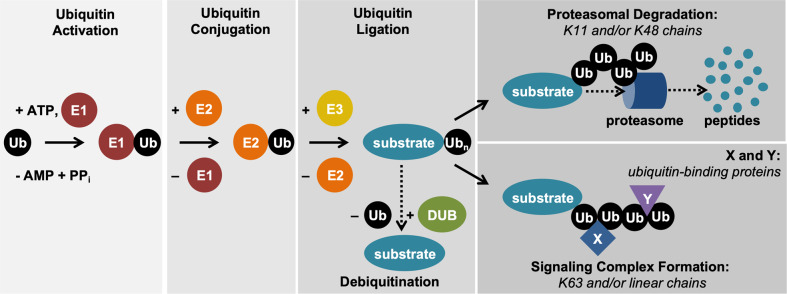
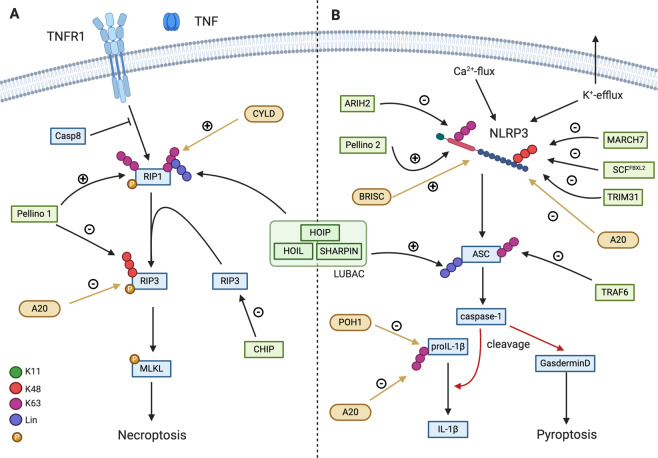
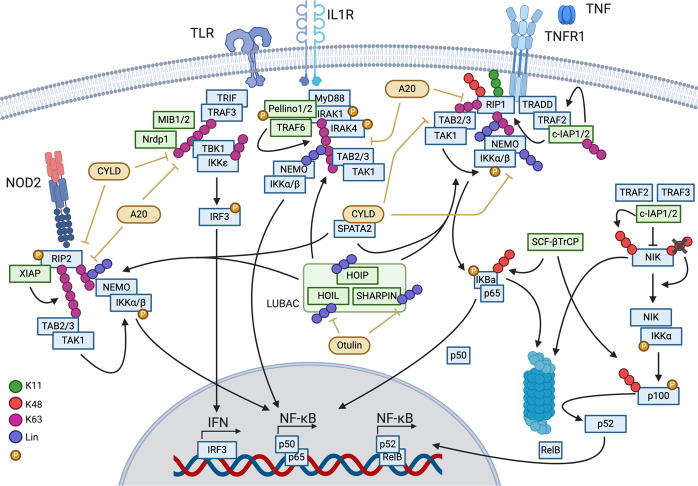
The ubiquitin system is complex, multifaceted, and is crucial for the modulation of a vast number of cellular processes. Ubiquitination is tightly regulated at different levels by a range of enzymes including E1s, E2s, and E3s, and an array of DUBs. The UPS directs protein degradation through the proteasome, and regulates a wide array of cellular processes including transcription and epigenetic factors as well as key oncoproteins. Ubiquitination is key to the dynamic regulation of programmed cell death. Notably, the TNF signaling pathway is controlled by competing ubiquitin conjugation and deubiquitination, which governs both proteasomal degradation and signaling complex formation. In the inflammatory response, ubiquitination is capable of both activating and dampening inflammasome activation through the control of either protein stability, complex formation, or, in some cases, directly affecting receptor activity. In this review, we discuss the enzymes and targets in the ubiquitin system that regulate fundamental cellular processes regulating cell death, and inflammation, as well as disease consequences resulting from their dysregulation. Finally, we highlight several pre-clinical and clinical compounds that regulate ubiquitin system enzymes, with the aim of restoring homeostasis and ameliorating diseases.
泛素系统复杂多样,对调节大量细胞过程至关重要。泛素化在不同水平受到严格调控,包括 E1s、E2s 和 E3s 等一系列酶以及各种 DUBs。UPS 通过蛋白酶体指导蛋白质降解,并调节包括转录和表观遗传因子以及关键癌蛋白在内的广泛的细胞过程。泛素化是程序性细胞死亡动态调节的关键。值得注意的是,TNF 信号通路受竞争泛素缀合和去泛素化的控制,这决定了蛋白酶体降解和信号复合物的形成。在炎症反应中,泛素化通过控制蛋白质稳定性、复合物形成或在某些情况下直接影响受体活性,既能激活又能抑制炎症小体的激活。在这篇综述中,我们讨论了泛素系统中的酶和靶标,这些酶和靶标调节细胞死亡和炎症的基本细胞过程,以及它们失调导致的疾病后果。最后,我们强调了几种调节泛素系统酶的临床前和临床化合物,旨在恢复体内平衡并改善疾病。