Department of Nuclear Medicine, Jules Bordet Institute, Université Libre de Bruxelles, Rue Héger-Bordet 1, B-1000, Brussels, Belgium.
Nuclear Medicine Unit, Santa Maria Goretti Hospital, Latina, Italy.
Eur J Nucl Med Mol Imaging. 2021 May;48(5):1570-1584. doi: 10.1007/s00259-020-05163-5. Epub 2021 Jan 12.
A multidisciplinary expert panel convened to formulate state-of-the-art recommendations for optimisation of selective internal radiation therapy (SIRT) with yttrium-90 (Y)-resin microspheres.
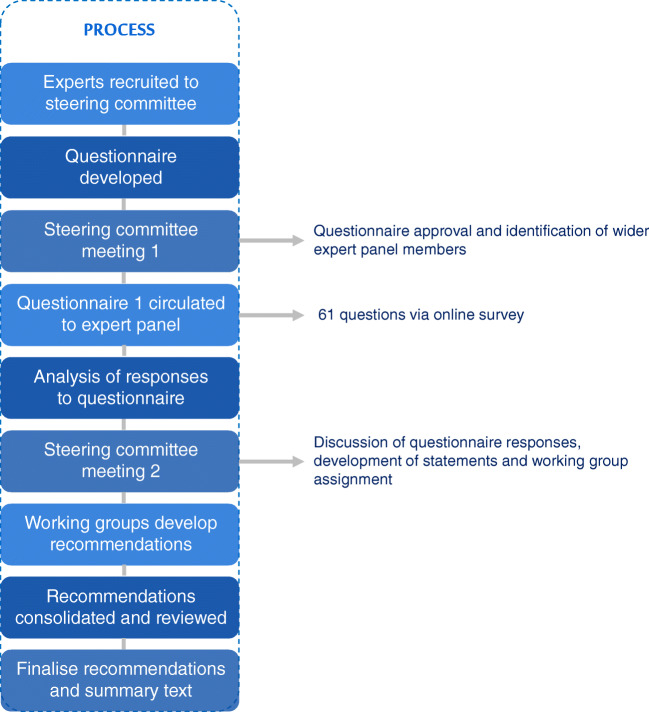
A steering committee of 23 international experts representing all participating specialties formulated recommendations for SIRT with Y-resin microspheres activity prescription and post-treatment dosimetry, based on literature searches and the responses to a 61-question survey that was completed by 43 leading experts (including the steering committee members). The survey was validated by the steering committee and completed anonymously. In a face-to-face meeting, the results of the survey were presented and discussed. Recommendations were derived and level of agreement defined (strong agreement ≥ 80%, moderate agreement 50%-79%, no agreement ≤ 49%).
Forty-seven recommendations were established, including guidance such as a multidisciplinary team should define treatment strategy and therapeutic intent (strong agreement); 3D imaging with CT and an angiography with cone-beam-CT, if available, and Tc-MAA SPECT/CT are recommended for extrahepatic/intrahepatic deposition assessment, treatment field definition and calculation of the Y-resin microspheres activity needed (moderate/strong agreement). A personalised approach, using dosimetry (partition model and/or voxel-based) is recommended for activity prescription, when either whole liver or selective, non-ablative or ablative SIRT is planned (strong agreement). A mean absorbed dose to non-tumoural liver of 40 Gy or less is considered safe (strong agreement). A minimum mean target-absorbed dose to tumour of 100-120 Gy is recommended for hepatocellular carcinoma, liver metastatic colorectal cancer and cholangiocarcinoma (moderate/strong agreement). Post-SIRT imaging for treatment verification with Y-PET/CT is recommended (strong agreement). Post-SIRT dosimetry is also recommended (strong agreement).
Practitioners are encouraged to work towards adoption of these recommendations.
一个多学科专家小组召集会议,制定了优化钇-90(Y)树脂微球选择性内部放射治疗(SIRT)的最新建议。
一个由 23 名国际专家组成的指导委员会,代表所有参与的专业,根据文献检索和对 43 名领先专家(包括指导委员会成员)完成的 61 个问题调查的回应,制定了关于 Y 树脂微球活动处方和治疗后剂量学的 SIRT 建议。该调查由指导委员会进行了验证,并匿名完成。在一次面对面的会议上,介绍和讨论了调查结果。建议是通过推导得出的,并定义了达成一致的程度(强烈一致≥80%,中度一致 50%-79%,无一致≤49%)。
确立了 47 项建议,包括多学科团队应定义治疗策略和治疗意图(强烈一致)等指导意见;建议对肝外/肝内沉积评估、治疗区域定义和所需 Y 树脂微球活性的计算使用 CT 进行三维成像和如果可用的话使用锥形束 CT 与 Tc-MAA SPECT/CT(中度/强烈一致)。当计划进行全肝或选择性、非消融或消融 SIRT 时,建议使用剂量学(分区模型和/或体素模型)进行个体化治疗方案(强烈一致)。非肿瘤性肝脏的平均吸收剂量<40Gy 被认为是安全的(强烈一致)。建议肝癌、结直肠癌肝转移和胆管癌的平均靶区吸收剂量至少为 100-120Gy(中度/强烈一致)。建议在治疗后使用 Y-PET/CT 进行治疗验证成像(强烈一致)。还建议进行治疗后剂量学(强烈一致)。
鼓励从业者努力采用这些建议。